Line cleaning between a gluten batch and a gluten-free batch — the invisible residue the quality manager signs off blind.
The AOECS rule for gluten-free product is ≤20 ppm. A trace of flour in a hopper, a crack in a belt, a bolt gasket — and the line contaminates the first gluten-free batch before anyone sees it. iLEAN Edge inspects every critical point with AI vision after cleaning, detects residue and does NOT let the line start until the quality manager signs the release.
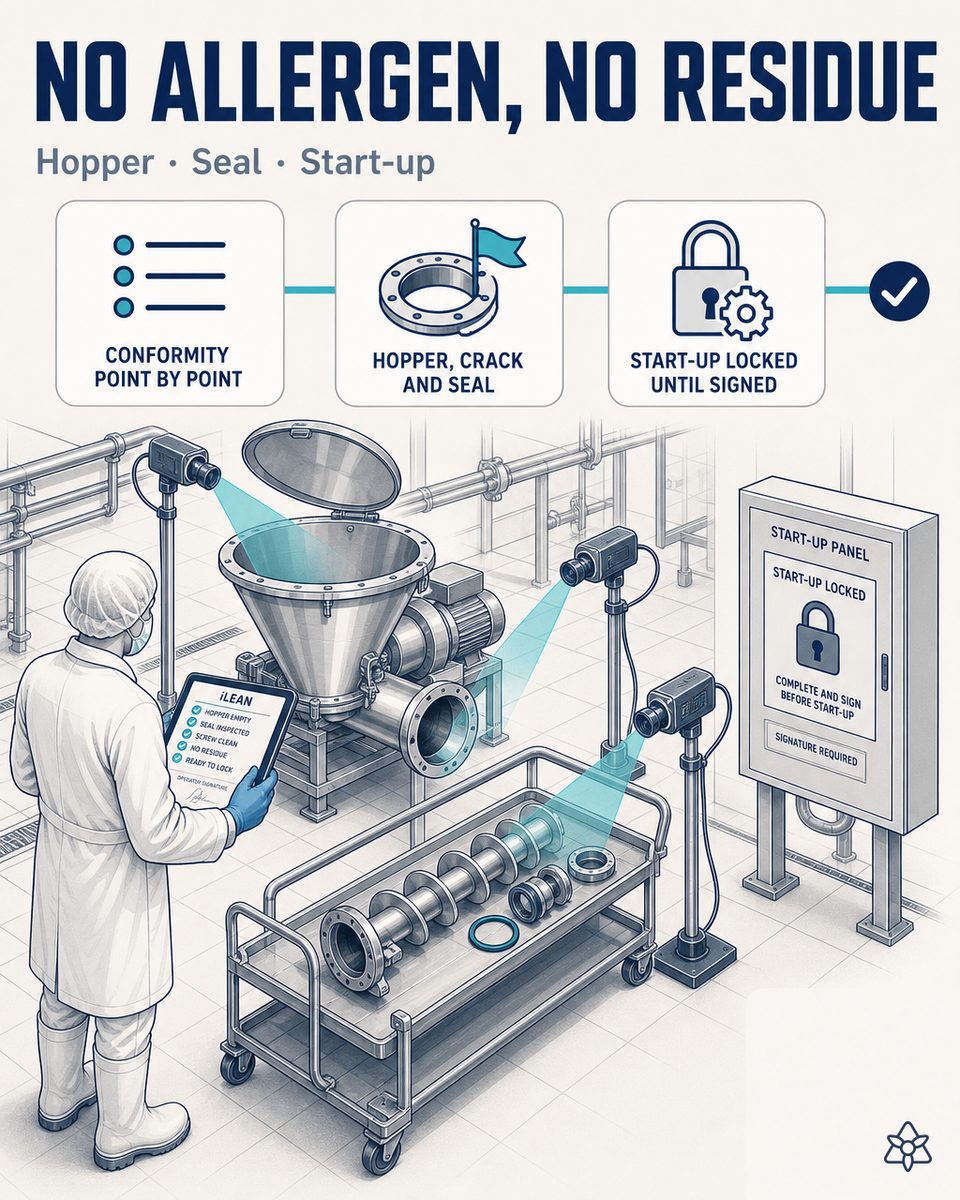
The cross-contact nobody sees until the batch has already been made.
In a food plant that shares a line between gluten product and gluten-free product, the risk is not in the recipe — it is in what stays on the line when the batch changes over:
- Flour stuck in a crack of the belt — invisible from the walkway, perfectly capable of crumbling onto the first gluten-free product that passes over it.
- Flour dust settled on the inner wall of a hopper — the operator opens up, looks with a flashlight, sees nothing odd, signs. The camera would have seen it.
- A bolt gasket with trapped crumbs — the classic point the daily cleaning skims over because "flour doesn't get in there". Until it does.
- A doser mouth or kneader outlet with a thin crust — cleaned with a cloth, residue left on the unlit edge.
The classic system covers this with three legs: a formal cleaning protocol, ELISA/lateral flow on the first gluten-free batch, and the quality manager's line-release signature. The first two work — but they arrive late, because by the time the ELISA comes back positive, the gluten-free batch has already been made. And the third is where the hole is: one person signing that they have visually verified ten critical points on a 30-meter line, at shift change, without having been able to look inside every gasket.
A single contamination that reaches the shelf is an AOECS recall, a regional fine, a RASFF alert and a gluten-free customer who never comes back. And a "gluten-free" brand is earned over years and lost in a week.
iLEAN Edge sees the line after cleaning — and does not let it start until the person signs.
The cross-contact problem on shared lines is not solved by adding another checklist to the quality manager: it is solved by giving them eyes where today they only have the word of the operator who cleaned. iLEAN Edge is exactly that — machine vision cameras that look at every critical point after cleaning, compare it against that line's "clean reference state" and leave the release signature to the person, with point-by-point visual evidence.
Edge looks at the hopper, the belt, the doser, the gasket and the forming table after cleaning. If it sees residue, the line does not start. The person validates and signs — never the other way around.
The iLEAN pieces applied to validating cleaning between a gluten batch and a gluten-free batch:
- Edge — a machine vision terminal (CNN) at every critical point the quality manager defines: mixing hopper, conveyor belt, doser, bolted gasket, forming table, kneader outlet. Each camera learns the "clean reference state" of that point on that line. After cleaning, it fires an inspection and compares — if it detects flour residue, crumbs or settled dust, it blocks the startup and records a photo of the finding. It works without a network: if the plant loses WiFi, Edge keeps inspecting and blocking, because what is critical cannot depend on connectivity.
- Connect — captures the end-of-gluten-batch event (from the ERP, the MES, a manual instruction from the operator or a line marker) and triggers the post-cleaning validation walkthrough. It also captures the quality manager's release signature through whichever channel they use (mobile app, earpiece, tablet), and archives it with the photo and timestamp.
- Agent — orchestrates the full walkthrough: gluten batch end marked → reminds the cleaning crew of the protocol → when they finish, launches the Edge inspection round → if there is residue, holds the line and alerts the quality manager through their channel → when the person signs with the evidence in front of them, releases the startup of the gluten-free batch. And it leaves the per-changeover dossier ready for an IFS/BRC/FSSC 22000 audit.
Blind release signature vs. release with point-by-point visual evidence
| Aspect | Classic cleaning validation | With iLEAN Edge on the line |
|---|---|---|
| Verification after cleaning | Eyeball inspection by the operator and the quality manager | AI vision inspection at every critical point, with an archived photo |
| Line-release signature | Blind — signed without having looked inside every gasket | With point-by-point visual evidence in front of the manager |
| Cross-contact detection | Post-production (ELISA on the first gluten-free batch) | Pre-startup (residue seen before the first package) |
| Cleaning validation time | Varies by shift and workload — sometimes rushed under pressure | Standard walkthrough — Edge does not tire at the end of the shift |
| Hard-to-reach zones | The assumption that "flour doesn't get in there" | Explicit coverage of the zones the camera can see, reinforced manual protocol where it cannot |
| File for the IFS/BRC/FSSC auditor | Signed cleaning sheets, reconstructed by hand | Per-changeover dossier: photo + timestamp per point + the manager's signature |
Impact estimate for your plant — to be validated with your numbers.
The block below is an estimate to be validated with the specific data of your plant. We put it forward so the committee has an order of magnitude; we refine it during the diagnostic.
- Food plant with one line shared between gluten product and gluten-free product, 1-2 batch changeovers a day, 6-10 critical points defined by the cleaning plan.
- Edge pilot on the priority critical points (cameras + startup-blocking actuator + integration with the release signature). First value expected within a few weeks: the first post-cleaning inspection with archived visual evidence.
- Indicative payback between 4 and 9 months, depending on the documented average cost of a recall/rework in your sector and the frequency of cross-contact incidents reported in recent years.
- Reduction of cross-contact incidents ≥ 30% against the baseline (the "before" we measure during the immersion) — a defensible floor, not a shiny ceiling.
- The hard lever is a single avoided AOECS recall: product pulled from the shelf, reverse transport, destruction, a potential fine and damage to the "gluten-free" brand. One single recall pays for the pilot many times over.
And the quality manager's reasonable doubt
"What if the AI camera gets it wrong and lets residue through, or worse, says there is residue when there isn't and stops the line for nothing?" — hallucination is a problem of free generation, not of anchored tasks. In tasks where the AI merely compares the current image with a previously validated "clean reference state" (which is exactly what Edge does here), the best models brought error below 1.5% [1]. And even so, what is critical is never decided alone: Edge holds the line and the person signs, looking at the photo that triggered the hold. iLEAN's three safety rings are there precisely for this — the AI proposes, the quality manager decides.
[1] OpenAI paper "Why Language Models Hallucinate", 2025 — on the reliability of AI in anchored tasks.
What people ask about validating line cleaning between gluten and gluten-free
What level of residue can an AI camera detect on a hopper or belt?
An Edge camera with a CNN trained on your line's "clean reference state" detects visible traces of flour, crumbs and settled dust on metal surfaces, plastics and gaskets — the typical range is on the order of milligrams per illuminated surface. It does not measure ppm of gluten in a sample (that is what ELISA or lateral flow does); it detects the visual indicator of cross-contact that today gets signed off by eye. The difference is decisive: the camera sees before the gluten-free line starts, not after.
Does it cover all the hard-to-reach points on the line?
It covers the critical points the quality manager defines in the cleaning plan: mixing hopper, conveyor belt, doser, forming table, bolted gasket, kneader outlet, oven mouth. At each one, an Edge camera is installed with its own "clean reference state". For physically inaccessible points (blind zones) the system says so explicitly: the agent records "point X — no visual coverage, manual validation with signature" and keeps the classic protocol there. The camera contributes where it can see — it does not invent where it cannot reach.
Does it replace the ELISA / lateral flow tests we run today?
No. ELISA and lateral flow measure ppm of gluten in a sample — they are your analytical proof of AOECS compliance and remain necessary. The Edge camera solves a different, earlier problem: the blind line-release signature. Today the quality manager signs that the cleaning is OK without having been able to look at every point. With Edge they sign with point-by-point visual evidence. ELISA confirms afterwards that the result was correct; Edge prevents a bad startup. They complement each other.
Does it comply with AOECS / Codex Alimentarius (≤20 ppm)?
Complying with AOECS (≤20 ppm of gluten in the final product) remains the responsibility of your plant's allergen management system, validated by ELISA. What iLEAN Edge adds is traceability and documentary evidence of the preceding step: the post-cleaning visual inspection with a photo and timestamp per critical point, ready for an IFS/BRC/FSSC 22000 auditor. That evidence is exactly what an auditor asks for when reviewing your allergen management system — and what today is submitted as "the manager's signature" becomes archived visual evidence.
And when the residue is in a blind zone the camera cannot reach?
That is the right question — and the answer is not to gloss over it. Edge explicitly documents the zones that are covered and the ones that are not; in the blind zones the manual deep-cleaning protocol + signature stays active, and the agent reminds the team of it at every batch changeover so it is never skipped. What does change: the quality manager no longer signs off the whole line blind. They sign with visual evidence the 70-85% the camera sees and keep the rigorous routine where the camera cannot reach. The system wins where it can win — and is honest where it cannot.
More cases in food
- The supplier's email at 8:14 can't wait for the purchasing manager's first free slot.iLEAN Connect reads the raw material supplier's email at second zero. If it flags a delay, production…
- The section lead can't be in five places at once — his AI earpiece can.The section lead talks to iLEAN without breaking stride on the production line. It listens, logs what…
- A paper delivery note should not block the unloading of the truck.A photo of the delivery note and the batch labels, validated in seconds and pushed to the ERP. Raw…
- Evidence pack for gluten / gluten-free changeover cleaning — the AOECS audit stops being a sprint.iLEAN combines Edge + Agents to generate the auditable dossier for every gluten to gluten-free cleaning.…
- Uneven seasoning and foreign bodies caught before packing — nothing odd makes it into the bag.iLEAN Edge checks salt and sesame uniformity piece by piece and, with Connect, integrates the metal…
- Broken or misshapen products caught in line — the defective piece never reaches packing.iLEAN Edge inspects every piece at the oven or line exit and ejects broken or misshapen ones before…
Tell us your case and in 48h we'll send you the estimated ROI of this AI project for your food production line.
We work on your plant's real data, not ours. Diagnostic with no commitment.
Request estimated ROI in 48h ‹ All food product cases See food industry