Zero labeling recalls — iLEAN's agentic system for breadstick and crispbread snacks.
The leading cause of recalls in the food sector is not a manufacturing failure: it is an information failure on a well-made product. A label from the previous SKU, a date from the previous shift, an allergen declaration that does not match the formulation. iLEAN closes that gap with a coordinated agentic system: the line does not release product until every package in the batch has been verified by the combination of Connect, Edge and Agents. The person signs.
The most silent and most expensive failure of any food plant.
It is the most silent and most expensive failure of any food plant, and it can happen to all of them: the product was made perfectly, but goes out to the shelf with the wrong label, a misprinted expiry date, an incorrect batch or an allergen declaration that does not match that formulation. It is not a manufacturing failure: it is an information failure, and it is today the sector's leading cause of product recalls.
It happens, above all, at SKU changes, when the previous format crosses with the next one: a label reel not changed in time, a date code left over from the previous shift, a correct product inside a package announcing something else.
The classic system (an attentive operator + a paper checklist + the shift lead's glance) works 99% of the time. And that 1% is what ends in a RASFF alert, a shelf recall, a call from the retailer at 10 pm. The cost is not the sanction: the cost is the recall, the rework, the reverse transport, the destruction of well-made product and the brand damage that shows on no invoice but weighs for years.
The iLEAN agentic system, step by step, inside a breadstick and crispbread plant.
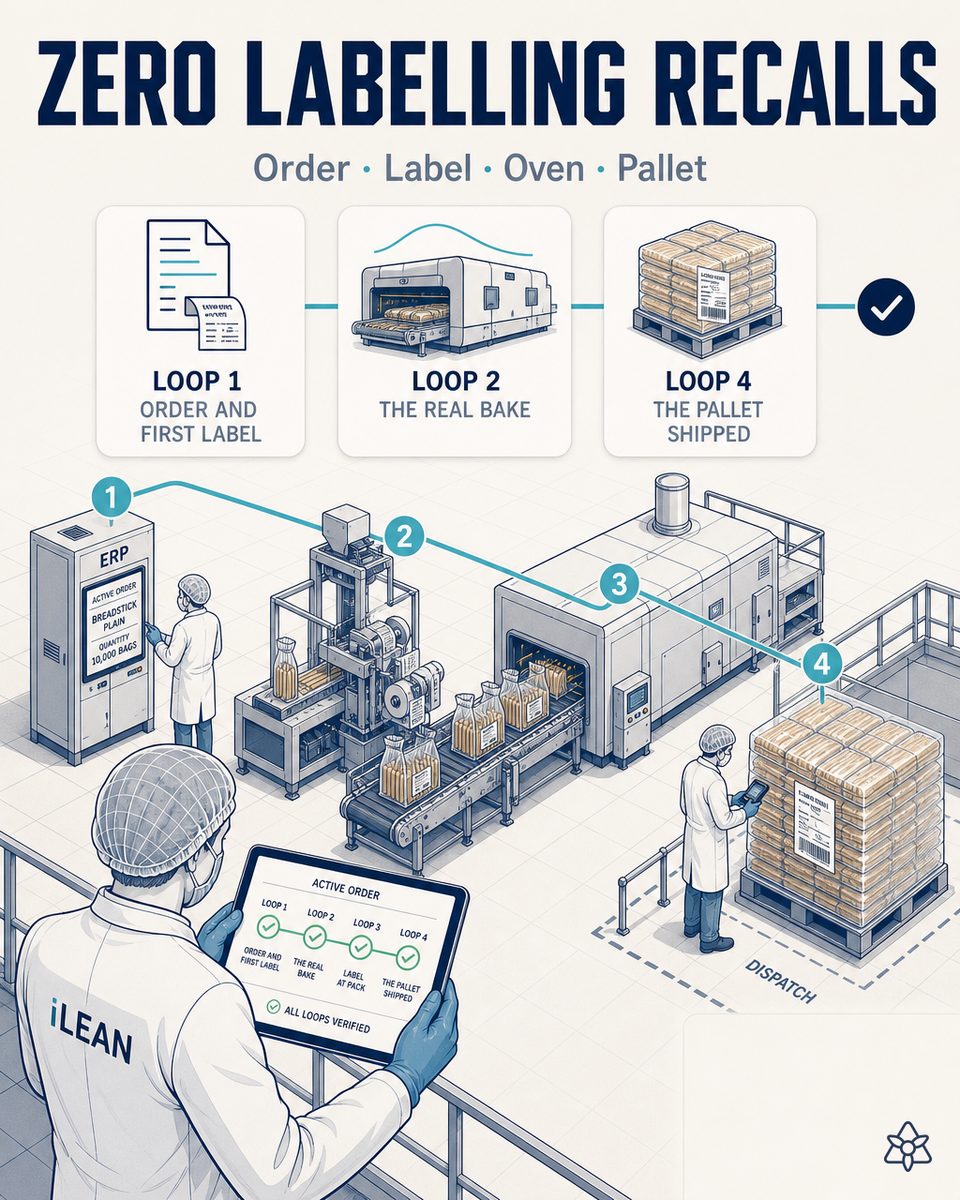
The practical case shows how a coordinated AI system guarantees that every package leaving the line carries printed and declared exactly what it must. Step by step, the system's complete sequence:
- Batch startup — Connect capture. When the batch starts, the operator photographs the production order document about to run on the line and the first product label to be printed for the whole batch. The AI digitizes both documents and stores them in central memory.
- Coherence verification — central AI + a personal assistant in the earphone. The central AI verifies that the production order and the printed label correspond, and guides the operator step by step, through a personal AI assistant in the earphone, to review and confirm one by one that specific label's critical points.
- 100% in-line inspection — Edge + JIDOKA AI. The AI terminals installed on the line review every package by vision (dozens of times per second) and verify that the label, the expiry date, the batch and the allergen information are correct, automatically extracting any non-conforming unit (JIDOKA AI) without stopping the line, or even stopping it if the error is repetitive or a manager requests it through their personal assistant in the earphone.
- Traceability to the ERP — legacy integration. The AI integration system pushes each batch's traceability directly to the ERP (what was printed, on which unit and at what time), leaving a complete and auditable record, without paper and without manual transcriptions.
- Assisted SKU change — SMED AI. The SMED AI system oversees the SKU change and verifies that it was executed per the set standard, on time and in form, detecting any deviation the instant it happens, not days later.
- Legacy machine capture — graduated Connect. All this process information is captured by AI even from old machines with no interface, and is automatically integrated with the company's legacy systems (ERP, MES, labelers, coders).
- Batch release — only if everything adds up. The line does not release product for shipment until the system confirms that every package in the batch is conforming. The gap through which the vast majority of recalls slip simply ceases to exist.
The real result: this system eliminates the rework, the relabeling, the stops at format changes and the customer rejections at receiving — recovering line hours every shift — and, above all, closes at the root the exact point where most incidents happen: not a failure in making, but an information failure on a well-made product. It is not an insurance you might use once a year: it is measurable saving every day and, at the same time, the best possible prevention of the incident no plant director wants to live through.
Classic labeling vs. the iLEAN agentic system
| Aspect | A line with classic control | A line with the iLEAN agentic system |
|---|---|---|
| Batch startup | The operator reads the order, checks the first label by eye | A photo of the order + first label; the AI crosses and guides the operator by earphone |
| The SKU change | A paper checklist, the shift lead's signature | SMED AI oversees the sequence and detects the deviation on the instant |
| Per-package verification | Manual sampling every N units | 100% vision of the batch, dozens of inspections per second |
| A non-conforming package | Reaches the end of the line, detected late or not at all | JIDOKA AI: automatic ejection without stopping the line |
| Traceability to the ERP | Manual transcription at the end of the shift, on paper or Excel | A direct push — what printed, on which unit and at what time |
| Old coders and labelers | "They do not integrate, it costs more than it is worth" | Graduated Connect captures them (a panel photo, a serial read, direct integration) |
| The batch's release | On trust in the process | Only when the system confirms every package in the batch is conforming |
| The frequency of label recalls | 1 every N batches — the 1% that slips to RASFF | Zero, by the system's design |
| The dossier for IFS/BRC | Rebuilt by hand, weeks | A per-batch file, automatic, with an image of every package |
Impact estimate for your plant — to be validated with your own numbers.
The block below is an estimate to be validated against your plant's actual data. We put it forward so the committee has an order of magnitude; we refine it during the assessment.
- Breadstick/crispbread plant with 2-3 multi-SKU packing lines (salted, whole wheat, with sesame, allergen-free), coders and labelers of several generations.
- A pilot on one line with the complete combination — Connect capture at batch startup, Edge with JIDOKA AI on every package, SMED AI on the SKU change, ERP integration. First value within a few weeks.
- Indicative payback between 3 and 9 months. The hard lever is triple: (1) daily savings on rework, relabeling and hours lost at format changes, (2) elimination of customer rejections at receiving, (3) a single recall avoided pays for the whole pilot — product recovered from the shelf, reverse transport, destruction and brand damage.
- The pilot line operational in 2-3 months; replication to the remaining lines executed by your own people trained during the pilot, over the following months.
And the fair question: "what if the system itself errs?"
The quality manager's right question. Two answers that hold each other up. The technical one: hallucination is a problem of free generation, not of anchored tasks — reading a printed label and comparing it with the production order is as anchored a task as they come. In tasks of this kind, the best models brought the error below 1.5% [1]. The architectural one: the iLEAN system is built on the three IRIS safety rings — Connect transports, the Agents decide, the person signs. The critical verification never executes alone. It is not that everything passes through a person; it is that the system allows it where it matters, and here it matters.
[1] OpenAI paper "Why Language Models Hallucinate", 2025 — on the reliability of AI in anchored tasks.
What people ask about the iLEAN agentic labeling system
What percentage of food sector recalls are for incorrect labeling?
According to RASFF (the European food alert system) and the Spanish food safety agency AESAN, undeclared or misdeclared allergens are year after year the first or second cause of food product recalls in Europe — alongside microbiological contamination. When the errors of date, batch and misprinted code are added, the label/information block far outweighs manufacturing failures. The paradox: the product is well made, the package lies. That is why we say it is not a manufacturing failure, it is an information failure — and why the saving from closing this gap is among the largest a food plant can capture.
Can I install only part of the system or does it have to be everything?
You can start with the piece that hurts most and grow from there. The most common start is the Edge verification on the line (a camera reading label + date + batch and applying JIDOKA AI on every package) and the Connect capture at batch startup (a photo of the production order and the batch's first label). With those two pieces you already close 80% of the risk. The SKU change's SMED AI and the ERP integration come in the next phase. iLEAN is sold modular precisely because the Pareto rules — the ripe fruit first.
Does it work with coders and labelers of any brand?
Yes. iLEAN does not force you to change the coder or the labeler — it works on top of the ones you already have. Edge sees the package and the label as a person would: with an industrial camera over the line itself. And Connect captures the coder's data with three degrees of integration depending on what the machine allows — from the photo of an old interface-less coder's panel, through the serial read of intermediate equipment, to direct integration with modern coders. That is the system's commitment: we do not force you to throw away anything you already have.
How long until it is operational in a plant?
The standard iLEAN method — a 3-5 day immersion with a mixed team (your plant's people + embedded industrial AI engineers), applying the Pareto, first value within a few weeks, the complete pilot line typically in 2-3 months. The rollout to the remaining lines is replicated by your own people, trained during the pilot. The best documented real case (powder coating, automotive) had first value in 2 weeks, a complete pilot in 60 days, and the expansion to the other 4 lines was done by the customer with their own people in 3 months, without the vendor. That is what we call a pilot that creates no dependency.
How is it guaranteed that the system itself does not err?
Two answers, one technical and one architectural. Technical: hallucination is a problem of free generation, not of anchored tasks. Reading a label and comparing it with the production order is an anchored task — the best recent study (OpenAI 2025 paper) puts the best models' error in anchored tasks below 1.5%. Architectural: the iLEAN system is built on the three IRIS safety rings — the critical verification never executes alone, there is always a human who signs. Connect transports, the Agents decide, the person signs. It is the golden rule and it does not break.
More cases from this series
- The coder and labeler integrated with iLEAN — the operator stops typing the SKU change.iLEAN Connect integrates your breadstick coder with the ERP: batch, date and allergens loaded without…
- The supplier's email at 8:14 cannot wait for the purchasing manager's first free moment.iLEAN Connect reads the flour supplier's email at second zero. If it warns of a delay, planning is…
- The lab's Excel is not the problem — it is that nobody on the ERP sees it.iLEAN Connect detects the breadstick line's quality control Excel, absorbs it in real time and, after…
- A human verification tablet on the line — the person signs, in 2 taps, before the data enters the system.iLEAN Connect puts a tablet on the breadstick line so the operator confirms in seconds what the AI has…
- Batch startup in a breadstick and crispbread snack factory — the first label is where the shift is at stake.Connect captures by photo the production order and the batch's first label in a breadstick plant, and…
- The section lead cannot be in five places at once — their AI earpiece can.The section lead talks to iLEAN without breaking stride along the breadstick line. It listens, records…
Tell us your case and we will send within 48h the estimated ROI of this agentic system for your breadstick plant.
We work on your plant's real data, not ours. Assessment with no commitment.
Request estimated ROI within 48h ‹ See all 13 breadstick and crispbread cases See food industry