Batch startup in a breadstick and crispbread snack factory — the first label is where the shift is at stake.
In a breadstick or crispbread snack factory, the most critical moment is the batch startup: the paper production order, the first printed label and the operator crossing them by hand. iLEAN Connect captures both by photo, digitizes them instantly and guides the operator through the critical points before the line releases the first package.
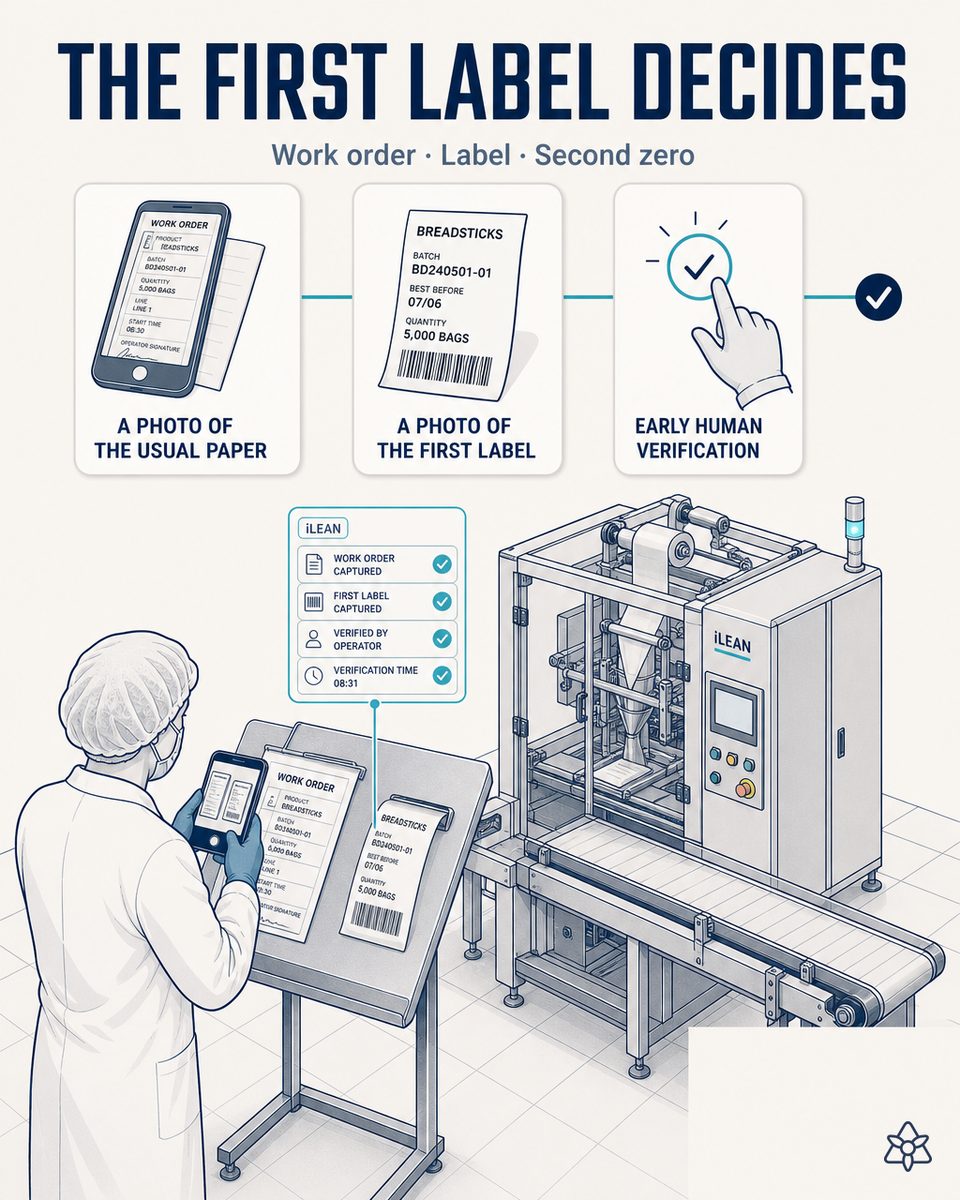
The batch startup is where the chain breaks, not steady-state production.
In a factory of breadsticks, crispbreads or grissini — any regional dry bakery running multi-SKU lines — the line in steady state is stable: once it starts, package after package comes out with little incident. The problem is the SKU change moment, happening several times per shift and concentrating three changes at once:
- The label reel — the ingredient declaration, allergens and format change. The previous batch's label should never appear on the new one.
- The date code — the expiry recalculated for that SKU, with whichever retailer rule applies (different weeks for private label or own brand).
- The seasoning recipe — sesame, cumin, whole wheat, salt-free, with tomato. The silo and the doser change; the intermediate cleaning should be recorded before starting.
The production order arrives on paper from the office (sometimes late, sometimes with a change scrawled in pen on top). The operator reads it, mentally crosses it with the first label out of the printer, and decides whether to start or call the shift lead. It is the shift's natural bottleneck: if they decide right, nothing happens; if they decide wrong, the brand can end in a recall for wrong labeling. And they almost always do it alone, by the cabinet light, with the line stopped waiting.
Connect in manual mode — the operator's phone digitizes the paper and the package, without touching the line.
The batch startup needs no new screen on the line or a touched PLC. The information that already exists on paper (the office's production order) and the one that already comes out printed (the first label) needs to reach the system at second zero, without rewriting it and without depending on the operator's memory. That is what Connect in manual mode is for.
The operator photographs the paper production order. Connect digitizes it by OCR. They photograph the first label. Connect reads it and crosses it with the expected recipe. If something does not add up, it alerts that very instant. The person signs — the line does not resume on its own.
How Connect manual operates at the batch startup of breadsticks and crispbreads:
- A photo of the paper production order — the operator or the shift lead photographs with their phone or tablet the production order that came down from the office. Connect digitizes the SKU, the expected recipe, the quantity, the customer and the expiry date to apply. In seconds, the order is in the system with nobody having typed it.
- A photo of the first printed label — before releasing the first package, the operator photographs the first label out of the printer. Connect reads by OCR the ingredients, the declared allergens, the batch code and the printed expiry.
- A cross-check with the plant's recipe wherever it lives — Connect crosses the digitized order and the label with the silo's recipe, wherever it is: a modern ERP, a vertical bakery MES or the Excel the R&D manager keeps in a shared folder. Nothing has to be migrated; it connects where the data is.
- An alert on the earpiece — if the current batch's label declares "nut-free" but the previous batch's seasoning carried almond and the intermediate cleaning is not on record as complete, Connect alerts the operator instantly with a short phrase: "careful, this label declares nut-free but the cleaning after the almond batch is not recorded as closed". The person validates or calls the shift lead; the line does not start on its own.
- The startup file saved — the photo of the order, the photo of the first label and the cross-check with the recipe are archived per batch. When the IFS/BRC auditor asks for the February 14 startup file, there is nothing to reconstruct: it is there.
Manual startup by eye vs. startup digitized with Connect
| Aspect | Classic startup by the cabinet light | With iLEAN Connect manual |
|---|---|---|
| The production order | On paper, read by hand, sometimes with pen changes | A phone photo — digitized by OCR in seconds |
| The batch's first label | Crossed from memory with the order, the operator's call | A phone photo — crossed with recipe and order at second zero |
| The SKU change on the line | 20-25 min with three paper checklists | 4-6 min with two photos and an alert if there is a deviation |
| The seasoning recipe / silo | An R&D Excel that does not always reach packing | Connect reads it wherever it is — ERP, MES or the Excel itself |
| The incident notice | The operator goes looking for the shift lead | An instant alert on the earpiece or phone — a short phrase |
| The file for the IFS/BRC auditor | Rebuilding the startup by hand, weeks later | Photo + cross-check archived per batch, automatic |
Impact estimate for your plant — to be validated with your own numbers.
The block below is an estimate to be validated against your plant's actual data. We put it forward so the committee has an order of magnitude; we refine it during the assessment.
- Breadstick, crispbread or grissini factory: 1-2 packing lines, 6-10 SKUs per shift, reel and recipe changes several times a day.
- Connect manual pilot on the batch startup — only the operator's phone/tablet, no construction work on the line. First value expected within a few weeks.
- Indicative payback between 4 and 9 months, depending on the frequency of documented startup incidents (wrong label, misapplied expiry, crossed seasoning) and the average recall or rework cost at your retailer.
- Expected reduction of startup incidents ≥30% in the first three months, by simple automatic cross-checking at second zero. Estimate to be validated with your data.
- The hard lever is a single recall avoided: product recovered from the shelf, reverse transport, destruction, brand damage. One recall pays for the pilot.
And the fair question from the production manager
"What if the OCR misreads the label and lets a batch through with the wrong declaration?" — hallucination is a problem of free generation, not of anchored tasks. In tasks where the AI limits itself to recontextualizing a specific data point from one medium to another (reading the printed label and comparing it with the expected recipe), the best models brought the error below 1.5% [1]. And even then, nothing critical is decided alone: Connect holds the startup and the person signs. The three safety rings are there precisely for this.
[1] OpenAI paper "Why Language Models Hallucinate", 2025 — on the reliability of AI in anchored tasks.
What people ask about the batch startup in breadsticks and crispbreads
Why does the batch startup fail in a breadstick bakery?
Because the startup concentrates three changes at once within a few minutes: a new label reel (with its ingredient and allergen declaration), the expiry date code recalculated for that SKU, and the seasoning recipe (sesame, cumin, salt-free, whole wheat, with tomato) going into the mixer. The production order usually arrives on paper from the office, the operator crosses it by hand against the printed label and against the silo's recipe — all of that in a few minutes, with the line stopped waiting to start. It is the shift's natural bottleneck and the moment where most errors appear.
Do I have to put a new screen on the line?
No. Connect in manual mode works with the phone or tablet the operator or the shift lead already carries. They photograph the paper order, photograph the first label out of the printer, and Connect digitizes both by OCR/vision in seconds. There is nothing to wire, no new industrial screens to mount, no change to the label printer you already have. If later you want Edge over the line for continuous verification, it can be added — but the manual startup already covers 80% of the first package's risk.
Does the operator have to learn an app?
The interaction is deliberately minimal: one photo of the order, one photo of the label, and reading on the phone or the earpiece the confirmation or the warning. There are no menus, no checklists to fill, no fields to type. The real learning curve on the floor is one shift — because the gesture (taking a photo with the phone) is already learned by everyone. If Connect detects a deviation, it does not send an email: it alerts the operator that very instant, with a short phrase, in the shift's language.
What about old machines with no screen?
That is exactly the scenario where Connect manual shines. In breadstick and crispbread factories with 15-20 year old lines, the label printer, the mixer and the oven rarely have a touch screen or a modern industrial protocol. Connect does not connect to the machine — it connects to the paper and the package. A photo of the paper order, a photo of the first printed label, and the system crosses with the silo's recipe wherever it is (ERP, vertical MES or the Excel R&D keeps). No PLC touched, no line stop for integration.
How is each SKU's first label validated?
The operator photographs the first label out of the printer before releasing the line. Connect reads by OCR the ingredient list, the declared allergens, the batch, the expiry date and the SKU code. It crosses it at second zero against the digitized order and the expected recipe: if the label declares "sesame-free" but the previous batch's seasoning carried sesame and the cleaning is not on record as complete, Connect holds and alerts. The person validates and signs — the line does not start on its own. The startup file is saved with the photo, with nobody having to reconstruct it later for the IFS/BRC auditor.
More cases from this series
- The coder and labeler integrated with iLEAN — the operator stops typing the SKU change.iLEAN Connect integrates your breadstick coder with the ERP: batch, date and allergens loaded without…
- The supplier's email at 8:14 cannot wait for the purchasing manager's first free moment.iLEAN Connect reads the flour supplier's email at second zero. If it warns of a delay, planning is…
- The lab's Excel is not the problem — it is that nobody on the ERP sees it.iLEAN Connect detects the breadstick line's quality control Excel, absorbs it in real time and, after…
- A human verification tablet on the line — the person signs, in 2 taps, before the data enters the system.iLEAN Connect puts a tablet on the breadstick line so the operator confirms in seconds what the AI has…
- The section lead cannot be in five places at once — their AI earpiece can.The section lead talks to iLEAN without breaking stride along the breadstick line. It listens, records…
- The paper delivery note should not block the truck's unloading.A photo of the delivery note and the flour batch labels, validated in seconds and pushed to the ERP.…
Tell us your case and we will send within 48h the estimated ROI of this AI project for your breadstick or crispbread factory's batch startup.
We work on your plant's real data, not ours. Assessment with no commitment.
Request estimated ROI within 48h ‹ See all 13 breadstick and crispbread cases See food industry