The paper delivery note should not block the truck's unloading.
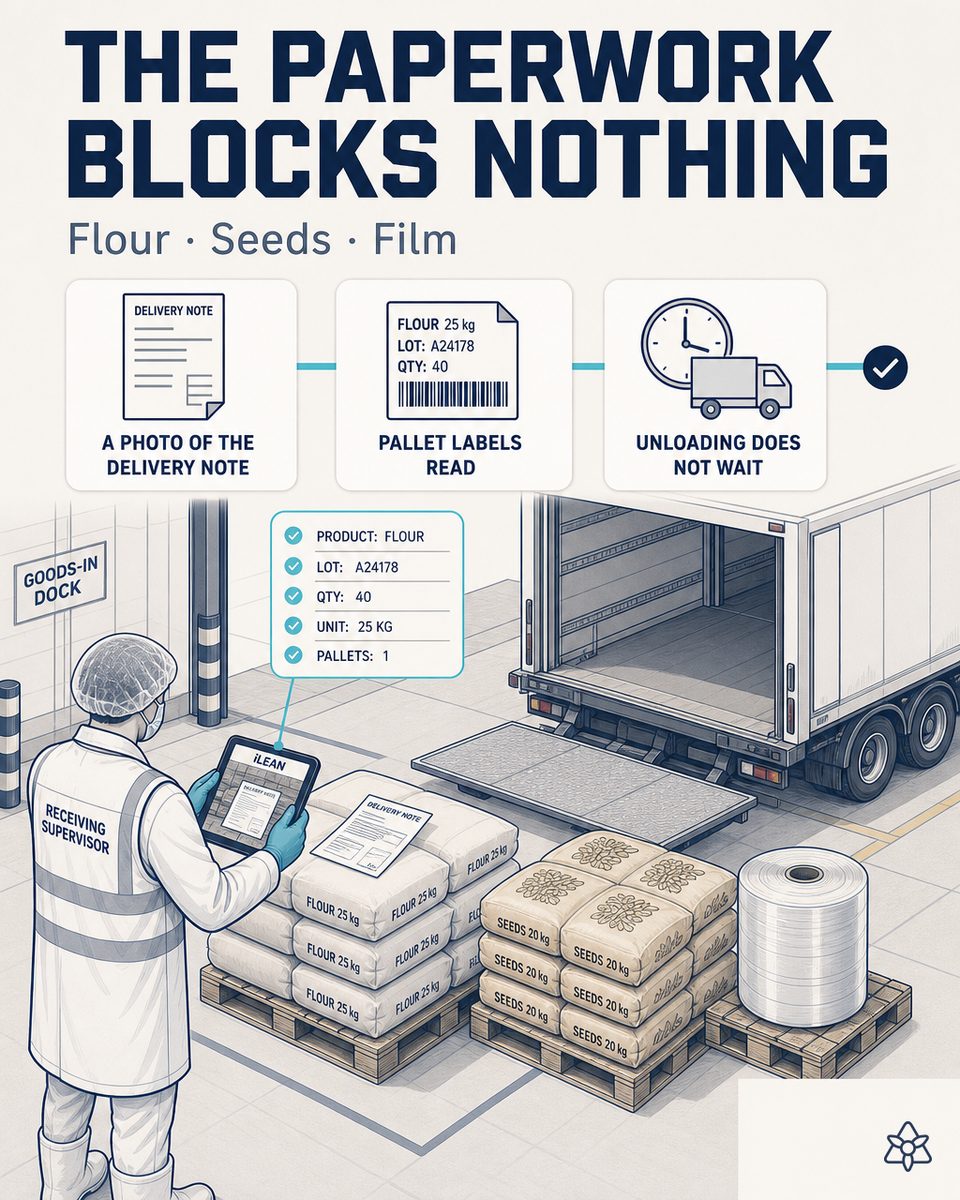
The truck arrives with the flour, the seeds or the packaging film. The receiving manager takes the paper delivery note and each pallet's labels and, instead of getting into the ERP to type batch by batch, takes a photo with the phone. iLEAN Connect digitizes both documents in seconds, extracts batch, quantity, expiry date and supplier, stores them in central memory and, after one validation tap, inserts them directly into the ERP. The truck's unloading stops blocking the receiving lead for an hour.
Receiving's bottleneck is not the truck: it is the keyboard.
Any given morning in a factory producing breadsticks, crispbreads and grissini:
- At 9:30 the truck enters with a big order: strong flour, seasoning, sesame, packaging film. Twelve pallets in total.
- The supplier hands over an A3 delivery note with twelve detail lines, each with its product, quantity, batch and expiry. Each pallet also carries its own batch labels stuck on the side.
- The receiving lead has to sign the note and enter the ERP to record line by line, batch by batch, before that flour can be registered as available for production.
- If they do it slowly to avoid mistakes, the driver waits 45 minutes billing demurrage. The factory pays the demurrage invoice.
- If they do it fast, batch errors appear three weeks later in a health alert that can no longer be traced — because the batch the ERP says is not the batch that actually came in.
- Today's alternative: either an intern transcribing, or an ERP receiving module that costs a license per user plus implementation. And even then, someone keeps typing.
The bottleneck is not the truck, nor the warehouse, nor the ERP. It is the person who has to recontextualize by hand what is already written on a paper.
Connect in "photo of the analog" mode — digitization starts at the dock.
iLEAN does not add another screen to the receiving lead; it takes away the two they had. The piece is iLEAN Connect in its most characteristic mode: photo of the analog, the one that digitizes paper reports, delivery notes, labels and signatures without asking the supplier to change anything in their system.
The receiving lead takes out the phone or the industrial tablet and takes two photos. Connect reads, extracts, proposes. The person validates with one tap. The ERP receives the clean entry. The truck leaves in 5 minutes, not 45.
The Connect pieces applied to raw material receiving:
- A photo of the whole delivery note. The camera recognizes the supplier's note format without asking the supplier to change theirs. The inference understands the tabular structure and extracts what matters: note number, lines (product, quantity, batch, expiry), supplier, date. It works for the lifelong flour miller's handwritten A3 and for the film supplier's printed A4 with a barcode.
- A photo of the incoming pallet. For the pallet's batch labels, the camera recognizes GS1-128, QR, barcodes or, if the label only has plain batch and date text, reads it by OCR. If three batches are mixed on one pallet, it separates them as three independent entries instead of inventing an average one.
- Everything goes to the AI central memory at second zero. It does not wait for the end of the shift, does not wait for "someone to write it up". The raw information is stored with its original photo as evidence.
- One-tap validation. The receiving lead sees on their tablet a summary ("12 lines extracted, 3 unique batches, one doubtful field flagged in yellow, confirm?") and signs with one tap. If something does not add up, they correct it before signing — never after.
- Automatic insertion into the ERP via API/RPC. Without anyone from receiving having opened the ERP's receiving module, the lines enter clean, with their batch, quantity and expiry. The ERP's bulk-capture module is no longer needed.
- The result at the dock: the driver leaves in five minutes. Zero demurrage invoice. The flour is registered as available for production without waiting for the last keystroke.
- A direct saving in ERP licenses. The ERP's receiving module typically demands 2-3 active licenses (receiving lead + peak-hour support + supervisor). With Connect, only the receiving lead validates with a tap, without properly entering the ERP. Typical result: a single receiving ERP license instead of three, and the bulk-capture module's cost removed. What used to be paid per user to "enter data" is now paid by the phone's camera.
A keyboard at the dock vs. a photo to central memory
| Aspect | Manual receiving + ERP module | With iLEAN Connect (photo to the ERP) |
|---|---|---|
| The truck's unloading time | 45 min while someone types | 5 min — the photo is processed afterwards |
| The receiving lead's work | Typing 12 lines into the ERP | One photo + one validation tap |
| Hidden batch errors | Surface 3 weeks later in an alert | Zero — validated with the photo in front |
| Batch-to-plant traceability | Rebuilt by hand when there is a scare | Photo + GS1 linked to the batch, automatic |
| Receiving module ERP licenses | 2-3 active users | 1 — the rest validate from the tablet |
| Carrier demurrage | A recurring invoice | Zero |
| The batch's IFS/BRC audit | An Excel rebuilt the night before | A per-batch dossier, automatic, with the photo |
Impact estimate for your plant — to be validated with your own numbers.
The block below is an estimate to be validated against your plant's actual data. We put it forward so the committee has an order of magnitude; we refine it during the assessment.
- Mid-sized plant making breadsticks, crispbreads and grissini, with 8-12 daily raw material receipts (strong flour, seasoning, seeds, packaging film, oil) and batch-to-plant traceability demanded by the retail customer and by IFS/BRC audits.
- Estimated payback 3-8 months, depending on the daily receipt volume and the carrier demurrage documented in recent years.
- A direct saving in ERP licenses: typically a 50-70% reduction in receiving/warehouse module licenses depending on how many people enter today just to record entries, plus removal of the ERP bulk-capture module's cost when it was contracted separately.
- Recovery of the receiving lead's time ≥ 1 hour/day returned to their real job (raw material quality control, supplier non-conformity management, coordination with production).
- Carrier demurrage cut to minutes: a direct saving on recurring demurrage invoices and a better relationship with carriers who stop losing the morning at your dock.
- Batch-to-plant traceability complete by photo (audits without archaeological reconstruction). The batch's file for the IFS/BRC auditor comes out on its own.
- Estimate to be validated with your numbers.
And the fair question from the logistics manager
"What if the AI misreads the batch and puts a wrong expiry into the ERP?" — hallucination is a problem of free generation, not of anchored tasks. In tasks where the AI limits itself to recontextualizing a data point from one system to another (reading a GS1-128 label or a delivery note line and translating it into an ERP entry), the best models brought the error below 1.5% [1]. And even then, nothing critical is decided alone: Connect proposes, the receiving lead validates with one tap, and only then does the data enter the ERP. The original note's photo is stored as evidence — if someone ever disputes a batch, the original paper is there, with its signature.
[1] OpenAI paper "Why Language Models Hallucinate", 2025 — on the reliability of AI in anchored tasks.
What people ask about digitizing the supplier's delivery note by photo
Does it work with handwritten delivery notes or only printed ones?
It works with both. The easy part is the printed notes from the supplier's ERP (a clean tabular structure, near-infallible OCR). The interesting part is the handwritten ones — the delivery driver adding in pen "1 sack missing", the red customs stamp, the carrier's signature. Connect reads handwritten text and signatures as one more piece of the information, marks them as "verification recommended" and puts them in front of the receiving lead to confirm with one tap. The original note's photo is stored as audit evidence — nothing the supplier wrote by hand is lost.
What about multi-batch pallets of the same product?
It is the typical case: a strong-flour pallet with three milling batches mixed, or a sesame seed pallet with two different packing dates. The receiving lead photographs the pallet and Connect reads every visible label (GS1-128, QR, barcode or plain text by OCR), separates them by batch and proposes them as independent ERP entries. If one label is hidden behind another box, the system warns that codes remain unread instead of making the data up. Batch-to-plant traceability ends up complete, not approximate.
Does it recognize any supplier's label without training on each one?
Yes, that is the difference from classic optical readers. Connect needs no template of supplier X's or Y's delivery note. The inference understands a delivery note's tabular structure as such: "this is a quantity column, this is a batch column, this is an expiry". It applies that understanding to any format coming through the door — the miller's A3, the film supplier's A4, the bilingual international note. The supplier is not asked to change their system; that is exactly what made integration impossible for decades. Not anymore.
Is the batch-to-plant traceability complete for audits?
More complete than with human typing. Every ERP entry is linked to two proofs: the photo of the whole delivery note (with the carrier's signature and the stamp, if any) and the photo of the pallet with its readable labels. The IFS/BRC auditor no longer receives an Excel rebuilt by hand at eleven at night; they receive the per-batch dossier with the original image, the exact receiving time, the operator who validated and the ERP's timestamp. Batch-to-plant traceability stops being an archaeology exercise when there is a health scare.
How many ERP licenses does this really save me?
It depends on how many people enter the ERP's receiving/warehouse module today just to record entries — the receiving lead, a peak-hour support person, a reviewing supervisor. In a mid-sized breadstick and crispbread plant, we typically talk about 2-3 active receiving module licenses. With Connect, only the receiving lead validates with a tap from the tablet and the ERP insertion runs on a single technical service session. Typical result: a 50-70% reduction in receiving module licenses, plus removal of the ERP bulk-capture module's cost when it was contracted separately. We refine it against your current contract during the assessment.
More cases from this series
- The coder and labeler integrated with iLEAN — the operator stops typing the SKU change.iLEAN Connect integrates your breadstick coder with the ERP: batch, date and allergens loaded without…
- The supplier's email at 8:14 cannot wait for the purchasing manager's first free moment.iLEAN Connect reads the flour supplier's email at second zero. If it warns of a delay, planning is…
- The lab's Excel is not the problem — it is that nobody on the ERP sees it.iLEAN Connect detects the breadstick line's quality control Excel, absorbs it in real time and, after…
- A human verification tablet on the line — the person signs, in 2 taps, before the data enters the system.iLEAN Connect puts a tablet on the breadstick line so the operator confirms in seconds what the AI has…
- Batch startup in a breadstick and crispbread snack factory — the first label is where the shift is at stake.Connect captures by photo the production order and the batch's first label in a breadstick plant, and…
- The section lead cannot be in five places at once — their AI earpiece can.The section lead talks to iLEAN without breaking stride along the breadstick line. It listens, records…
Tell us what your raw material receiving looks like today and we will send the estimated ROI within 48h.
We work on your plant's real data — receipt counts, carrier delays, the receiving module's current licenses. Assessment with no commitment.
Request estimated ROI within 48h ‹ See all 13 breadstick and crispbread cases See food industry