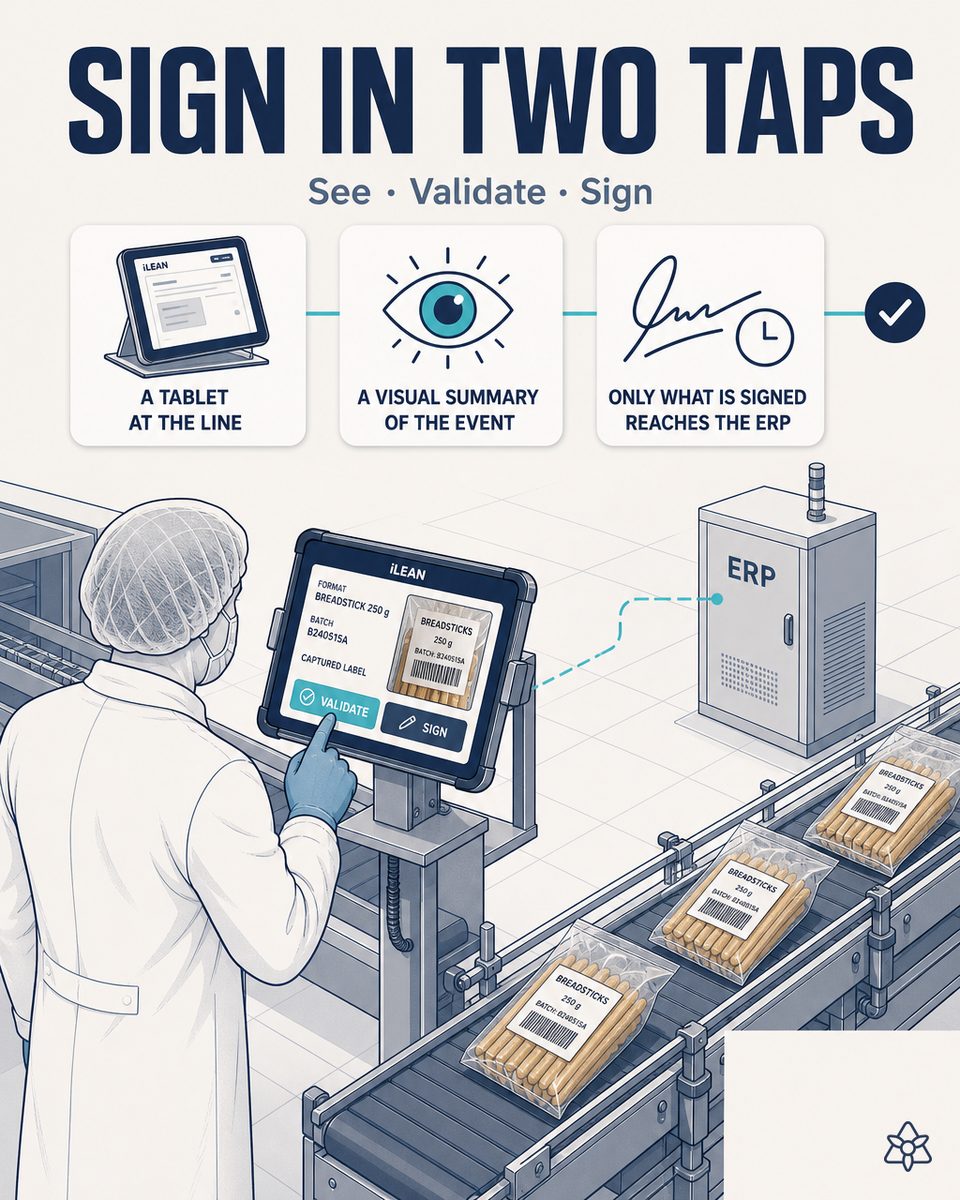
A human verification tablet on the line — the person signs, in 2 taps, before the data enters the system.
The AI captures everything: the label photo, the oven panel reading, the shift lead's voice. But the iLEAN rule is non-negotiable: the person signs. The tablet on the breadstick line shows the operator what iLEAN has just read ("is this batch 24-A-1138 with nut-free?") and asks for validation with one tap before the data enters the central system. Early human verification — without stopping the line, without an endless form.
The AI captures a lot — and sometimes captures wrong. That "sometimes" cannot slip into the system.
In a breadstick and crispbread factory, capture happens in a thousand places at once: the photo of the label coming out of packing, the oven panel reading the operator no longer jots by hand, the shift lead's voice giving the recipe change over the radio. iLEAN sees it all. But capture is not infallible:
- The label comes out of the heat-sealer wrinkled and the camera reads "nut-free" as "contains nuts" (one misread character).
- The oven panel is fogged by steam and the temperature read as 215°C was actually 245°C.
- The shift lead says over the radio "we switch to batch one thirty-eight" and the flour extractor's noise turns the data unintelligible.
If that data enters the system unverified, it contaminates traceability and, worse, the agent takes its next decision on false data. The classic way out — an after-the-fact validation form in the ERP — does not work: the operator skips it because it is endless and because by the time it reaches them they no longer remember the context. And the temptation is to solve it badly at one of the two extremes: giving the AI full autonomy (dangerous) or asking it to validate absolutely everything (paralyzes the line). Neither.
Connect in "early human verification" mode — the tablet that puts the person before the system, not after.
iLEAN Connect is not only the capture channel (voice, photo, text, sensor) — it is also the return channel: the AI shows the human what it has just read, at the station, in the next second, and asks them to sign. It is the iLEAN principle "the person signs" applied to the exact moment the data is born, not to a later audit.
An industrial tablet hung at each critical station. A photo of what iLEAN read. Two buttons: "OK" or "Correct". 2 seconds. The line does not notice.
How Connect materializes on a breadstick and crispbread line:
- An industrial tablet at the station — IP65, a stainless bracket, a multi-glove screen. One per critical station: oven exit, packing, palletizing. A minimalist interface — a big photo + 2 buttons (OK / Correct) + one line of context ("Batch 24-A-1138 · SKU BREADSTICK-NUTFREE · morning shift").
- Selective, not exhaustive — Connect only asks for human validation at the critical points defined by your quality manager: an SKU change, the batch's first package, data with confidence <85%, any capture tied to allergens. The rest enters automatically with high confidence. The operator does not tire, because we do not ask them to sign every pallet — only what matters.
- Configurable per plant and per station, without touching code — some customers ask for auto-approval with a confidence threshold. Others require mandatory human validation at every step. iLEAN lets each plant decide it in the console, per station and per SKU. It is safety ring 4 of the IRIS scheme (see Part C safety rings).
- Unsigned data does not enter the central system — it stays in a held queue. If the configured minutes pass, an alert goes up to the supervisor through the usual channel. The line does not resume with data hanging, and the agent does not decide on false data.
An endless after-the-fact form vs. a 2-tap tablet on the line
| Aspect | Classic validation (ERP / checklist) | With the iLEAN Connect tablet on the line |
|---|---|---|
| How validation happens | A 12-field form at the end of the shift | A photo + 2 buttons (OK / Correct), 2 seconds |
| When validation happens | After the fact — sometimes hours later | Early — in the second after the capture |
| Doubtful data (low confidence) | Enters the system, discovered in an audit | Held in a queue, does not contaminate traceability |
| Context for the operator | Recalling from memory what happened 4 hours ago | They see the photo of what iLEAN read, at their station |
| Configuring what to validate | Rigid — set by the ERP, the same for everyone | Per station, per SKU, per shift — no code |
| An overloaded operator | A high form-skip rate | Asked only at critical points — never saturated |
Impact estimate for your plant — to be validated with your own numbers.
The block below is an estimate to be validated against your plant's actual data. We put it forward so the committee has an order of magnitude; we refine it during the assessment.
- Breadstick and crispbread factory, 2-3 packing lines, multi-SKU with variable recipes (with and without nuts, whole wheat, extra virgin olive oil, etc.).
- Connect pilot on one line with the tablet at 2-3 critical stations (oven exit, packing, palletizing) + integration with your ERP/MES for the batch's recipe. First value expected within a few weeks.
- Indicative payback between 4 and 9 months, depending on the volume of daily SKU changes and the average cost you bear today for doubtful data slipping through (relabeling, rework, a reopened file).
- Expected reduction of doubtful data slipping into the central system ≥40% versus the classic after-the-fact validation flow — because the data is signed while the operator still has the context fresh, not 4 hours later.
- The hard lever is the same as in labeling: a single incident avoided that would have reached the end customer (a mislabeled batch, an undeclared allergen, an undocumented crossed trace) pays for the whole pilot.
And the fair question from the quality manager
"What if the AI misreads the label and the operator, trusting it, taps OK without looking?" — that is why the interface shows the full photo, not the interpretation. The operator does not sign "yes, it is batch 138", they sign over the label's real image. Besides, hallucination is a problem of free generation, not of anchored tasks; in tasks where the AI limits itself to recontextualizing a data point from one system to another (reading a label, transcribing a panel), the best models brought the error below 1.5% [1]. And even then, nothing critical is decided alone: iLEAN holds the data and the person signs. The three safety rings are there precisely for this.
[1] OpenAI paper "Why Language Models Hallucinate", 2025 — on the reliability of AI in anchored tasks.
What people ask about the human verification tablet on the line
Does having to confirm every capture not slow the operator down?
No, because the tablet does not ask to confirm everything. iLEAN Connect only asks for human validation at the critical points (an SKU change, the batch's first package, low-confidence data, a declared allergen). The rest enters automatically with high confidence. The operator sees a minimalist screen with the photo of what the AI read and two big buttons ("OK" / "Correct"). Validating takes 2 seconds. The classic after-the-fact validation form — the one the operator skips because it is endless — disappears.
What happens if the operator is busy and does not confirm?
The data stays held in a queue, it does not enter the central system. If the configured minutes pass (your quality lead decides — typically 3-5 min on a breadstick line), Connect alerts the supervisor through whatever channel they use (WhatsApp, radio, a second tablet in the shift lead's office). The line does not resume with unsigned data. It is the non-negotiable iLEAN rule: the person signs, never the other way around. If the plant decides to auto-approve after X minutes with a confidence threshold ≥Y%, it is configured without touching code (Part C.4 safety rings).
Does it work with gloves and a food plant's HACCP environment?
Yes. The tablet is industrial IP65, with a multi-glove capacitive screen (nitrile, latex, cold), a stainless steel wall or floor mount fit for breadstick and crispbread packing areas. Daily cleaning with standard HACCP products. The interface has 2 big buttons (minimum 60×60 mm) precisely so it can be operated with a glove and flour on the hands without touch errors. It requires no fingerprint unlock or long PIN — a shift session with the operator's NFC card.
Who decides what the operator is asked to validate and what enters automatically?
Your quality manager decides, not iLEAN. The validation policy is a parameter configurable per station, per SKU and per shift — not code. By default we ask for human validation on: an SKU change, the batch's first package, a capture with confidence <85%, any data related to allergens or a held batch. The rest enters automatically. If your plant is more conservative (human validation on every pallet) or more relaxed (only SKU changes), it is adjusted in the console — nothing redeployed. It is safety ring 4 of the IRIS scheme.
Does the tablet replace the earpiece and the phone?
It does not replace them, it completes them. The earpiece (Connect voice mode) remains the natural channel when the shift lead speaks on the floor without stopping the line — the AI listens and captures. The manager's phone is for urgent off-line alerts. The tablet is for tactile validation at the critical station: the operator sees what iLEAN read, signs in 2 taps and moves on. Each channel does what it does best — and the three converge on the same anchored data point, not three parallel data points.
More cases from this series
- The coder and labeler integrated with iLEAN — the operator stops typing the SKU change.iLEAN Connect integrates your breadstick coder with the ERP: batch, date and allergens loaded without…
- The supplier's email at 8:14 cannot wait for the purchasing manager's first free moment.iLEAN Connect reads the flour supplier's email at second zero. If it warns of a delay, planning is…
- The lab's Excel is not the problem — it is that nobody on the ERP sees it.iLEAN Connect detects the breadstick line's quality control Excel, absorbs it in real time and, after…
- Batch startup in a breadstick and crispbread snack factory — the first label is where the shift is at stake.Connect captures by photo the production order and the batch's first label in a breadstick plant, and…
- The section lead cannot be in five places at once — their AI earpiece can.The section lead talks to iLEAN without breaking stride along the breadstick line. It listens, records…
- The paper delivery note should not block the truck's unloading.A photo of the delivery note and the flour batch labels, validated in seconds and pushed to the ERP.…
Tell us your case and we will send within 48h the estimated ROI of putting the human verification tablet on your breadstick line.
We work on your plant's real data, not ours. Assessment with no commitment.
Request estimated ROI within 48h ‹ See all 13 breadstick and crispbread cases See food industry