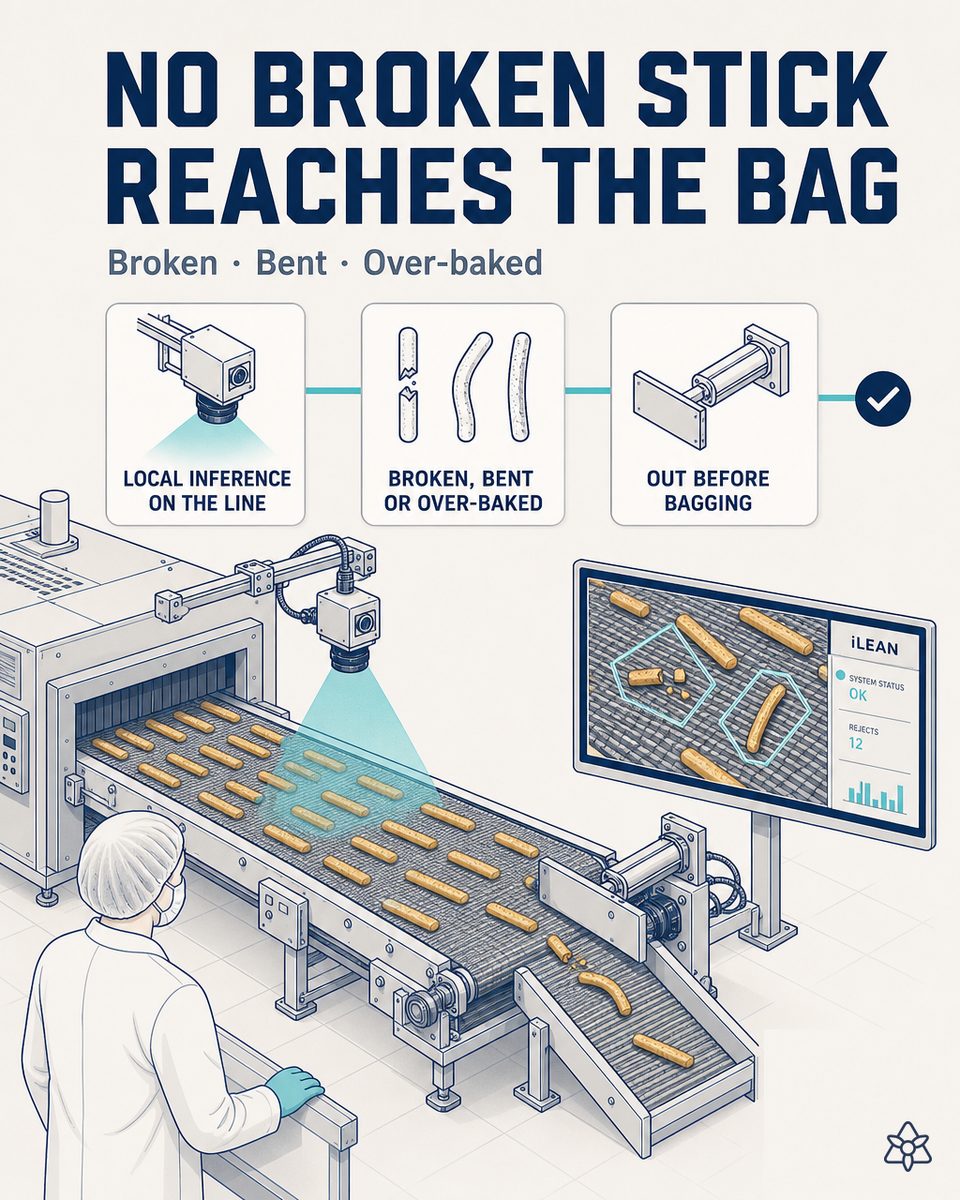
Broken or misshapen breadsticks detected in line — the defective piece does not reach packing.
On a breadstick, crispbread or grissini line the typical defect — a broken, bent, misshapen or over-toasted piece — is perfectly visible to the eye, but at the line's pace no operator captures it. iLEAN Edge inspects every piece with AI vision (a CNN) and ejects the defective one with an actuator before packing. Without stopping the line, without rework.
The defect is visible from a meter away — but at the line's pace no human eye can follow it.
A split breadstick, a bent crispbread, an over-toasted grissino: all three jump out when the piece sits still on the table. The problem starts when that same defect crosses the belt at the oven's exit at several dozen pieces per second, mixed with hundreds of good pieces, and the operator who should filter it is also watching the oven, the toasting tunnel, packing and a couple more screens.
- The defective piece slips into the bag. The operator never gets to see it; sampling every N bags does not catch it either because it is exactly the one not sampled.
- The pallet ships to the customer. The retailer — a large chain, a HORECA distributor, an export customer — finds it at receiving. The customer's quality control rejects the whole pallet for the defect percentage.
- The pallet comes back. Reverse logistics, product destroyed or reprocessed in bulk, an invoice issued then voided, sales giving explanations, the quality team reconstructing which batch it was, which shift, which oven.
The classic system — operator + checklist + sampling — works on perfect product, but lets through what should not pass on the day the flour changes supplier, the baker adjusts the fermentation or the line runs flat out to cover the retailer's peak. The defect is not invisible; the pace is what makes it uncapturable. And every pallet rejection weighs more than the product's cost: it weighs on the retailer's supplier scorecard.
iLEAN Edge — the eyes and hands on the belt, without rebuilding the line.
The problem is not one of judgment (the operator knows perfectly well what a defect is) nor of standards (the internal standard is clear): it is one of pace and sustained attention, two things where the person loses and machine vision wins. iLEAN Edge replicates the veteran operator's judgment at the belt's speed, without fatigue, piece by piece.
Edge sees every piece at the oven's exit. The CNN tells apart broken, bent, misshapen and toasting out of range. The actuator ejects before packing. It works without a network. The line does not notice — the bad piece simply stops getting through.
iLEAN's concrete piece for a breadstick, crispbread or grissini line:
- Edge — a physical terminal installed over the belt, at the exit of the oven or the toasting tunnel, before packing. It carries an industrial camera and a convolutional neural network (CNN) trained with pieces of your own product. It tells a good piece from a broken, bent, misshapen one or one with color out of range. On detecting a defect, it fires an actuator (a compressed-air blast, a mechanical diverter) that ejects it off the belt into the scrap or recirculation bin. It works without a network: if the plant loses WiFi, Edge keeps inspecting and ejecting on the cabinet's power — the critical part does not depend on connectivity.
- Connect — captures the batch's recipe (which flour, which hydration %, which fermentation time, which oven temperature), whether from the ERP, the vertical MES or the baker's production sheet. So when Edge detects a defect spike, we know in the same second whether it coincided with a flour, shift or recipe change.
- Agent — lives in Central, crosses Edge's history (how many defective pieces per hour, per SKU, per shift) with Connect's recipe and the ERP. If it sees the defect spike every time a certain flour comes in or the ambient humidity rises, it does not send an email at 10 pm: it alerts the quality manager with the hypothesis already cross-checked. The person validates and decides.
Human inspection vs. inspection with iLEAN Edge
| Aspect | Operator + sampling | With iLEAN Edge in line |
|---|---|---|
| Inspection coverage | Sampling every N bags, 1-2 pieces/second by eye | 100% of pieces, 50+/second |
| Sustained attention | Drops after 1-2h of the shift | Stable, no fatigue, all 3 shifts |
| Detecting a broken / bent piece | Depends on the operator and the piece's position | A CNN trained with real samples of the product |
| Toasting out of range (light/dark) | Subjective, unmeasured | Objective color within the SKU's standard |
| Reaction to a defect | Set aside by hand or let through | An actuator in milliseconds, before packing |
| An SKU change (breadstick → crispbread → grissino) | Re-explaining the criteria to the operator | Loading the format's model, same terminal |
| The retailer's pallet rejection | It happens; rework, reverse logistics, brand damage | ≥30% less (estimate to be validated) |
| Operation without a network | n/a | Edge keeps running on the cabinet's power |
| Traceability by batch | Rebuilt by hand | A per-piece history, automatic |
Impact estimate for your plant — to be validated with your own numbers.
The block below is an estimate to be validated against your plant's actual data. We put it forward so the committee has an order of magnitude; we refine it during the assessment.
- Breadstick / crispbread / grissini line with a rotary or tunnel oven, multi-SKU (short breadstick, thin crispbread, grissino), feeding a vertical or flow-pack packing machine.
- Edge pilot on one line (an industrial camera over the belt + an air-blast actuator + integration with the batch's recipe). First value expected within a few weeks.
- Indicative payback between 3 and 9 months, depending on the retailer's current rejection %, the average cost of a returned pallet and the line's volume. The hard lever is the pallet return avoided, not the defective bread saved: one return pays for the pilot.
- Estimated shelf rejection reduction ≥30% in the first months, scalable as the CNN sharpens with new samples. (Conservative range — estimate to be validated.)
And the fair question from the quality manager
"What if the AI errs and lets a broken piece through?" — hallucination is a problem of free generation, not of anchored tasks. In tasks where the AI limits itself to classifying an image against known patterns (this piece matches the "good" pattern or the "broken" pattern), the best models brought the error below 1.5% [1]. And even then, it is not decided in a vacuum: the quality manager sees each shift's history, validates the false positives in Edge's own interface and retrains the model when needed. The line does not stop while it trains. The person provides the judgment; the machine keeps the cycle turning.
[1] OpenAI paper "Why Language Models Hallucinate", 2025 — on the reliability of AI in anchored tasks.
What people ask about shape defect detection in breadsticks and crispbreads
Which defects exactly does iLEAN Edge detect on a breadstick or crispbread line?
The defects visible to the human eye but that the line's pace makes unviable to filter: a broken or split piece, a bent or curved one, a misshapen one (caliber out of range, irregular geometry), one over-toasted or pale (color outside the SKU's standard), open dough or a visible fermentation defect. The CNN trains with real samples of your product — it is not a generic library — and learns what your shift lead would recognize at a glance, replicated piece by piece at the belt's speed.
Does it work with all the formats (breadstick, crispbread, grissino)?
Yes, with a single Edge terminal and per-format training. Short breadstick, thin crispbread, long grissino, mini-grissino, rustic crispbread with coarse salt — each format is a trained class in the CNN, and the SKU change is done by loading the model for the format due. The camera and the actuator are the same; what changes is the model and the ejector's parameters (blast pressure or diverter) per the piece's caliber and weight.
What pace does iLEAN Edge reach on an industrial bakery line?
The line's real pace. Edge inspects 50+ pieces/second without breaking a sweat — the bottleneck is never the vision, it is the physical actuator. The useful reference comes from the automotive powder coating case, where the Edge's actuator fires at 45 milliseconds after detection. On a breadstick line at the exit of the oven or the toasting tunnel, that means the defective piece is ejected before reaching the packing area, without stopping the belt and without the operator having to react.
Does it keep working if the plant loses its network?
Yes, and this is the critical point many cloud systems do not cover. Edge is a physical on-premise terminal with the CNN loaded on the device itself. If the plant loses WiFi or fiber, or the provider's cloud has a bad day, Edge keeps inspecting pieces and firing the actuator on the electrical cabinet's power. The critical thing — that a broken piece not slip into packing — cannot depend on connectivity. When the network returns, the history uploads so the Agents can cross it with recipe, batch and production order.
How is a new defect trained?
With samples from your own line. When a new defect appears — because the flour changed, the baker adjusted the fermentation or an export SKU with a stricter tolerance came in — the quality manager marks pieces in Edge's own interface (this is good, this is a defect) and the CNN retrains. The typical cycle the powder coating case demonstrated is detection >90% in 2 weeks and >98% at the pilot's close in 60 days. The line does not stop while training: the old model keeps working until the new one is validated.
More cases from this series
- The coder and labeler integrated with iLEAN — the operator stops typing the SKU change.iLEAN Connect integrates your breadstick coder with the ERP: batch, date and allergens loaded without…
- The supplier's email at 8:14 cannot wait for the purchasing manager's first free moment.iLEAN Connect reads the flour supplier's email at second zero. If it warns of a delay, planning is…
- The lab's Excel is not the problem — it is that nobody on the ERP sees it.iLEAN Connect detects the breadstick line's quality control Excel, absorbs it in real time and, after…
- A human verification tablet on the line — the person signs, in 2 taps, before the data enters the system.iLEAN Connect puts a tablet on the breadstick line so the operator confirms in seconds what the AI has…
- Batch startup in a breadstick and crispbread snack factory — the first label is where the shift is at stake.Connect captures by photo the production order and the batch's first label in a breadstick plant, and…
- The section lead cannot be in five places at once — their AI earpiece can.The section lead talks to iLEAN without breaking stride along the breadstick line. It listens, records…
Tell us your case and we will send within 48h the estimated ROI of this AI project for your breadstick line.
We work on your line's real data, not ours. Assessment with no commitment.
Request estimated ROI within 48h ‹ See all 13 breadstick and crispbread cases See food industry