Uneven seasoning and foreign bodies detected before packing — nothing odd reaches the bag.
On a breadstick, crispbread or grissini line, uneven seasoning — salt or sesame badly spread — is visible at a glance on the oven's exit tray, and a foreign body (glass, metal) is the risk no quality manager wants to run. iLEAN Edge controls seasoning uniformity piece by piece with AI vision (a CNN) and, with Connect, integrates the metal detector or X-ray you already have on the line. Without duplicating equipment, without stopping the line.
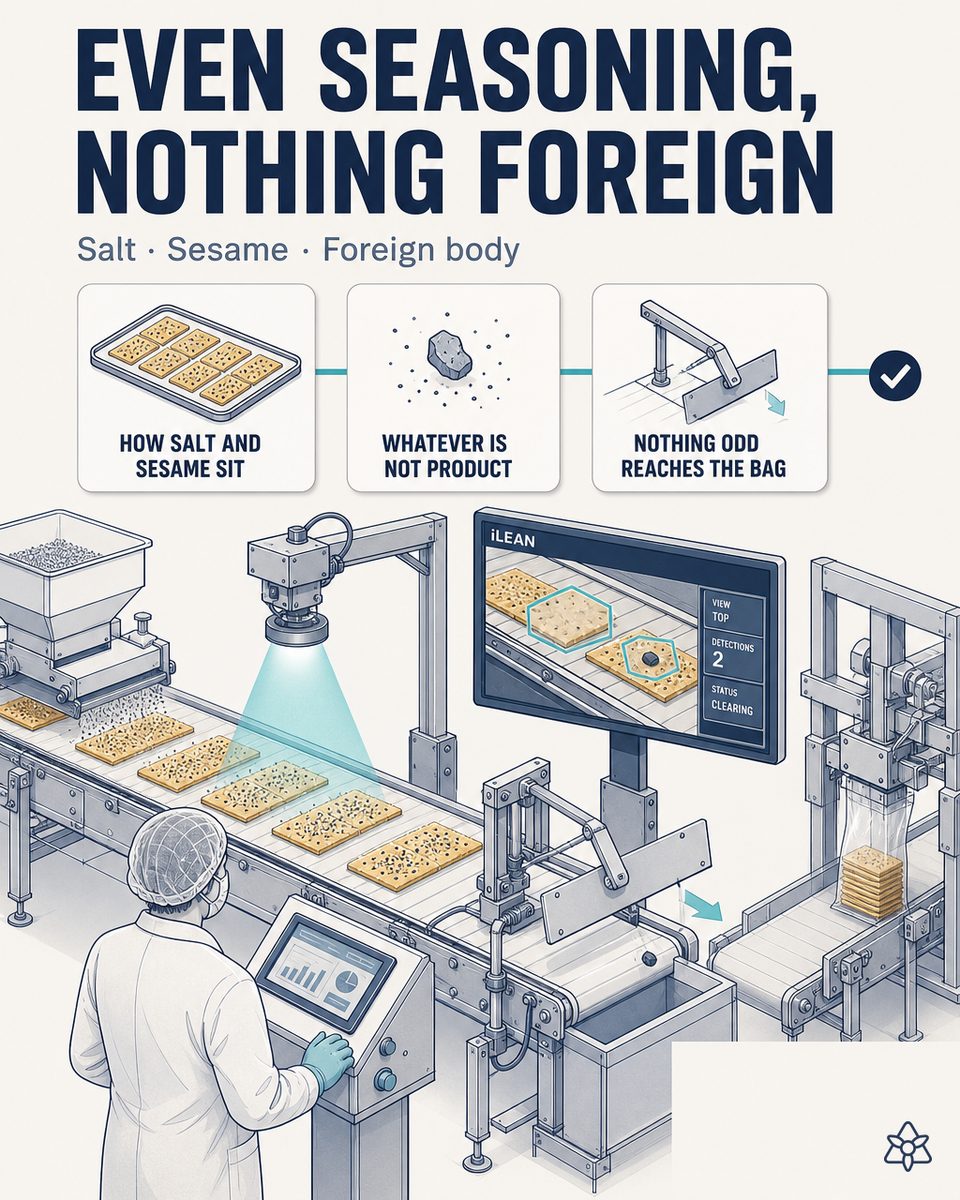
Two different risks, one same blind spot: the oven's exit tray.
The breadstick or crispbread leaves the oven with a layer of salt or sesame that should be homogeneous across the whole piece — it is the first thing the consumer notices on biting, and the first thing the retailer penalizes on the quality scorecard. On that same meter of belt, if something has slipped into the process — a shard from a package broken in the warehouse, a metal chip after maintenance — it must be detected before reaching packing. They are two risks of different natures cohabiting at the same point of the line: one commercial (uneven seasoning), the other of food safety (a foreign body).
- The seasoning comes out uneven across a strip of the tray — the seasoner lost calibration, the salt or sesame batch changed — and nobody detects it until the retailer or the consumer complains.
- The metal detector or X-ray does its job and rejects a piece, but that signal stays isolated: nobody crosses it with the batch, the supplier or the shift, so if the problem is recurring, the pattern takes weeks to show.
- When something escapes — a batch with off-spec seasoning reaches the store, or a contaminant alert is not investigated in time — the quality team reconstructs by hand what happened, and sales gives explanations to the retailer.
The metal detector and the X-ray have done their point job well for years. The problem is not that they fail: it is that their signal lives isolated, uncrossed with recipe, supplier or history. And the seasoning, which is purely visual, has no dedicated sensor — it depends on the eye of an operator who is also watching the oven, packing and two more screens.
iLEAN Edge + Connect — the sight for the seasoning, the integration for what your detector already controls.
They are two problems solved with two different IRIS pieces, not with one magic box. Seasoning is vision: it can be seen, and a CNN trained with your product measures it piece by piece without fatigue. The dense foreign body is already covered by the equipment you have — iLEAN's piece there is not "seeing more", it is connecting what does not talk and giving it memory.
Edge sees each piece's seasoning at the oven's exit. Connect reads the signal of the X-ray or metal detector you already have. The agent crosses both with recipe, supplier and batch. None of this requires changing your line.
iLEAN's concrete piece for a breadstick, crispbread or grissini line:
- Edge — a physical terminal with an industrial camera and a convolutional neural network (CNN) trained with pieces of your own product. It measures the coverage and homogeneity of salt, sesame or another visible condiment, and alerts (or fires an actuator) when a piece leaves the range validated by quality.
- Connect — reads the signal of the already-installed metal detector or X-ray, whether from a modern PLC or a simple dry contact on older equipment. It does not replace the equipment: it gets it talking with the rest of the system. It also captures the batch's recipe (the salt, sesame, flour supplier) to cross it later.
- Agent — lives in Central, crosses Edge's seasoning history and Connect's contaminant alerts with the batch, the supplier and the shift. If the seasoning always drifts on the same shift, or the metal alerts concentrate after one specific supplier, it does not send an email at 10 pm: it alerts the quality manager with the hypothesis already cross-checked. The person decides whether the batch is held.
Loose sensors vs. iLEAN Edge + Connect integrated
| Aspect | Not integrated | With iLEAN Edge + Connect |
|---|---|---|
| Seasoning coverage | The operator's occasional visual sampling | 100% of pieces, a CNN on every tray |
| Glass / metal detection | A metal detector or X-ray already installed, working well | The same equipment — not replaced, now integrated |
| The detector's / X-ray's signal | Isolated, uncrossed with batch or supplier | Captured by Connect and correlated by the Agent |
| Reaction to seasoning out of range | Detected in a customer complaint or an audit | An alert on the line itself, before packing |
| A pattern of recurring alerts | Rebuilt by hand weeks later | The Agent flags it with the hypothesis crossed |
| An SKU change (breadstick → crispbread → grissino) | Re-explaining the seasoning criteria to the operator | Loading the format's model, same terminal |
| Old equipment with no network (a dry contact) | A signal reaching no system | Connect captures it all the same |
| A commercial or quality incident | It happens; a commercial and reputational cost | ≥30% less (estimate to be validated) |
Impact estimate for your plant — to be validated with your own numbers.
The block below is an estimate to be validated against your plant's actual data. We put it forward so the committee has an order of magnitude; we refine it during the assessment.
- Breadstick / crispbread / grissini line with a seasoner (salt, sesame) after the oven and a metal detector or X-ray already installed before packing.
- Edge pilot (a camera + CNN on the seasoning) + Connect (integration of the existing detector). First value expected within a few weeks.
- Indicative payback between 3 and 9 months, depending on the cost of the quality incidents avoided — a retailer rejection for seasoning, or handling a badly investigated contaminant alert. The hard lever is the incident avoided, not the product saved.
- Estimated reduction of out-of-range seasoning incidents ≥30% in the first months, scalable as the CNN sharpens with new samples. (Conservative range — estimate to be validated.)
And the fair question from the quality manager
"What if the AI errs and lets a badly seasoned piece through?" — hallucination is a problem of free generation, not of anchored tasks. In tasks where the AI limits itself to comparing an image against a known pattern (this piece matches the "correct seasoning" pattern or deviates from it), the best models brought the error below 1.5% [1]. And as for the foreign body, the critical decision — rejecting the piece — is still taken by the same certified metal detector or X-ray you use today; iLEAN does not step into that decision, it only records and correlates it.
[1] OpenAI paper "Why Language Models Hallucinate", 2025 — on the reliability of AI in anchored tasks.
What people ask about seasoning and foreign bodies in breadsticks and crispbreads
What exactly does iLEAN Edge control in breadstick and crispbread seasoning?
The coverage and homogeneity of salt, sesame or another visible condiment on every piece at the exit of the oven or the seasoner. The CNN trains with real samples of your product — your SKU's standard, not a generic threshold — and detects a pale piece (insufficient seasoning), a piece with irregular buildup or an uncovered zone. It is a legitimate vision problem: seasoning can be seen, and at the line's pace no operator evaluates it piece by piece through an 8-hour shift.
Does iLEAN replace my metal detector or my X-ray?
No, and it matters to say it clearly: iLEAN does not replace the certified equipment you already have. The metal detector and the X-ray remain the right technology to detect dense contaminants like glass or metal — CNN vision does not see what is inside an opaque piece. What iLEAN does is integrate that equipment's signal (whether from a modern PLC or a simple dry contact on older units) with Connect, and cross it with the batch, supplier and shift history through an Agent. The equipment keeps rejecting the piece; iLEAN adds the traceability and correlation that equipment, on its own, does not offer.
How does it tell a seasoning deviation from normal piece-to-piece variation?
With a tolerance range trained on dozens of real pieces of your own SKU, not a fixed threshold. Two breadsticks from the same batch are never identical — the CNN learns that normal variation and only fires an alert when the piece leaves the range your quality manager validated as acceptable. When you change SKU (breadstick, crispbread, grissino, with or without coarse salt), that format's model is loaded; the criteria do not have to be re-explained every shift.
What if the old metal detector only has a dry contact, no network?
Connect is designed for exactly that case. A dry contact (a yes/no signal when the detector rejects) is enough: Connect reads it, stamps the event with time, shift and the active batch, and uploads it to the history so the Agent can cross it with recipe and supplier. There is no need to change the detector or wire it to a network it may not even have an Ethernet port for. It is the same logic iLEAN already applies to vintage panels and isolated equipment elsewhere on the line.
How is a possible foreign body alert prioritized versus a simple calibration stop?
The Agent crosses every rejection with its context: if it coincides with the shift-start calibration test piece, it is an expected test and is archived without more. If the rejection appears outside that pattern — mid-batch, with no known test piece — it is marked high priority and the quality manager is alerted immediately with the batch, the time and the recent rejection history of that SKU or supplier. The person decides whether the batch is held; iLEAN never decides a recall on its own.
More cases from this series
- The coder and labeler integrated with iLEAN — the operator stops typing the SKU change.iLEAN Connect integrates your breadstick coder with the ERP: batch, date and allergens loaded without…
- The supplier's email at 8:14 cannot wait for the purchasing manager's first free moment.iLEAN Connect reads the flour supplier's email at second zero. If it warns of a delay, planning is…
- The lab's Excel is not the problem — it is that nobody on the ERP sees it.iLEAN Connect detects the breadstick line's quality control Excel, absorbs it in real time and, after…
- A human verification tablet on the line — the person signs, in 2 taps, before the data enters the system.iLEAN Connect puts a tablet on the breadstick line so the operator confirms in seconds what the AI has…
- Batch startup in a breadstick and crispbread snack factory — the first label is where the shift is at stake.Connect captures by photo the production order and the batch's first label in a breadstick plant, and…
- The section lead cannot be in five places at once — their AI earpiece can.The section lead talks to iLEAN without breaking stride along the breadstick line. It listens, records…
Tell us your case and we will send within 48h the estimated ROI of this AI project for your breadstick line.
We work on your line's real data, not ours. Assessment with no commitment.
Request estimated ROI within 48h ‹ See all 13 breadstick and crispbread cases See food industry