The evidence pack of the cleaning between gluten / gluten-free batches — the AOECS audit stops being a sprint.
The AOECS, IFS or BRC audit asks you to prove that every gluten→gluten-free batch change was cleaned thoroughly. Today that is photos on the operator's phone, Excel sheets and after-the-fact signatures. iLEAN combines Edge (a pre/post photo of each critical point) and Agents (an auto-generated auditable dossier per change) so the file is closed before the next batch starts. The audit stops being a sprint.
The annual sprint before the auditor — and the batch nobody can reconstruct when an alert arrives.
In a breadstick or crispbread factory sharing a line between wheat product and gluten-free product, the operational reality of the cleaning between batches usually looks like this:
- The operator takes photos with their personal phone at every cleaning — they sit in their camera roll, mixed with their birthday pictures. When they go on vacation, those photos are nowhere in the plant.
- The shift lead fills in an Excel sheet at the end of the shift, ticking "cleaning OK" in a box. The signature is after the fact, sometimes the next day, almost always without going back to the station to verify.
- Three weeks before the AOECS, IFS or BRC audit the sprint starts: the quality manager traces photos on phones, reconstructs Excel sheets, chases pending signatures and assembles a dossier that looks coherent. Two weeks of extra work for a person who was already stretched.
- And if mid-year a health alert arrives — a celiac consumer reporting a reaction, an analysis testing positive on a specific batch — the authority's question is very specific: "show me how the line was cleaned on the day of batch 247-B". Reconstructing that specific change, weeks later, is often impossible. And not being able to prove it equals having done it wrong.
The classic system works 99% of the time. That 1% is what puts the Crossed Grain mark on the package at risk — and with it, the contract with the retailer that requires it.
iLEAN does not add a fourth system — it turns the cleaning into a file that closes itself.
The evidence pack's problem is not that the cleaning is done badly: the problem is that the proof it was done right lives in places incompatible with an audit (personal phones, Excel sheets, the shift lead's memory). iLEAN acts as the putty that collects that proof at the exact moment it is being generated, packages it, signs it and deposits it in your QMS. Without anyone changing how they clean.
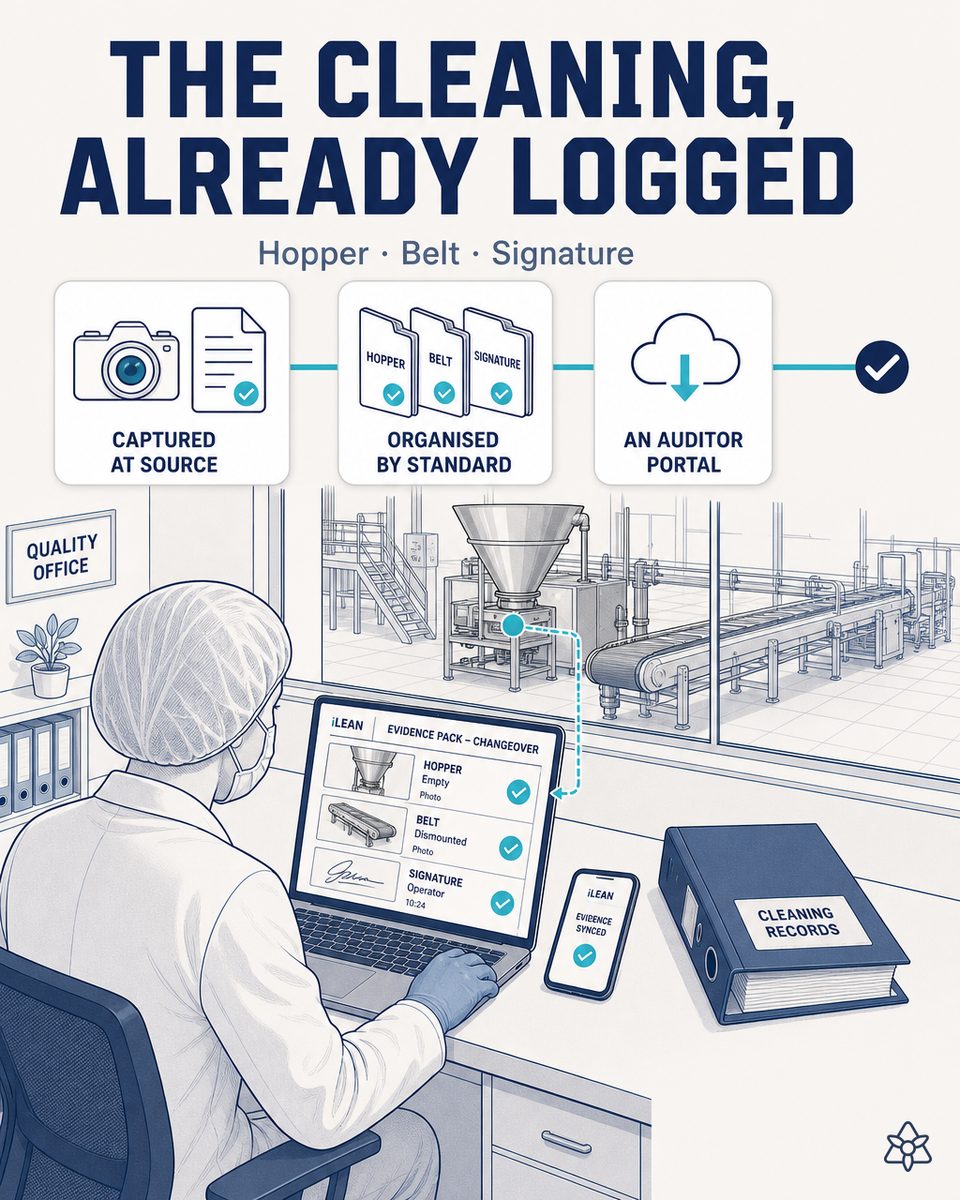
Edge captures the pre/post photo at each critical point. Agents assembles the per-batch-change dossier with a timestamp, the responsible person and a hash. The person signs on the spot — the file is closed before the next batch. The audit stops being a sprint.
The two iLEAN pieces applied to the cleaning evidence pack:
- Edge — a machine vision terminal (CNN) that runs a pre-programmed walk through the breadstick/crispbread line's critical points: the mixer, the flour hopper, the molding belt, the oven, the cooling belt, the packing exit. At each point, a pre-cleaning photo and a post-cleaning photo with a timestamp. It works without a network: if the plant loses WiFi, Edge keeps capturing and storing locally; when the network returns, it syncs. The critical part cannot depend on connectivity.
- Agents — an agent collects Edge's images, crosses them with the current cleaning SOP, the order change recorded in the MES (which batch ended, which starts) and the signature of the person who validated on the spot, and packages the per-change dossier as a PDF with an integrity hash. It deposits it in the QMS or the repository you already use. The file lives in your system — iLEAN does not build a fourth silo, it feeds the one you have.
The annual sprint vs. a file closed before the next batch
| Aspect | Cleaning documented by hand | With iLEAN Edge + Agents |
|---|---|---|
| Capturing the photo | The operator's personal phone, a private camera roll | An Edge terminal on the floor, a pre-programmed walk, a central archive |
| The AOECS / IFS / BRC pre-audit | A 2-3 week sprint reconstructing dossiers | Zero. The file is already closed and signed per change |
| The responsible person's signature | After the fact, sometimes the next day | At the moment, on the spot, anchored to the photo pack |
| Reconstructing a specific batch months later | Hunting photos on phones, recalling who was in that day | Filter by batch number → a signed PDF in 3 clicks |
| Operation without a network | n/a (the operator's phone does not depend either, but their camera roll does) | Edge keeps capturing on the cabinet's power; syncs on return |
| The file's integrity | An Excel sheet editable after the signature | A PDF with a cryptographic hash — tampering shows |
Impact estimate for your plant — to be validated with your own numbers.
The block below is an estimate to be validated against your plant's actual data. We put it forward so the committee has an order of magnitude; we refine it during the assessment.
- SME-type breadstick/crispbread factory, 1 shared line with daily or weekly gluten / gluten-free batch changes, a current AOECS certification plus IFS Food.
- Edge + Agents pilot on that line (a camera terminal at the 5-6 critical points + integration with the MES/QMS). First value expected within a few weeks — from the first audited batch change.
- Indicative payback between 4 and 9 months, depending on the batch change frequency, the current cost of the pre-audit sprint (quality hours + floor hours) and the cost of an eventual non-conformity or re-audit.
- The hard lever is not losing the Crossed Grain: a re-audit, the explanation to the retailer that requires it, the risk of shelf withdrawal for an indefensible "gluten-free" label. A single major non-conformity avoided pays for the pilot.
And the fair question from the quality manager
"What if the AI assembles a dossier that looks correct but is not?" — the evidence pack iLEAN generates is an anchored task, not free generation: the agent takes real photos Edge captured, MES data and the operator's human signature, and joins them in a template. It invents nothing. In anchored tasks, the best models brought the error below 1.5% [1]. And even then, nothing critical is decided alone: the person signs on the spot before the dossier closes. The three safety rings are there precisely for this.
[1] OpenAI paper "Why Language Models Hallucinate", 2025 — on the reliability of AI in anchored tasks.
What people ask about the gluten / gluten-free cleaning evidence pack
What exactly does AOECS require for gluten-free product?
The AOECS standard (Crossed Grain) requires proving that the finished product contains less than 20 mg/kg of gluten and that the management system guarantees it traceably. In a breadstick and crispbread factory sharing a line with wheat product, that means: a written between-batch cleaning procedure, records of every cleaning with date/responsible/result, periodic analytical validation (R5 ELISA kits or equivalent), and evidence that the specific change about to be audited was done right. The audit does not settle for "we do the cleaning": it asks for the proof of the batch of the 14th of any month last year.
How is the evidence pack generated without typing anything?
iLEAN Edge runs a pre-programmed walk through the line's critical points (the mixer, the hopper, the belt, the oven, the exit). At each point it captures a pre-cleaning and post-cleaning photo with a timestamp and in-plant geolocation. iLEAN Agents collects those images, crosses them with the cleaning SOP, the order change in the MES and the signature of the person who validated on the spot, and packages the per-batch-change dossier as a signed PDF with an integrity hash. The file is closed before the next gluten-free batch starts. Nobody has typed a field.
Does it work for IFS, BRC, FSSC 22000 too?
Yes. The skeleton is the same across AOECS, IFS Food, BRCGS Food Safety and FSSC 22000: the auditor asks to prove that the critical control points (CCP) and the prerequisite programs (PRP) are executed and documented. What changes between standards are the forms and emphases (allergens in AOECS, food defense in IFS, food safety culture in BRC). The base dossier iLEAN generates — pre/post photo + timestamp + responsible person + hash — serves all of them; the output templates change, not the capture.
Who signs the dossier?
A person. Always. The quality manager or the shift lead who validated the cleaning on the spot signs at the moment — tablet, phone or terminal — and that signature is cryptographically anchored to the photo pack and the batch change. iLEAN never signs on the plant's behalf. The Agents prepare the file and present it already squared, but the legal and brand responsibility rests with the person who validates. This is in iLEAN's DNA — the three-ring architecture enforces it — and it is exactly what an AOECS auditor wants to see: human traceability, not opaque automation.
How much does deploying it on one line cost?
The order of magnitude of an Edge + Agents pilot for an evidence pack on a breadstick/crispbread line is in line with any iLEAN pilot in a food plant: an initial investment covering the Edge terminal + cameras at the critical points + integration with the MES/QMS, plus an annual license for the agent swarm. The reasonable payback to present to the committee is a matter of months — the hard lever is not losing the AOECS certification (the cost of a re-audit + the cost of explaining to the retail customer why the Crossed Grain disappeared from the package weighs more than the whole pilot). We ask for your plant's data and send you the estimated ROI within 48h, with your numbers, not ours.
More cases from this series
- The coder and labeler integrated with iLEAN — the operator stops typing the SKU change.iLEAN Connect integrates your breadstick coder with the ERP: batch, date and allergens loaded without…
- The supplier's email at 8:14 cannot wait for the purchasing manager's first free moment.iLEAN Connect reads the flour supplier's email at second zero. If it warns of a delay, planning is…
- The lab's Excel is not the problem — it is that nobody on the ERP sees it.iLEAN Connect detects the breadstick line's quality control Excel, absorbs it in real time and, after…
- A human verification tablet on the line — the person signs, in 2 taps, before the data enters the system.iLEAN Connect puts a tablet on the breadstick line so the operator confirms in seconds what the AI has…
- Batch startup in a breadstick and crispbread snack factory — the first label is where the shift is at stake.Connect captures by photo the production order and the batch's first label in a breadstick plant, and…
- The section lead cannot be in five places at once — their AI earpiece can.The section lead talks to iLEAN without breaking stride along the breadstick line. It listens, records…
Tell us your case and we will send within 48h the estimated ROI of this AI project for your breadstick and crispbread factory.
We work on your plant's real data, not ours. Assessment with no commitment.
Request estimated ROI within 48h ‹ See all 13 breadstick and crispbread cases See food industry