A 1998 tunnel oven with an isolated Windows 2000 — and a per-batch baking dossier the IFS auditor asks for tomorrow.
Your breadstick tunnel oven is 15-25 years old with an isolated Windows 2000 industrial PC nobody pulls data from. iLEAN Connect in intermediate mode connects to that machine's serial port / screen / control panel and digitizes the baking curve, the setpoints and the alarms in real time — replacing nothing.
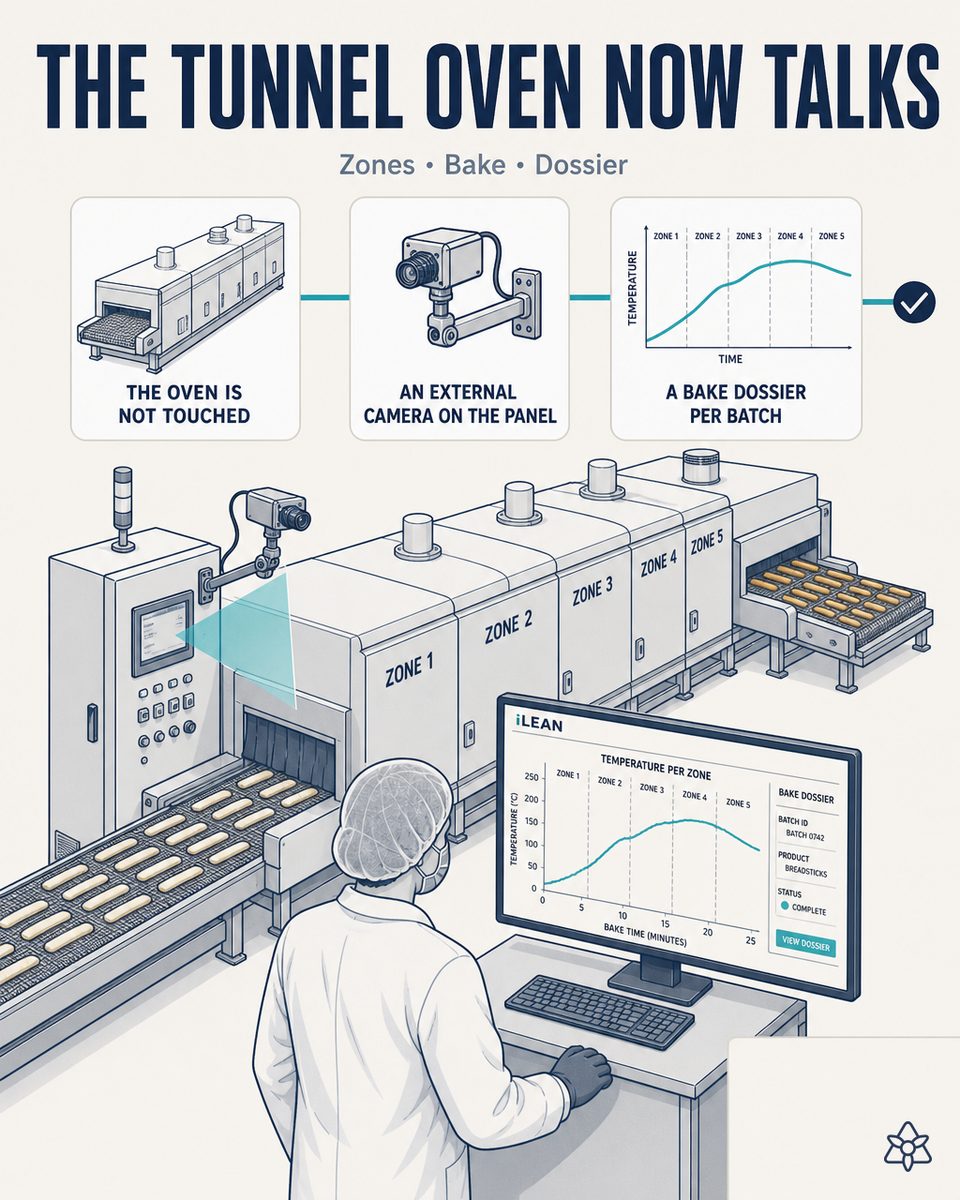
The oven works perfectly. The problem is what does not come out of it.
In a breadstick and crispbread factory, the tunnel oven is the most expensive piece and the most reliable. It has been baking for 15, 20, sometimes 25 years. The baking curve was tuned back in the day by the master baker — together with the technician of a manufacturer that has since closed — and the oven has delivered ever since. The problem is not the oven; it is what surrounds the oven:
- Only the master baker sees the baking curve. It lives in their head, in a crumpled folder next to the panel, and in what the operator jots down by hand when they remember. The day the master retires, out goes the baking pattern of the thin crispbread, the one for the olive-oil breadstick, and the trick to keep the tunnel's exit from coming out pale when the hall's air changes with October's humidity.
- The industrial PC is isolated from the network. It is a Windows 2000 (sometimes Windows NT) with the oven manufacturer's proprietary driver. It has no usable Ethernet, no Internet, and the IT department has spent years asking "please, do not touch it". They are right: that PC controls the baking, and if it goes down, the line stops.
- The IFS/BRC auditor asks for per-batch baking data and there is no record. There is a paper sheet the shift lead signs at the end of the day. No curve, no setpoint, no recorded alarm. The non-conformity lands in the report and from the next year on the customer demands corrective action — or leaves for the competitor that does have it.
This is not negligence. Integrating old machines was unviable for decades: the project's cost exceeded the saving, the drivers did not exist, and modernizing the whole oven cost more than buying a new one. That equation has changed.
Connect, intermediate mode — the putty between your 1998 oven and the rest of the 21st century.
iLEAN Connect was designed with this kind of machine in mind. The philosophy is capture graduation: Connect adapts to what your machine can give, not the other way around. Three modes depending on the oven in front of you:
Connect reads the old PC's serial port or the screen with a camera. The Agents cross the curve with the ERP's batch. The per-batch dossier assembles itself. The master baker stops being the sole keeper of the baking pattern — without losing their authority over the line.
The effect in a breadstick/crispbread factory:
- Manual — a 100% analog panel, needles and pilot lights. A fixed camera points at the panel and a neural network reads the values as the master would. The civil work is a bracket and a power cable.
- Intermediate (your tunnel oven's) — the machine has an isolated, old industrial PC with an RS-232/RS-485 serial port or a flat-file export. Connect connects to that port or reads the export folder, and extracts temperature by zone, belt speed, setpoint, alarms and events. Nothing new is installed inside the old PC — Connect is the external box that reads.
- Integrated — the oven has OPC-UA or modern Modbus. Direct integration to the SCADA or the MES.
- A real baking curve, per batch, in real time. Every tray leaving the tunnel has associated the temperature by zone, the seconds spent in each stretch and the alarms that fired. That is what the IFS auditor asks for, and what never existed on paper.
- The master baker's knowledge is captured as data. Not to replace them — so that the day they are on vacation, the shift's second has the pattern of the last 200 correct batches to guide them. The veteran's eye, at last, stops being an island.
- It works without a network. Connect captures locally and syncs when it can. The plant can lose WiFi for three days: the baking goes on, the capture goes on, the dossier is rebuilt afterwards without gaps.
- Bidirectional but with a brake. Connect transports, the Agents reason, the person signs. The system can suggest to the shift lead that the curve is drifting because the hall's air is more humid than average — but the one who decides to slow the belt is the master, not the agent.
A tunnel oven with a notebook vs. a tunnel oven with Connect
| Aspect | Today: a paper sheet + an isolated PC | With iLEAN Connect intermediate mode |
|---|---|---|
| The batch's baking curve | In the master baker's head | Captured in real time, by zone, by minute |
| Data for the IFS/BRC auditor | A sheet signed at the end of the shift, no curve | A per-batch dossier with setpoints, the real curve and alarms |
| The day the master retires | The baking pattern leaves with them | The pattern saved as a reference for the successor |
| The oven's alarms | A pilot light seen if someone walks by | A timestamped event, notified by channel |
| The cost of touching the industrial PC | n/a — IT forbids going near it | Zero — Connect reads from outside, nothing installed inside |
| Integration with ERP/MES/Excel | Manual, weeks after the batch | Automatic cross-check with the work order |
Impact estimate for your plant — to be validated with your own numbers.
The block below is an estimate to be validated against your plant's actual data. We put it forward so the committee has an order of magnitude; we refine it during the assessment.
- Mid-sized breadstick and crispbread factory, 1-2 tunnel ovens 15-25 years old, an isolated Windows 2000/NT industrial PC or a mixed analog-digital panel.
- Connect pilot on one oven (a Connect box + serial port reading or a camera over the panel + integration with the ERP/Excel batch). First value expected within a few weeks — the per-batch dossier starts generating the day the box is hung.
- Indicative payback between 3 and 9 months, depending on the audit dossier's weight with your end customer (retailer, UK/USA export) and the documented cost of the last baking incident.
- The hard lever is a single IFS/BRC non-conformity avoided in an audit — or a single customer complaint over a badly baked batch that can now be traced to the exact minute. That pays for the pilot.
- A career anchor: the powder coating case documented in iLEAN's base closed its pilot with a real year-1 investment near €30,000 and a conservative payback of ~3 months, with first value in weeks. Same mechanics, another sector: the order of magnitude applies.
And the fair question from the plant director
"What if Connect misreads the panel and records a temperature that is not the real one?" — hallucination is a problem of free generation, not of anchored tasks. Reading a 7-segment display, a thermometer needle or the old PC's flat file and moving that value into a database is an anchored task: there is a source, there is a value that can be verified. In tasks of this kind, the best models brought the error below 1.5% [1]. And even then, nothing critical is decided alone: the data is saved, the agent proposes, and the master baker or the shift lead signs. The three safety rings are there precisely for this.
[1] OpenAI paper "Why Language Models Hallucinate", 2025 — on the reliability of AI in anchored tasks.
What people ask about digitizing an old tunnel oven in a bakery
Do I have to replace my tunnel oven to digitize it?
No. iLEAN Connect in intermediate mode is designed exactly for this: 15-25 year old machines that work perfectly but have an industrial PC with Windows 2000 (or an analog panel with needles and thermocouples) isolated from the network. Connect connects to the serial port, the local PC, or reads the screen by camera, and digitizes the baking curve, the setpoints and the alarms in real time. The machine is untouched, neither the PLC nor the control wiring. Civil work is zero — a serial cable or a camera pointing at the panel.
What happens if the old machine loses its network?
That is the normal case, not the exception. In a breadstick plant with a 1998 tunnel oven, the industrial PC never had a network and the baker's computer is on another LAN. Connect works as a local box: it captures the data from the serial port or the panel, buffers it and syncs when the network comes back. The critical part does not depend on WiFi: the baking goes on, the capture goes on, and the per-batch dossier is rebuilt without gaps when connectivity returns.
How is an analog panel with no digital interface captured?
It is Connect's manual/visual graduation: a fixed camera points at the oven's panel (needle thermometers, 7-segment displays, alarm pilot lamps) and a neural network reads the values in real time, just as the master baker would walking past every quarter hour. The difference is that it does not go to lunch, does not retire and does not err from fatigue at 3 in the morning. The reading is stored with the batch and the operator remains the one who decides whether to act — Connect transports, the Agents propose, the person signs.
Is the digitized baking curve valid for an IFS/BRC audit?
Yes, and it resolves one of the auditor's classic findings in older breadstick plants: "the HACCP plan requires recording baking temperatures and times per batch, and here we only have a sheet the master signs at the end of the shift". With Connect, every batch has its real baking curve (not the nominal one), the applied setpoints, the fired alarms and the responsible person's signature. The dossier generates automatically and is handed to the IFS, BRC or FSSC 22000 auditor without reconstructing anything by hand.
Does it integrate with an ERP or MES?
Yes. The data captured from the old oven is crossed with the ERP's batch (work order, raw material, destination) and with the MES if there is one. That is what turns a loose temperature value into something useful: "this batch of virgin olive oil crispbreads for customer X baked on this exact curve, with this setpoint deviation at minute 12, and was labeled with this number". If there is no ERP, or the ERP is the planning manager's Excel, Connect reads that too — it is the putty, it demands no modernization first.
More cases from this series
- The coder and labeler integrated with iLEAN — the operator stops typing the SKU change.iLEAN Connect integrates your breadstick coder with the ERP: batch, date and allergens loaded without…
- The supplier's email at 8:14 cannot wait for the purchasing manager's first free moment.iLEAN Connect reads the flour supplier's email at second zero. If it warns of a delay, planning is…
- The lab's Excel is not the problem — it is that nobody on the ERP sees it.iLEAN Connect detects the breadstick line's quality control Excel, absorbs it in real time and, after…
- A human verification tablet on the line — the person signs, in 2 taps, before the data enters the system.iLEAN Connect puts a tablet on the breadstick line so the operator confirms in seconds what the AI has…
- Batch startup in a breadstick and crispbread snack factory — the first label is where the shift is at stake.Connect captures by photo the production order and the batch's first label in a breadstick plant, and…
- The section lead cannot be in five places at once — their AI earpiece can.The section lead talks to iLEAN without breaking stride along the breadstick line. It listens, records…
Tell us your case and we will send within 48h the estimated ROI of digitizing your tunnel oven with iLEAN Connect.
We work on your plant's real data, not ours. Assessment with no commitment.
Request estimated ROI within 48h ‹ See all 13 breadstick and crispbread cases See food industry