Zero fruit loss, from scale to pallet
Cold-chain loss and natural fruit variability are the capital pain of an avocado processing plant. iLEAN flagship coordinates Connect, Edge, Agents, JIDOKA AI and SMED AI in cross-checking rings, from the orchard scale to the pallet.
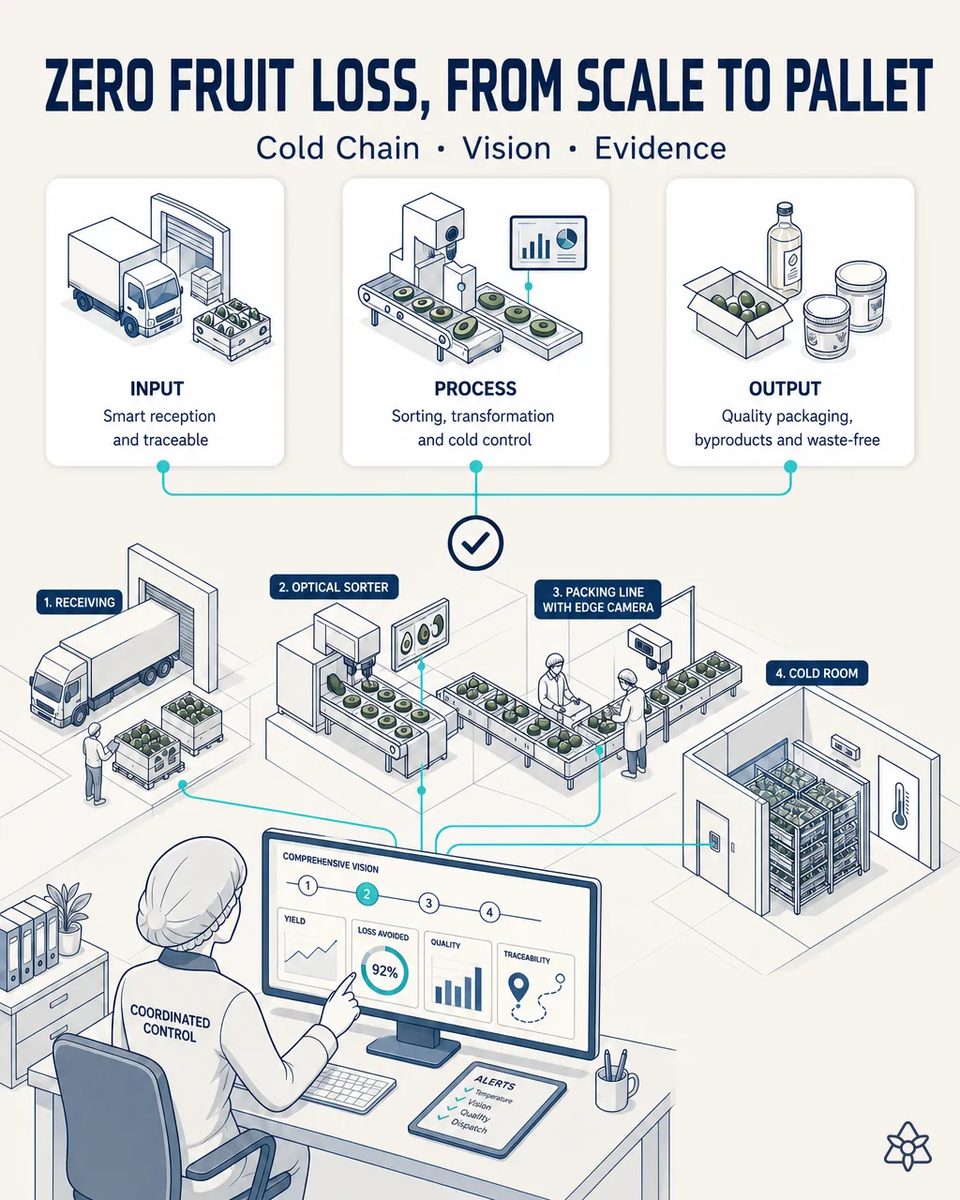
Fruit loss is rarely one failure: it is a warm hour, a missed defect and a late signature.
Fruit loss from out-of-range temperature or an undetected defect is the sub-sector's biggest economic risk, worsened because the harvest window concentrates most of the annual volume into a few months, leaving little room to react on the fly. An incident in peak season or a defective lot reaching export destroys margin and, worst case, an international distributor's trust.
- Loss from out-of-range temperature or an undetected defect is the sub-sector's biggest economic risk.
- It is made worse by the harvest window, which concentrates most of the year's volume into a few months and leaves almost no room to react on the fly.
- Each link looks acceptable alone: the truck waited a little, the cold room drifted a little, the sorter was set by hand, the defect was subtle.
- Together they produce a lot that ripens too fast or arrives defective at export — and one such lot can cost an international distributor's trust.
Four cross-checking rings — the previous eleven cases, orchestrated.
The iLEAN flagship system coordinates 4 rings:
No ring solves the problem alone; each one exists today in some form and fruit is still lost. What gives away the chain of small failures is independent sources ceasing to agree — the lot's temperature, its grading, its images and its sign-off. When they all agree, the pallet ships with its dossier already closed.
- Connect captures orchard-to-lot traceability and harvest alerts in real time;
- the optical sorter applies the size/destination criteria published by the ERP with no manual entry;
- Edge cameras detect external defects in packing and validate critical changeovers, with JIDOKA AI blocking when something doesn't match;
- every lot leaves with an evidence dossier cross-referencing temperature, sorting, visual inspection and quality sign-off. SMED AI speeds up format changeovers so coordination doesn't hurt productivity in peak season.
The four rings and what each one blocks
| Ring | What it draws on | What it closes |
|---|---|---|
| 1 · Orchard | Orchard receiving (1, 7) + grower alerts (3) | Orchard-to-lot traceability and a line plan that matches the fruit |
| 2 · Grading and yield | Optical sorter (8) + lab (6) + press panel (2) | Destination from the ERP, dry matter and yield tied to the lot |
| 3 · Packing and pulping | Packing defect (9) + guacamole changeover (10) + supervisor voice (4) | Defects and cross-recipe residue caught before the box |
| 4 · Lot dossier | Evidence pack (11) + verification tablet (5) | A dossier per lot: temperature, sorting, images and sign-off |
| JIDOKA AI hold | All four rings | Holds the lot when two sources disagree |
| SMED AI changeovers | Size and recipe changes | Keeps coordination from costing throughput at harvest peak |
Temperature or undetected-defect loss incidents, handled case by case and often too late → early detection and blocking before the fruit leaves the plant.
Impact estimate — to be validated with your quality lead and general management.
The block below is an estimate to be validated against your plant's actual data. We put it forward so the committee has an order of magnitude; we refine it during the assessment.
- Estimated payback 6-12 months, counted against the first relevant loss avoided.
- Margin protection against perishable-product loss and export returns — a potential impact in the hundreds of thousands of dollars per season.
- Temperature or defect incidents stop being handled case by case, often too late, and are detected and blocked before the fruit leaves the plant.
- We validate these figures with your quality lead and general management, not against a generic benchmark.
Margin protection against perishable-product loss and export returns (potential impact in the hundreds of thousands of dollars per season). Estimated payback 6-12 months against the first relevant loss avoided. *Estimate to be validated with the quality lead and general management.*
And the fair question from the production manager
“Do we need all twelve cases before any of this pays?” — no. The rings are built in layers and most cases pay on their own; receiving and the sorter already close much of the origin and grading rings. On reliability, each cross-check compares anchored readings — a weight, a temperature, a grade — where the best models drop below 1.5% error [1], and JIDOKA AI holds a lot only on a verifiable mismatch.
[1] OpenAI paper "Why Language Models Hallucinate", 2025 — on the reliability of AI in anchored tasks.
What people ask about the zero-loss system
Which piece goes first in an avocado plant?
Usually orchard receiving, because it has the fewest dependencies and every other ring needs to know where each lot came from. The sorter and the lab usually follow, because they close the grading ring.
What does the cross-check catch that each control misses?
The chain: a truck that waited, a cold room that drifted and a faint bruise each pass their own control, and together they produce the lot that arrives soft at the destination. No single control was wrong; the combination was.
What happens when two rings disagree about a lot?
JIDOKA AI holds the lot and escalates it to the quality lead with the evidence from each source. The decision stays with a person. Holding one lot for an hour is far cheaper than losing a container.
Does all this coordination slow the plant at harvest peak?
That is why SMED AI is part of the flagship: it shortens format changeovers so the checks do not cost throughput when volume is highest. Coordination that slowed the plant down would not survive its first harvest.
Does it cover the cold room between packing and shipping?
Yes. The temperature history of each lot in the cold room is one of the signals crossed before the pallet is released for the container. A lot that spent too long above range is flagged even if it looks perfect.
More cases from this series
- Camera that reads the cold-press panelDigitize your cold-press avocado oil extraction curve without touching the machine's original panel.
- WhatsApp from the orchard that replans the lineTurn orchard delay or harvest-change alerts into automatic replanning for your avocado line.
- The shift supervisor dictates while walking the floorCapture the shift supervisor's operational knowledge by voice without stopping the plant floor walk.
- The lab spreadsheet flows into the ERP by itselfSave quality-module ERP licenses by connecting your avocado plant's lab spreadsheet.
- The optical sorter stitched to the ERPSync your avocado optical sorter's size and destination criteria with the ERP, no manual entry.
- Photo of the scale ticket at truck unloadingDigitize orchard-level avocado receiving with one photo: zero-second traceability, no change to the…
Tell us what the last lot you lost to temperature or a missed defect cost you.
We work on your plant's real data, not ours. Assessment with no commitment.
Request estimated ROI within 48h ‹ See all cases of avocado processing See food industry