The optical sorter stitched to the ERP
The optical sorter that separates by size and color already has an API, but remains isolated from the ERP: the commercial-destination criteria is typed in by hand. With iLEAN, the criteria flows automatically from the active work order to the sorter.
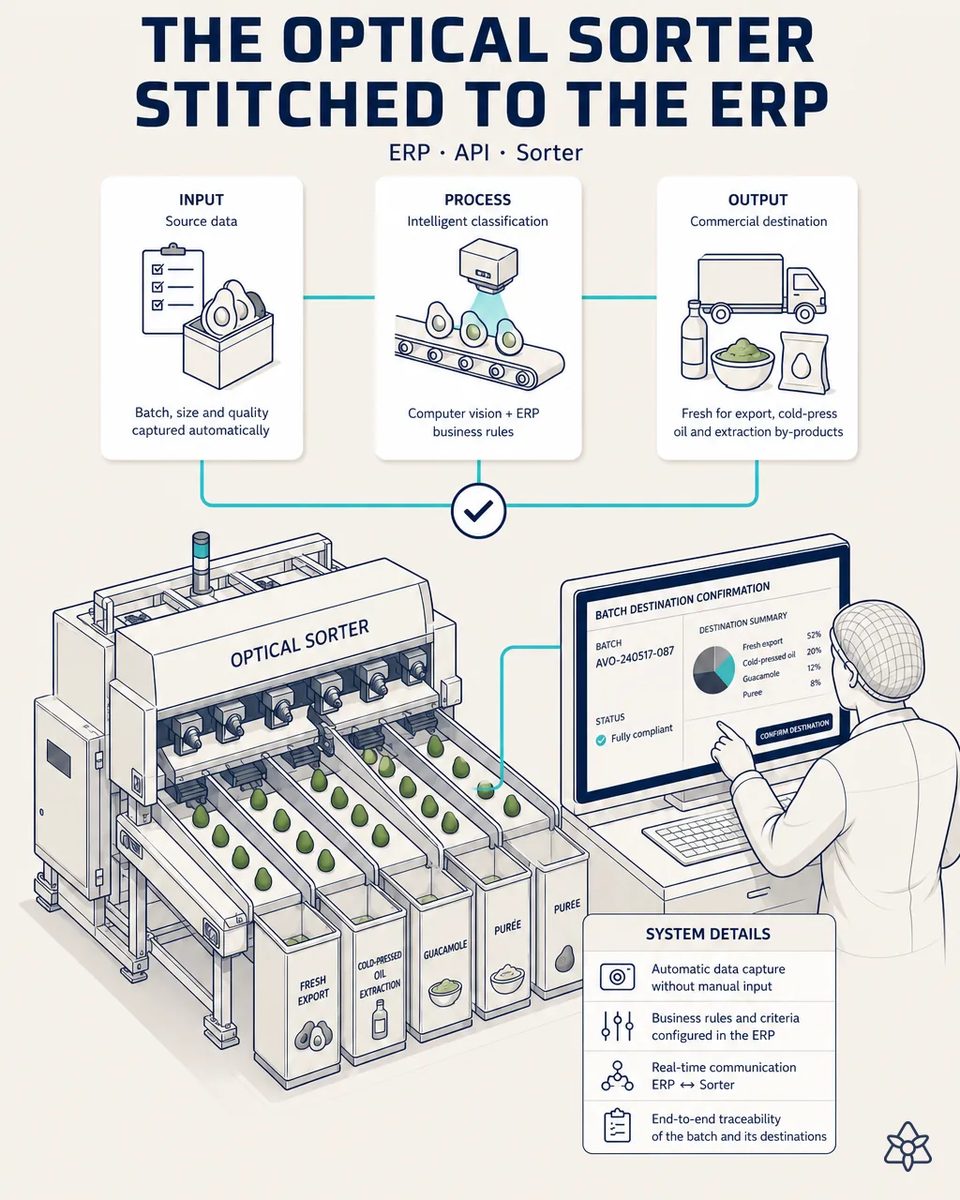
One wrong setting on the sorter sends export fruit down the wrong lane.
The optical sorter decides the commercial channel for each piece of fruit (export, domestic, industrial). When the destination changes, someone types the setting into the sorter panel by hand; one wrong setting can send export-grade fruit down the wrong channel, costing margin or creating a quality risk.
- The optical sorter decides the commercial channel of every avocado by size and color: export, domestic market or industrial for pulp and oil, and each channel has a very different price per kilo.
- The destination changes with the work order — different markets ask for different size counts — and someone types the new criteria into the sorter panel by hand, often reading them from a printout at the side of the machine.
- The ERP already knows the active order and its specification. The sorter already has an API. Nobody connected them.
- A wrong setting sends export-grade fruit to the domestic lane or lets undersized fruit into an export box: lost margin or a quality claim, and usually nobody finds out until the boxes are counted.
Connect stitches ERP and sorter over the API — the order sets the criteria.
Connect stitches the ERP and the sorter together via API: when the ERP marks the active commercial destination, it automatically publishes the size/color criteria to the sorter. Destination change = one tap in the ERP, not a manual panel adjustment.
With a perishable fruit, the sorting decision is the price decision: once an avocado lands in the wrong lane, there is rarely time to send it back. Taking the keyboard out of that decision is the fastest payback in the matrix. It also leaves a record of which criteria every lot was graded under.
The sorter set by hand versus the sorter fed by the order
| Aspect | Today | With iLEAN Connect |
|---|---|---|
| Changing the destination | Manual panel adjustment | One tap in the ERP |
| Size and color criteria | Typed from a printed spec | Published from the active work order |
| Export fruit in the wrong lane | A permanent risk | Removed at the source |
| Market-specific size counts | Remembered by the operator | Carried by the order |
| What the sorter really applied | Assumed | Confirmed back to the ERP |
| Replacing the sorter or the ERP | — | Neither |
Manual adjustments with channel-error risk → criteria automatically synced with the active work order.
Impact estimate — to be validated with your numbers.
The block below is an estimate to be validated against your plant's actual data. We put it forward so the committee has an order of magnitude; we refine it during the assessment.
- Fast payback, estimated at 3-6 months, the shortest in this matrix.
- From the reduced risk of margin loss when export fruit is misrouted to a lower-value channel.
- And from claims avoided when undersized or off-color fruit never reaches an export box, which protects the next shipment to the same customer as well.
- Manual criteria adjustments with channel-error risk become criteria synced automatically with the active order, with no extra work for the line.
Fast payback, 3-6 months, from reduced risk of margin loss due to misrouted export fruit. *Estimate to be validated.*
And the fair question from the production manager
“What if the ERP publishes the wrong criteria?” — then the error sits in the order, where it is visible and correctable, not hidden in a panel setting. Mapping an order's specification to the sorter's parameters is an anchored task, where the best models drop below 1.5% error [1], and the sorter confirms back what it applied, so a mismatch shows up before the first box is closed. The person at the sorter still sees the active criteria on the panel, only without typing them.
[1] OpenAI paper "Why Language Models Hallucinate", 2025 — on the reliability of AI in anchored tasks.
What people ask about connecting the optical sorter
What if our sorter has no documented API?
Then we check what it does expose — a file exchange, a network interface, a recipe import. Most modern sorters have one; if yours has none, this is not the right case to start with. We check that before any commitment, in a short call with your maintenance team.
Does it change how the sorter grades the fruit?
No. The sorter keeps its own vision and grading; what changes is who sets the destination criteria — the order instead of a person at the panel. Its calibration and its maintenance contract stay as they are.
Can the destination change in the middle of a lot?
Yes. If sales changes the order, the new criteria reach the sorter as soon as the ERP publishes them, with no stop to reprogram. With a perishable fruit, not stopping the line matters as much as getting the setting right.
Does it route fruit for guacamole, frozen pulp and oil too?
Yes. The industrial lane is one more destination with its own criteria, so fruit for processing is routed by the same rule as fruit for export. That keeps pulp and oil supplied with the right fruit instead of whatever was left over.
Is the lane each lot went to recorded?
Yes. The sorter's confirmation comes back to the ERP, so every lot has a record of how much went to export, domestic and industrial. That split per orchard is what the buying team needs to price the next season.
More cases from this series
- Camera that reads the cold-press panelDigitize your cold-press avocado oil extraction curve without touching the machine's original panel.
- WhatsApp from the orchard that replans the lineTurn orchard delay or harvest-change alerts into automatic replanning for your avocado line.
- The shift supervisor dictates while walking the floorCapture the shift supervisor's operational knowledge by voice without stopping the plant floor walk.
- The lab spreadsheet flows into the ERP by itselfSave quality-module ERP licenses by connecting your avocado plant's lab spreadsheet.
- Photo of the scale ticket at truck unloadingDigitize orchard-level avocado receiving with one photo: zero-second traceability, no change to the…
- Photo of the scale ticket that reaches the ERPFree up your avocado plant's scale in minutes with a photo of the ticket and crate labels.
Tell us how many times a shift the destination on your sorter changes.
We work on your plant's real data, not ours. Assessment with no commitment.
Request estimated ROI within 48h ‹ See all cases of avocado processing See food industry