Photo of the scale ticket that reaches the ERP
The truck arrives with orchard fruit. Instead of typing lot by lot into the ERP, the receiving supervisor photographs the scale ticket and crate labels, and everything goes into the ERP with one tap -freeing up the scale in minutes.
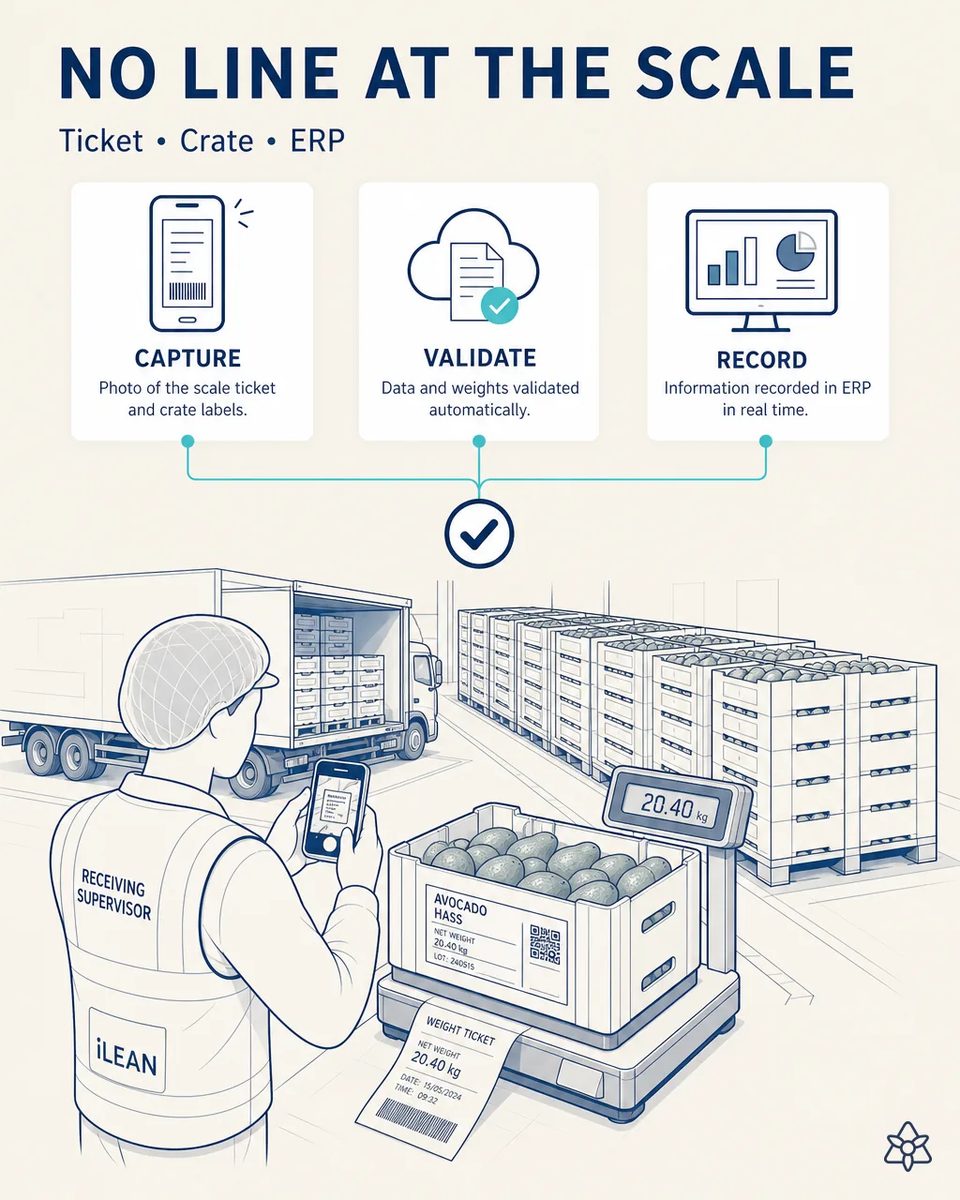
In peak season the queue at the scale is really a queue at the keyboard.
In peak season, trucks pile up at the scale while the receiving supervisor types orchard by orchard into the ERP. Rushing to avoid demurrage means lots get entered wrong, which later shows up as a traceability discrepancy hard to resolve in time for export.
- At harvest peak, trucks line up at the scale while the receiving supervisor types orchard by orchard, crate by crate, into the ERP, with the scale ticket in one hand and the crate labels in the other.
- Every minute of queue is fruit sitting warm in a truck and a carrier charging demurrage, while the next orchard's truck waits behind it with the same problem.
- Typing in a hurry to clear the queue means lots entered with the wrong orchard or harvest date, and nobody has time to double-check them.
- The error surfaces later as a traceability discrepancy on an export shipment, exactly when there is no time left to resolve it, with the container booked and the vessel waiting.
Connect in photo-of-paper mode — the ticket and the crate labels, one tap to the ERP.
Connect photo-of-paper mode: one photo of the scale ticket and another of the crate labels (barcode, QR or plain text) digitizes both documents in seconds. iLEAN extracts orchard, weight, harvest date and grower; with one validation tap, everything is inserted into the ERP.
A truck of avocado waiting in the sun is not just a demurrage invoice: it is field heat the cold room will have to take out later. Freeing the scale in minutes protects the fruit as much as the schedule. In peak season, the scale is often the real bottleneck of the whole plant, not the sizer.
Receiving at the keyboard versus receiving posted from a photo
| Aspect | Today | With iLEAN Connect |
|---|---|---|
| Truck at the scale | Up to an hour | Minutes |
| Crate labels | Read and retyped | Barcode, QR or text read from the photo |
| Orchard and harvest date per lot | Typed in a hurry | Extracted and validated |
| Demurrage in peak season | Recurring | Eliminated |
| Export traceability discrepancy | Found at shipping | Does not arise |
| ERP users at receiving | Several active users | The supervisor who validates |
One-hour truck unload → minutes. Hidden orchard/lot errors → zero. Broken orchard-to-lot traceability → complete via photo.
Impact estimate — to be validated with your numbers and your ERP invoice.
The block below is an estimate to be validated against your plant's actual data. We put it forward so the committee has an order of magnitude; we refine it during the assessment.
- 💰 CFO angle: only the receiving supervisor validates, without logging into the ERP — a typical 50-70% reduction in receiving and warehouse module licenses.
- Estimated payback 3-8 months, including the truck demurrage that disappears.
- Truck unloading goes from an hour to minutes, so the fruit reaches the cold room sooner and carries less field heat into storage.
- And orchard-to-lot errors hidden at receiving go to zero, so traceability arrives complete at export.
CFO angle: only the receiving supervisor validates without logging into the ERP. Typical 50-70% reduction in receiving/warehouse module licenses, plus eliminated truck demurrage. Estimated payback 3-8 months. *Estimate to be validated.*
And the fair question from the production manager
“Crate labels are torn, wet and printed by dozens of growers — will it read them?” — it reads barcodes and QR codes where they exist and printed text where they do not, with no template per grower and no new label printers at the orchards. It is an anchored task, where the best models drop below 1.5% error [1], and any crate the model is unsure of is flagged in the summary before the supervisor posts the receipt. Nothing is posted with a crate left unread.
[1] OpenAI paper "Why Language Models Hallucinate", 2025 — on the reliability of AI in anchored tasks.
What people ask about posting receiving from a photo
How is this different from photographing the intake sheet?
That case creates the orchard-to-lot record in iLEAN's memory. This one goes further and posts the goods receipt into the ERP with one tap, which is what frees the scale. Many plants start with the first one and add this step once the photos are routine.
Does it read crate labels from every grower?
Yes, without asking growers for a standard label. It uses the barcode or QR when there is one and reads the printed text when there is not. Smallholder crates with handwritten labels are read too, and flagged for review when the writing is unclear.
What if the ticket weight and the crate count disagree?
The mismatch is shown in the summary before posting. Today nobody checks that with trucks queuing at the scale. Catching it before posting is far cheaper than finding it at export.
Is the harvest date captured?
Yes, and for avocado it matters: it tells the cold room and the ripening plan how long the fruit has been off the tree. That date is what decides which lots are packed first when the cold room is full.
Does the supervisor still need an ERP login?
No. The supervisor validates in iLEAN and the posting goes through the integration, which is where the license saving comes from. The receipt still lands in the ERP with the supervisor's name on it.
More cases from this series
- Camera that reads the cold-press panelDigitize your cold-press avocado oil extraction curve without touching the machine's original panel.
- WhatsApp from the orchard that replans the lineTurn orchard delay or harvest-change alerts into automatic replanning for your avocado line.
- The shift supervisor dictates while walking the floorCapture the shift supervisor's operational knowledge by voice without stopping the plant floor walk.
- The lab spreadsheet flows into the ERP by itselfSave quality-module ERP licenses by connecting your avocado plant's lab spreadsheet.
- The optical sorter stitched to the ERPSync your avocado optical sorter's size and destination criteria with the ERP, no manual entry.
- Photo of the scale ticket at truck unloadingDigitize orchard-level avocado receiving with one photo: zero-second traceability, no change to the…
Tell us how long a truck waits at your scale on a peak-season morning.
We work on your plant's real data, not ours. Assessment with no commitment.
Request estimated ROI within 48h ‹ See all cases of avocado processing See food industry