Camera that reads the cold-press panel
The cold-press extraction line is the most expensive, most differentiating asset in an avocado oil plant: its proprietary panel shows temperature, flow and yield every few seconds, but that data dies on screen. With iLEAN Connect, an external camera reads the panel without touching the equipment and digitizes the extraction curve batch by batch.
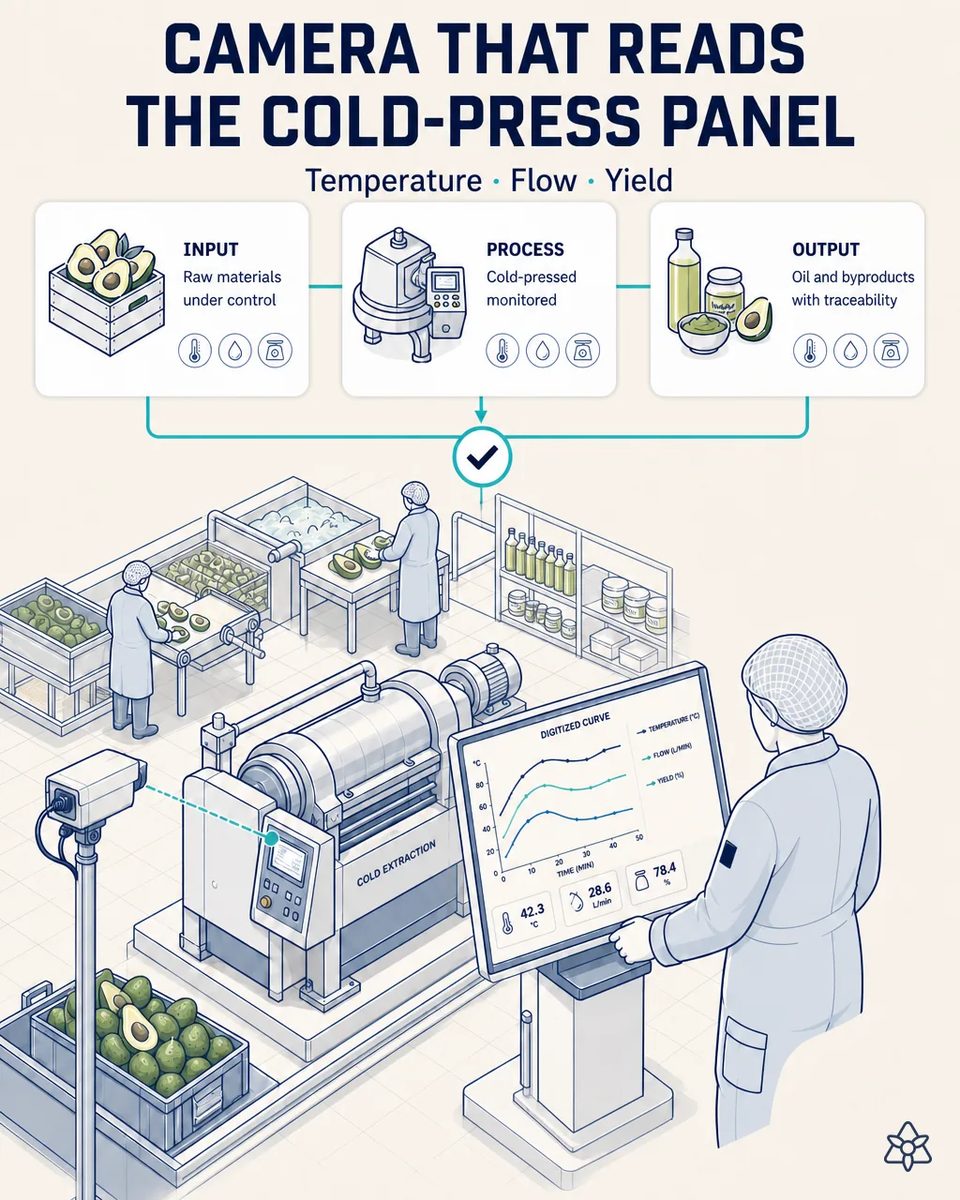
The line that makes the margin shows its data for a few seconds and forgets it.
Extraction yield varies between batches, and today nobody correlates that variation with the real curve on the press or centrifugal decanter panel, because the data rotates and disappears from the screen every few seconds. Replacing the panel with a modern connected one would mean stopping the plant's most critical line and a cost few factories take on during peak season.
- The cold-press line — malaxing, decanter, polishing — is the most expensive and most differentiating asset in an avocado oil plant, and the one that turns fruit rejected for export into margin.
- Its proprietary panel shows paste temperature, flow and yield every few seconds, and the value is gone as soon as the screen refreshes.
- Yield varies from batch to batch, and nobody can say whether it was the fruit's ripeness, the paste temperature or the decanter flow, because the curve was never kept. Every batch is a lesson the plant pays for and does not learn.
- Replacing the panel with a connected one means stopping the plant's most critical line — a cost few plants accept in the middle of the season.
Connect in photo mode on the extraction panel — read from outside, nothing opened.
Connect photo mode on the panel: a fixed industrial camera points at the proprietary panel. OCR with a grounded LLM interprets each frame and structures the temperature, flow and yield time curve per batch, cross-referencing it with the fruit lot that was entering the press at that moment (already available in central memory).
The camera does not guess the yield: it reads what the press already knows and nobody writes down. The value appears when that curve meets the fruit lot that was in the malaxer at that minute, with the ripeness and dry matter recorded at receiving. Over a season, that pairing tells you which fruit is worth sending to oil and at which settings.
The cold-press line as a black box versus the line being read
| Aspect | Today | With iLEAN Connect |
|---|---|---|
| Paste temperature per batch | Seen on screen, then lost | A stored curve per batch |
| Decanter flow and yield | A figure at shift end | A time series for the whole batch |
| Why a batch yields less | Nobody can tell | Root cause in minutes |
| Link to the fruit lot | None | Crossed with the lot in the malaxer |
| Proof of cold extraction | An operator's word | The temperature record of every batch |
| Replacing the panel | A capex line waiting for the off-season | Deferred |
Zero curve-to-yield correlation → root-cause yield analysis per batch in minutes.
Impact estimate — to be validated with your numbers.
The block below is an estimate to be validated against your plant's actual data. We put it forward so the committee has an order of magnitude; we refine it during the assessment.
- Estimated payback 5-10 months.
- From extraction yield gained by fine-tuning paste temperature and decanter flow against real curves.
- And from avoided capex: the proprietary panel and the line stay exactly as they are, with no revalidation and no stop in the middle of the season.
- Correlating curve and yield goes from impossible to a per-batch root-cause analysis in minutes.
Estimated payback 5-10 months, from improved extraction yield through fine parameter tuning and avoided CAPEX for panel/line replacement. *Estimate to be validated.*
And the fair question from the production manager
“A camera reading a panel in a room full of oil mist and condensation?” — it is a fixed screen, with fields in known positions and physical ranges the process cannot leave, which makes it an anchored task where the best models drop below 1.5% error [1]. A fogged frame or a value outside the physical range is discarded rather than stored, so the series stays clean enough to tune the press on.
[1] OpenAI paper "Why Language Models Hallucinate", 2025 — on the reliability of AI in anchored tasks.
What people ask about reading the oil press panel
Does the press manufacturer have to authorize anything?
No. Nothing is installed on the machine and no port is opened: the camera looks at the screen from outside, so the line and its warranty stay untouched. Installation takes a mount, a power socket and an afternoon, not a line stop.
Can the yield be linked to the fruit that went in?
Yes, and that is the point. Receiving already recorded the lot, its ripeness and its dry matter, so each extraction curve is crossed with the fruit that was in the malaxer at that moment. Over a season, that is how you learn which orchards and ripeness levels give the best yield.
Does it help prove the oil was really cold-extracted?
It gives you the paste temperature curve of every batch, which is what a buyer of premium avocado oil asks for. Today that proof rests on an operator's word. A stored curve per batch answers the question before the buyer finishes asking it.
What if the panel cycles through several screens?
The model identifies which screen is showing and reads each one with its own layout, so no parameter is lost between cycles. Alarm screens are read too, so a stop is recorded with its cause.
Can we see the curve while the batch is running?
Yes. The curve builds as the batch runs, so the extraction lead can correct paste temperature or flow before the batch closes instead of explaining it the next morning. That is where the fine tuning behind the payback actually happens.
More cases from this series
- WhatsApp from the orchard that replans the lineTurn orchard delay or harvest-change alerts into automatic replanning for your avocado line.
- The shift supervisor dictates while walking the floorCapture the shift supervisor's operational knowledge by voice without stopping the plant floor walk.
- The lab spreadsheet flows into the ERP by itselfSave quality-module ERP licenses by connecting your avocado plant's lab spreadsheet.
- The optical sorter stitched to the ERPSync your avocado optical sorter's size and destination criteria with the ERP, no manual entry.
- Photo of the scale ticket at truck unloadingDigitize orchard-level avocado receiving with one photo: zero-second traceability, no change to the…
- Photo of the scale ticket that reaches the ERPFree up your avocado plant's scale in minutes with a photo of the ticket and crate labels.
Tell us how much your oil yield varies from one batch to the next.
We work on your plant's real data, not ours. Assessment with no commitment.
Request estimated ROI within 48h ‹ See all cases of avocado processing See food industry