Camera that catches the defect that slips through
At packing-line speed, the human eye lets through bruised fruit or early anthracnose the optical sorter doesn't always catch. iLEAN Edge inspects 100% of the fruit and rejects defective pieces before the box.
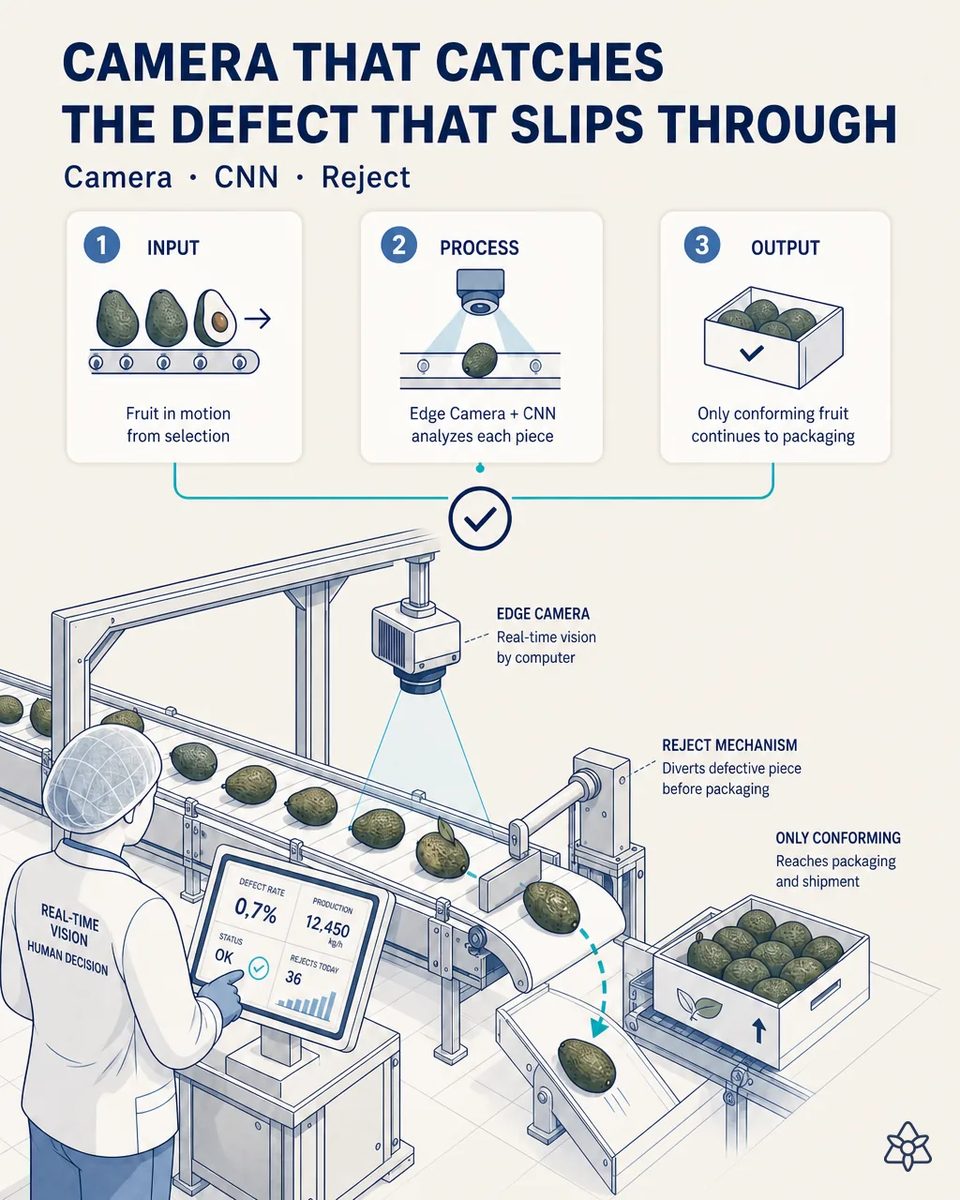
The sizer measures the avocado; it does not always see what is on its skin.
Natural fruit variation in size, ripeness and texture -the quality-control pain the plant declared- means the automatic size sorter doesn't always catch subtle external defects at real line speed. That fruit reaches the distributor: a claim, a full box return, lost trust in an export market where reputation is decided lot by lot.
- Avocado varies naturally in size, ripeness and skin texture, and the automatic sizer does not always tell a subtle defect from normal skin at real line speed.
- Bruises, skin spots, early anthracnose, black tip and over-ripe fruit slip past visual sampling at the end of the line, because at that speed a person sees a sample, not the fruit.
- That fruit keeps ripening on the way to market, and the defect shows up at the distributor as a claim or a full box returned, often with the whole lot put under suspicion.
- In export, reputation is decided lot by lot: a returned box costs far more than the fruit inside it, because the freight, the claim handling and the customer's doubt about the next lot all come with it.
Edge — every fruit classified in milliseconds, on a local GPU, before the box.
iLEAN Edge: an industrial camera over the packing line, with a local Edge GPU and a CNN trained on good/bad examples of the specific fruit (bruises, spots, black tip, over-ripeness), infers in milliseconds and rejects the defective piece before final packing.
A defect on an avocado grows after packing: a faint bruise at the plant is a dark patch at the destination. Catching it on the line is the last moment it costs one fruit instead of one box. And the rejected fruit still has a second life in the pulper.
Sampling at the end of the line versus Edge on every fruit
| Aspect | Today | With iLEAN Edge |
|---|---|---|
| Share of fruit inspected | A sample, when there is time | All of it |
| Subtle bruise or early anthracnose | Passes at line speed | Classified and rejected |
| Point where the bruise is found | At the distributor | Before final packing |
| What the model knows | Generic sizing rules | Your own good and bad fruit |
| Where inference runs | — | A GPU at the line, in milliseconds |
| Borderline fruit | Packed anyway | Escalated to a person |
Partial human visual sampling → 100% fruit inspection. Visual-defect claims → drastic reduction.
Impact estimate — to be validated with your numbers.
The block below is an estimate to be validated against your plant's actual data. We put it forward so the committee has an order of magnitude; we refine it during the assessment.
- Estimated payback 5-12 months, depending on your current reject ratio and on how many of your lots go to export markets that claim for visual defects.
- The return comes from fewer export claims and fewer returned boxes, and from the fruit that is diverted to pulp or oil instead of being written off at the destination.
- Inspection goes from partial visual sampling to every fruit on the line, at the line's real speed.
- And claims for visual defects drop sharply, which protects the lots you have not shipped yet and the distributor relationship behind them.
Estimated payback 5-12 months depending on current reject ratio, from fewer export claims and returns. *Estimate to be validated.*
And the fair question from the production manager
“Every avocado looks different — won't it reject good fruit and cut into the packout?” — natural variation is exactly why the model is trained on your own fruit, varieties and lighting, not on a generic catalog. Classifying a known list of defects under a fixed camera is an anchored task, where the best models drop below 1.5% error [1], and borderline fruit is escalated to the line supervisor instead of being rejected blindly. Every decision the supervisor makes on those borderline fruits goes back into training, so the model learns your own tolerance.
[1] OpenAI paper "Why Language Models Hallucinate", 2025 — on the reliability of AI in anchored tasks.
What people ask about vision on the avocado packing line
Does it replace the optical sorter?
No. The sorter keeps grading by size and color; the Edge camera adds the defect check the sorter does not always make at real line speed. Both work on the same conveyor without slowing it down.
Which defects can it learn?
The ones your customers claim for: bruises, spots, black tip, early anthracnose and over-ripe fruit. The list is defined with your quality team at commissioning. New defects can be added later, for example when a new market claims for something else.
Does it need the cloud to decide?
No. Inference runs on a GPU installed at the line, so the reject happens in milliseconds even if the plant network drops. No image of your fruit has to leave the plant.
What does it need to be trained?
Real fruit from your own lines, good and bad. The first training uses what the season is already producing, and it improves as supervisors confirm borderline cases. By the end of the first weeks, the model knows your varieties and your lighting.
What happens to the rejected fruit?
It is diverted before the box, and depending on the defect it can still go to pulp or oil instead of being lost. Fruit with a skin defect is often perfectly good for guacamole.
More cases from this series
- Camera that reads the cold-press panelDigitize your cold-press avocado oil extraction curve without touching the machine's original panel.
- WhatsApp from the orchard that replans the lineTurn orchard delay or harvest-change alerts into automatic replanning for your avocado line.
- The shift supervisor dictates while walking the floorCapture the shift supervisor's operational knowledge by voice without stopping the plant floor walk.
- The lab spreadsheet flows into the ERP by itselfSave quality-module ERP licenses by connecting your avocado plant's lab spreadsheet.
- The optical sorter stitched to the ERPSync your avocado optical sorter's size and destination criteria with the ERP, no manual entry.
- Photo of the scale ticket at truck unloadingDigitize orchard-level avocado receiving with one photo: zero-second traceability, no change to the…
Tell us what share of last season's export claims were visual defects.
We work on your plant's real data, not ours. Assessment with no commitment.
Request estimated ROI within 48h ‹ See all cases of avocado processing See food industry