Two taps before touching the ERP
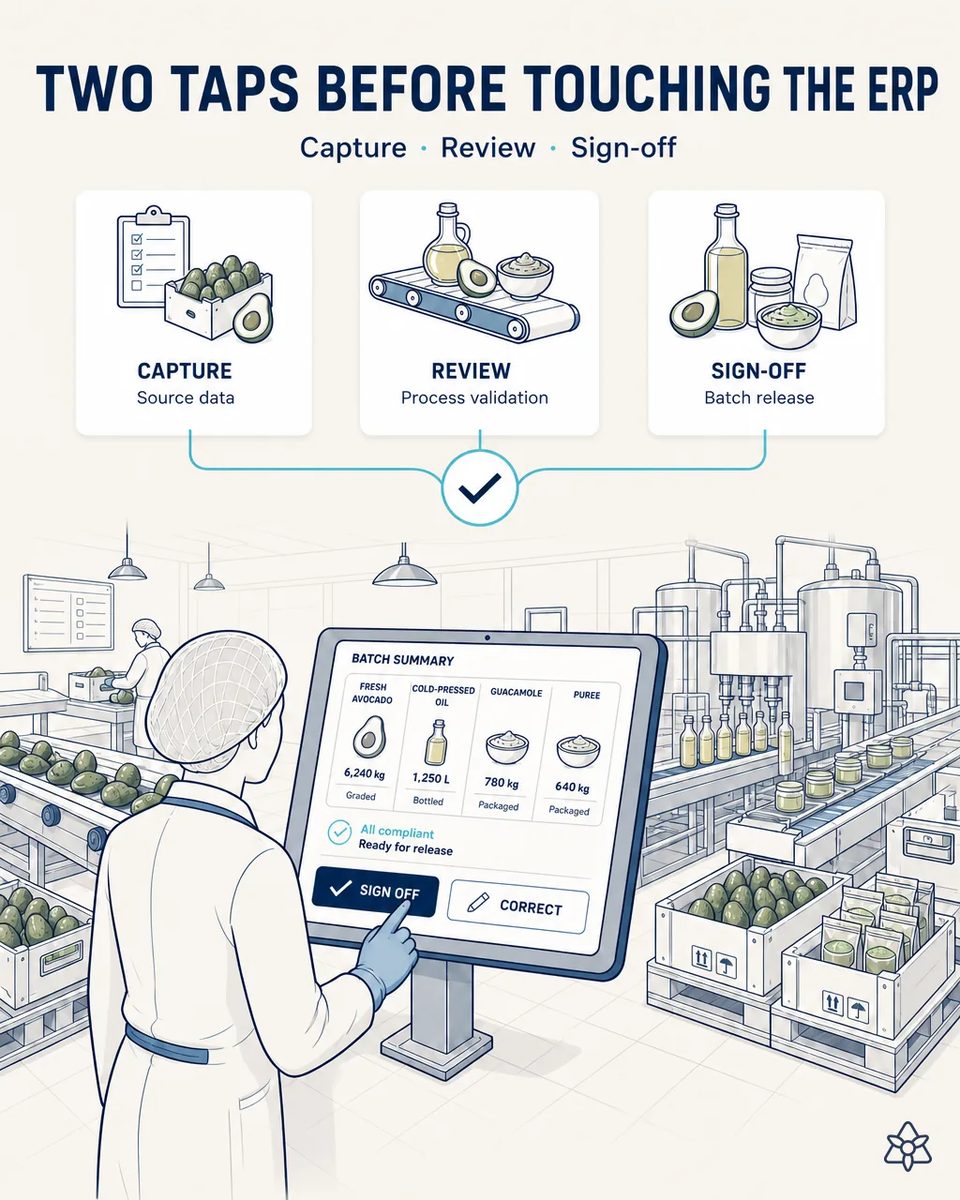
Nothing iLEAN captures enters the central system before a human has seen it. In an avocado plant that means a tablet at the line where the supervisor confirms with 2 taps.
The plant wants the data captured and is afraid of what it will write.
The main cultural brake on digitization is the fear that AI will enter data on its own and contaminate the master ERP. At the same time, operators don't want to type or waste time manually validating every capture either.
- The main cultural brake on digitizing an avocado plant is not the technology: it is the fear that AI enters data on its own and contaminates the master ERP.
- A wrong orchard on a lot, a wrong ripeness grade or a wrong destination does not stay in a report — it follows the fruit all the way to the export container, and correcting it there costs days.
- At the same time, nobody on the line wants to type or spend minutes validating every capture in the middle of the season.
- Between those two fears, the usual outcome is the worst one: the data is not captured at all, out of distrust, and the plant keeps running on paper and memory through its busiest months.
Connect with early human verification — a two-second summary, two taps.
Connect early human verification mode: every capture -scale photo, voice incident, parsed orchard alert- lands on an industrial tablet at the line as a 2-second visual summary. The line supervisor confirms with 2 taps (check to enter the ERP / edit to correct first).
This is the piece that makes the other eleven signable. Quality and IT do not approve AI writing into the ERP; they approve a supervisor confirming, in two seconds, what the AI has already assembled. That shift in who writes, and how, is what unlocks the budget for the rest.
Unchecked capture versus capture confirmed at the line
| Aspect | Today | With iLEAN |
|---|---|---|
| Who writes into the ERP | Nobody trusts the answer | The line supervisor, by confirming |
| Time per capture | Minutes of typing, or nothing at all | A 2-second summary, two taps |
| A wrong orchard or ripeness grade | Travels with the fruit | Corrected before it enters |
| Sources covered | Each one handled apart | Scale photos, voice notes and grower alerts |
| Master data | Contaminated or incomplete | Clean, with seconds of latency |
| What is stored | The final value only | The value, who confirmed it and what was edited |
Unvalidated data contaminating the ERP, or data not captured due to distrust → data captured and validated with seconds of latency, clean master data.
Impact estimate — to be validated with your numbers.
The block below is an estimate to be validated against your plant's actual data. We put it forward so the committee has an order of magnitude; we refine it during the assessment.
- No standalone payback: it is the enabling piece of the whole matrix, with strategic value that is not directly monetizable.
- Without early human verification, the rest of the pieces do not get signed off by quality or IT, so its value is counted in every other case of the matrix.
- Its measurable effect shows up in the other cases: data captured with seconds of latency instead of retyped hours later.
- And master data that stays clean because every entry has a named person who looked at it, which is what an export customer or an auditor ends up asking for.
The enabling piece for the whole iLEAN matrix: without early human verification, the rest of the pieces don't get signed off. *Strategic value, not directly monetizable.*
And the fair question from the production manager
“If a person confirms everything anyway, what does the AI actually save?” — the assembling, not the deciding. Reading a scale ticket or a dictated note is an anchored task where the best models drop below 1.5% error [1], so the summary usually arrives right and the supervisor only confirms. When it is wrong, the edit is stored with its author and becomes feedback for that exact point. Over a season, the share of summaries that need an edit keeps falling.
[1] OpenAI paper "Why Language Models Hallucinate", 2025 — on the reliability of AI in anchored tasks.
What people ask about the verification tablet
Where does the tablet go in an avocado plant?
Where the supervisor already is: at receiving, at the sizer and at the packing line. The point is that confirming never means walking to an office. Most plants need fewer tablets than they expect, because one supervisor covers several capture points.
Is it one more screen for the line staff?
No. Only the supervisor confirms; everyone else keeps doing their job, and the tablet shows a summary that takes two seconds to read. The operators' routine does not change at all.
Can anything bypass the tablet and go straight to the ERP?
No. That is the architecture, not a setting: nothing captured by iLEAN crosses into the ERP without a human confirmation. Quality and IT can check it on the first day, before any other case goes live.
Does it work with gloves and wet hands?
It uses an industrial tablet with large buttons designed for a wet processing area, and the whole interaction is two taps. It is placed out of the splash zone of the washers and the pulper.
What does the quality lead get out of it?
A record of every confirmation and correction, which is exactly what an auditor asks for when a lot is questioned: who validated this data, and when. With export lots, that answer is often what keeps a shipment moving.
More cases from this series
- Camera that reads the cold-press panelDigitize your cold-press avocado oil extraction curve without touching the machine's original panel.
- WhatsApp from the orchard that replans the lineTurn orchard delay or harvest-change alerts into automatic replanning for your avocado line.
- The shift supervisor dictates while walking the floorCapture the shift supervisor's operational knowledge by voice without stopping the plant floor walk.
- The lab spreadsheet flows into the ERP by itselfSave quality-module ERP licenses by connecting your avocado plant's lab spreadsheet.
- The optical sorter stitched to the ERPSync your avocado optical sorter's size and destination criteria with the ERP, no manual entry.
- Photo of the scale ticket at truck unloadingDigitize orchard-level avocado receiving with one photo: zero-second traceability, no change to the…
Tell us what stops your plant from letting new data sources feed the ERP today.
We work on your plant's real data, not ours. Assessment with no commitment.
Request estimated ROI within 48h ‹ See all cases of avocado processing See food industry