Two taps before it touches the ERP
Strategic value · the piece that unlocks the whole matrix
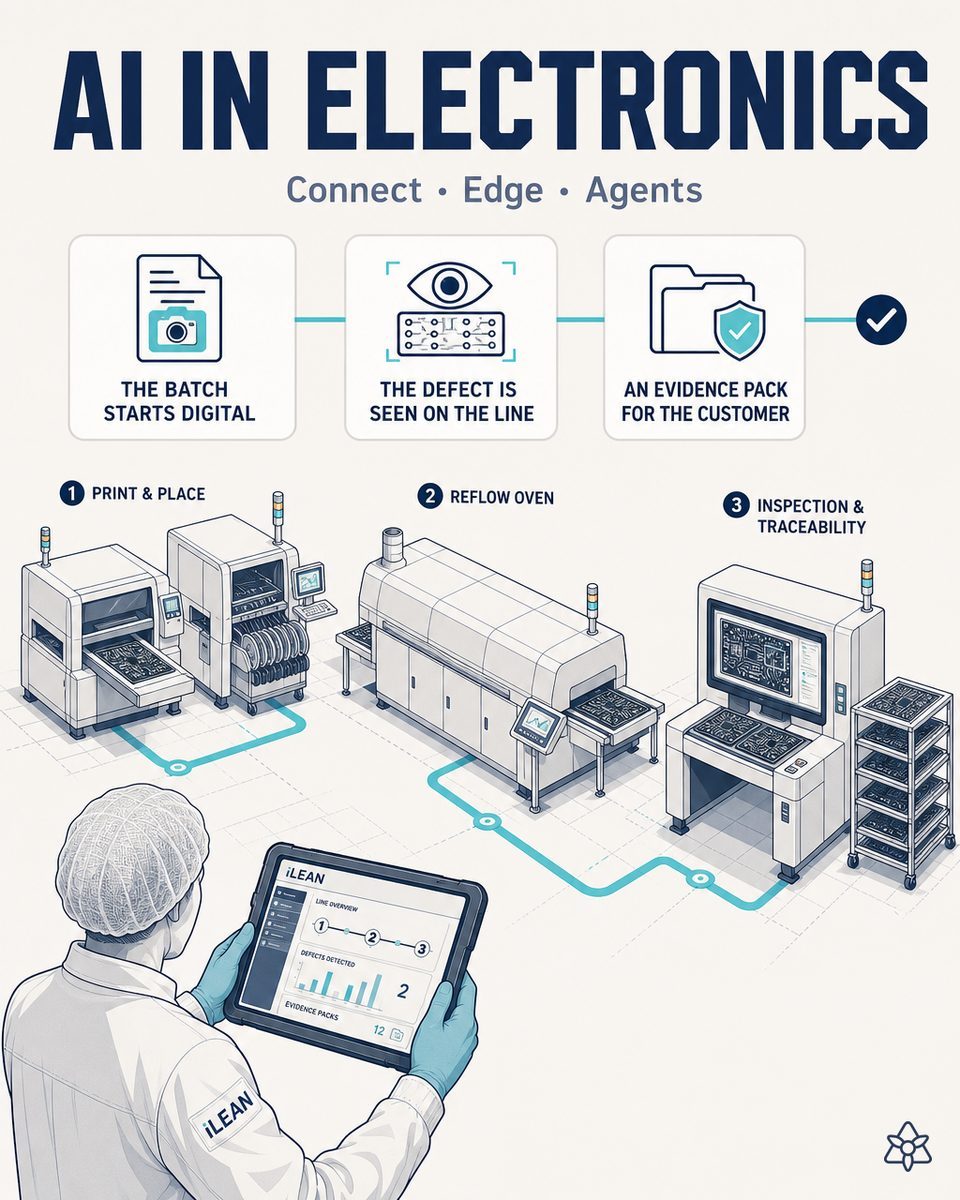
The real brake on digitization is not technical, it is trust.
In a multi-customer EMS plant, the main cultural brake on digitization is the fear that AI will enter data on its own and contaminate the ERP or MES master.
- In a multi-customer EMS plant the ERP and MES masters are the contract: part numbers, BOM revisions, work order status and consumption. Everything the plant bills rests on them.
- So the honest fear is the one that gets voiced in the first meeting: that AI writes on its own and contaminates the master, and that nobody notices until a customer audit does.
- The result is the opposite of the intended one. Either data is not captured at all, or it is captured and then left in a parallel system nobody trusts enough to push.
- And the second failure mode is just as expensive: data typed hours later by somebody who never saw the board, the reel or the traveler it describes, and who is reconstructing it from a photo on their phone or from what a colleague told them.
Connect with early human verification — two taps at the line.
Connect early human verification mode. Every capture (photo, voice, parsed email) reaches an industrial tablet as a 2-second visual summary. The supervisor confirms (✓) or corrects (✏️) before the data crosses into the ERP/MES master.
This is the piece the other eleven rest on. Every capture arrives as a two-second visual summary and a person confirms or corrects it before it crosses. Without this gate, nobody in an EMS plant signs off on the rest of the matrix — and they are right not to. With it, the conversation stops being about trusting a model and starts being about how much typing disappears.
Today's data entry versus verified entry
| Aspect | Today | With iLEAN |
|---|---|---|
| Who writes to the ERP master | A person, typing hours later | A person, confirming in seconds |
| Who the author is | Whoever types it | Whoever looked at the board or the reel |
| Capture latency | Hours, or never | Second-level |
| What a correction leaves behind | Nothing | A trail plus feedback for extraction |
| Data nobody captured out of distrust | A permanent gap | Captured, because it is validated first |
| AI writing unsupervised | The fear that blocks the project | Not possible by architecture |
Unvalidated data contaminating the ERP/MES, or data not captured due to distrust → data captured and validated with second-level latency, clean master.
Impact estimate — to be validated with your numbers.
The block below is an estimate to be validated against your plant's actual data. We put it forward so the committee has an order of magnitude; we refine it during the assessment.
- No standalone payback — the brief calls it strategic value, and that is exactly right: it is the enabling piece that unlocks the whole matrix, not a case you justify on its own savings.
- What it protects is the ERP and MES master, which is what the plant bills, audits and defends in front of every customer.
- It converts the cultural objection into an architecture decision: data crosses only after a human confirmation, and that cannot be configured away by anyone, at any level.
- And every correction is stored with its author, so extraction improves precisely where it fails instead of everywhere at once.
Strategic value · the piece that unlocks the whole matrix. Estimate to be validated.
And the fair question from the production manager
“If a person confirms in the end, what is the AI actually saving?” — the work is not in deciding, it is in assembling. Today somebody walks to a terminal, finds the work order and types. Here it arrives assembled and they confirm or correct. Assembling that summary is an anchored task where the best models drop below 1.5% error [1], so most confirmations are a single tap.
[1] OpenAI paper "Why Language Models Hallucinate", 2025 — on the reliability of AI in anchored tasks.
What people ask about early human verification
How long does it take the supervisor?
Seconds. The summary is designed to be read in about two, and it is resolved with a confirm or a correct from the tablet at their own station.
Can the AI write into the ERP on its own?
No, and it is not a setting. It is the architecture of the whole matrix: captures wait in the verification queue until a person resolves them.
What gets recorded when someone corrects it?
What summary was shown, who resolved it, when, and exactly what they changed. That trail is what an OEM quality audit asks for later, and it doubles as feedback so extraction improves precisely at the field that failed.
Does it slow the floor down at high volume?
Captures are batched by line and work order, so a shift's receiving or kitting confirmations are resolved in one pass rather than one interruption at a time. Anything urgent, such as a shortage affecting a work order starting now, jumps the queue.
Do we have to deploy this before the other cases?
In practice yes. It is what makes the rest approvable, because it is the answer to the question every plant manager asks first, and because it is what keeps the master clean while the other eleven start feeding it.
More cases from this series
- The AOI that never drifts from the work orderThe AOI machine gets stitched to the MES via API: the right inspection program activates automatically…
- Component shortage alert in zero secondsiLEAN silently reads a supplier's shortage alert and returns the concrete replanning action.
- Photo the kit traveler at batch startHow an EMS plant digitizes the kitting traveler with a photo: the work order exists in the system at…
- The line lead who dictates hands-freeThe line lead dictates incidents while walking the SMT floor; iLEAN structures them and replies in…
- The quality spreadsheet that flows to the ERP on its owniLEAN watches the quality lab folder and pushes data to the ERP after validation, saving licenses.
- Photo the packing slip, reels to the ERPOne photo of the packing slip and reel labels is enough to push component receiving into the ERP.
Tell us what would have to be true for you to let data reach your ERP master automatically.
We work on your plant's real data, not ours. Assessment with no commitment.
Request estimated ROI within 48h ‹ See all cases of electronics manufacturing services See electronics