Photo the packing slip, reels to the ERP
−50 to −70% receiving-module licenses · payback 3-8 months
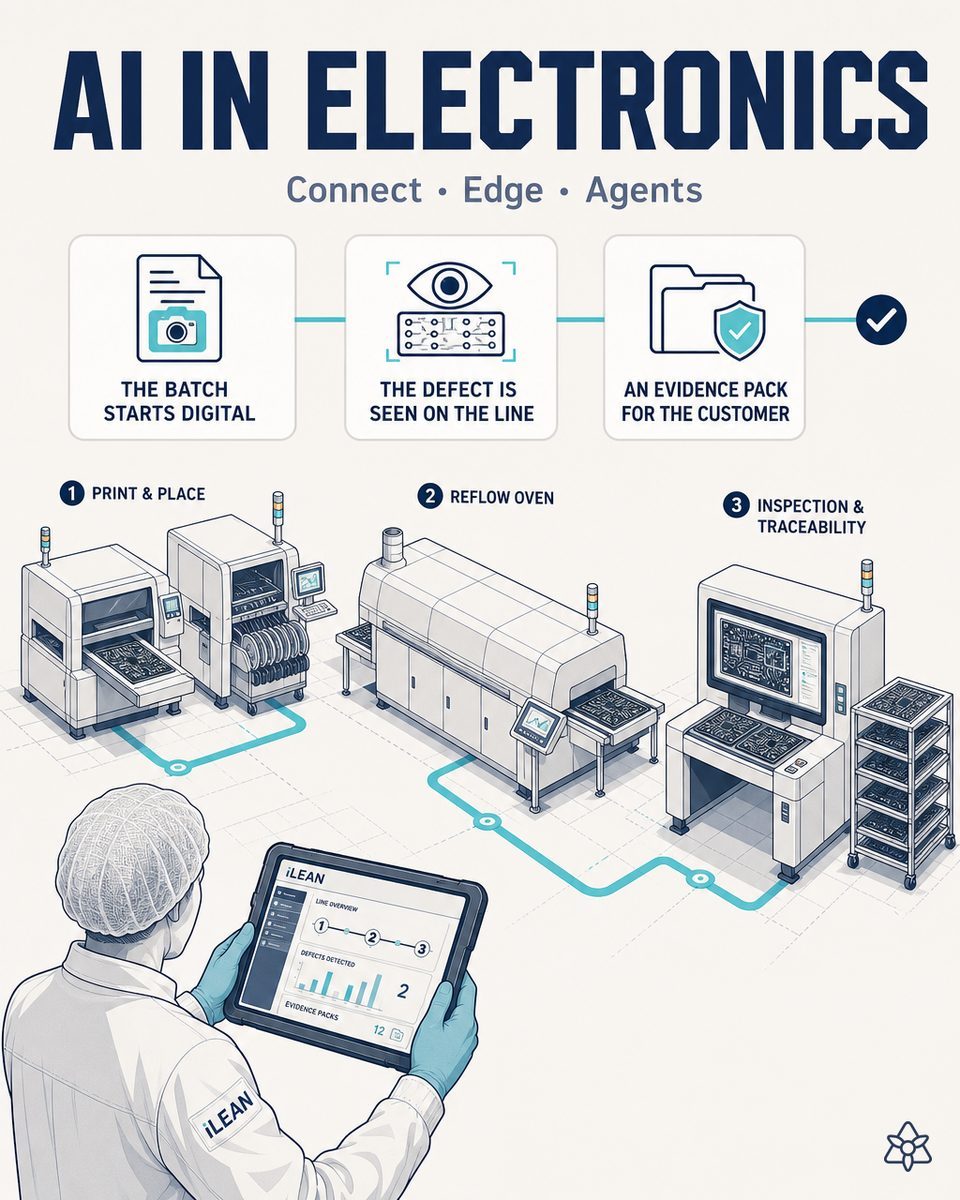
The foundation of all traceability depends on typing under pressure.
Instead of entering the ERP to type reel by reel -lot, quantity, date, moisture sensitivity- the supervisor spends much of the shift on the unload.
- A single delivery brings dozens of reels, trays and tubes: part number, lot, quantity, date code and moisture sensitivity level on each label, plus a packing slip whose format changes with every distributor.
- Instead of that taking minutes, the receiving supervisor spends much of the shift typing reel by reel into the ERP, with a dock that keeps filling behind them.
- Under that pressure, errors are not the exception. A wrong lot or a missed MSL rating is invisible at goods-in and expensive at reflow, where an improperly baked part delaminates and takes the board with it.
- And when an OEM customer asks months later which reel lot went onto which board, the answer depends on whatever was typed that afternoon. Traceability does not fail at the end of the process; it fails at goods-in, and everything downstream inherits that gap.
Connect in photo-of-the-analog mode — the packing slip and the labels, no distributor changes.
Connect photo-of-the-analog mode. Vision AI recognizes the supplier's packing-slip format and extracts tabular structure; for reel labels it reads barcodes/2D codes or plain text via OCR (lot, MSL, date). One-tap tablet validation, then automatic push to the ERP.
Barcode where there is a barcode, optical reading where there is not, and one tap to validate. The reel stops being a line somebody typed and becomes the first link of a genealogy that reaches the finished board — which is the link the flagship inventory case rests on.
Today's goods-in versus captured goods-in
| Aspect | Today | With iLEAN Connect |
|---|---|---|
| Booking in a delivery | Much of a shift, reel by reel | Minutes |
| Packing slip format | Different per distributor | Structure extracted with no template |
| Lot and date code per reel | Typed under pressure | Read from barcode or by OCR |
| MSL rating | Frequently missed | Captured and carried into the ERP |
| Reel → board traceability | Broken at the first gap | Complete from goods-in |
| Receiving-module licenses | Two or three | One, the supervisor who validates |
Extended blocking of the receiving supervisor typing reel by reel → minutes. Hidden lot/MSL errors → zero. Broken traceability → complete via photo and barcode.
Impact estimate — to be validated against your actual invoice.
The block below is an estimate to be validated against your plant's actual data. We put it forward so the committee has an order of magnitude; we refine it during the assessment.
- 💰 CFO angle: the receiving module typically needs two or three active seats; with Connect only the supervisor validates: −50 % to −70 %, recurring.
- Estimated payback 3-8 months, counting the license line and the receiving supervisor's shift back.
- From a blocked supervisor typing reel by reel to minutes per delivery, delivery after delivery, with the dock clearing at the pace the trucks arrive instead of the pace someone can type.
- Hidden lot and MSL errors down to zero, and traceability complete via photo and barcode instead of broken at the first gap — which is what makes the reel-to-board genealogy possible at all downstream.
−50 to −70% receiving-module licenses · payback 3-8 months. Estimate to be validated.
And the fair question from the production manager
“Does it recognize every distributor's packing slip?” — yes, and without asking any of them to change it: the table structure is extracted with no per-supplier template, and reel labels are read by standard symbology where it exists and by optical recognition where it does not. It is an anchored task where the best models drop below 1.5% error [1], and the supervisor validates before anything enters the ERP.
[1] OpenAI paper "Why Language Models Hallucinate", 2025 — on the reliability of AI in anchored tasks.
What people ask about digitizing reel receiving
Is the moisture sensitivity level captured too?
Yes, and it is the field that adds most risk protection. An MSL rating that never made it into the ERP is a part that gets reflowed without the bake it needed, and a delamination nobody can explain three weeks later.
Do we need barcode scanners?
Not necessarily. A photo from a phone or industrial tablet is enough, including for labels whose codes are damaged or partly covered. If the plant already has scanners that work well, they integrate the same way.
What if the packing slip and the reel labels disagree?
The discrepancy is highlighted in the summary before the supervisor validates. Today nobody performs that cross-check with a dock full of pallets waiting, which is exactly how a quantity error becomes an inventory deviation two months later.
Does it handle trays and tubes, not just reels?
Yes. What changes between them is the label layout, and the structure is interpreted per photo rather than looked up in a template, so a new package type needs no setup.
Can we start with receiving alone?
Yes, and it is a good first case: the result is visible from the very first delivery, it does not depend on any other piece being deployed beyond tablet validation, and it lays the first link of the traceability the rest of the matrix builds on.
More cases from this series
- The AOI that never drifts from the work orderThe AOI machine gets stitched to the MES via API: the right inspection program activates automatically…
- Component shortage alert in zero secondsiLEAN silently reads a supplier's shortage alert and returns the concrete replanning action.
- Photo the kit traveler at batch startHow an EMS plant digitizes the kitting traveler with a photo: the work order exists in the system at…
- The line lead who dictates hands-freeThe line lead dictates incidents while walking the SMT floor; iLEAN structures them and replies in…
- The quality spreadsheet that flows to the ERP on its owniLEAN watches the quality lab folder and pushes data to the ERP after validation, saving licenses.
- The reflow oven panel starts talkingAn external camera digitizes the thermal profile of an isolated reflow oven, without touching the…
Tell us how long it takes to book in a full component delivery today.
We work on your plant's real data, not ours. Assessment with no commitment.
Request estimated ROI within 48h ‹ See all cases of electronics manufacturing services See electronics