The AOI that never drifts from the work order
Payback 3-6 months · zero program misalignment
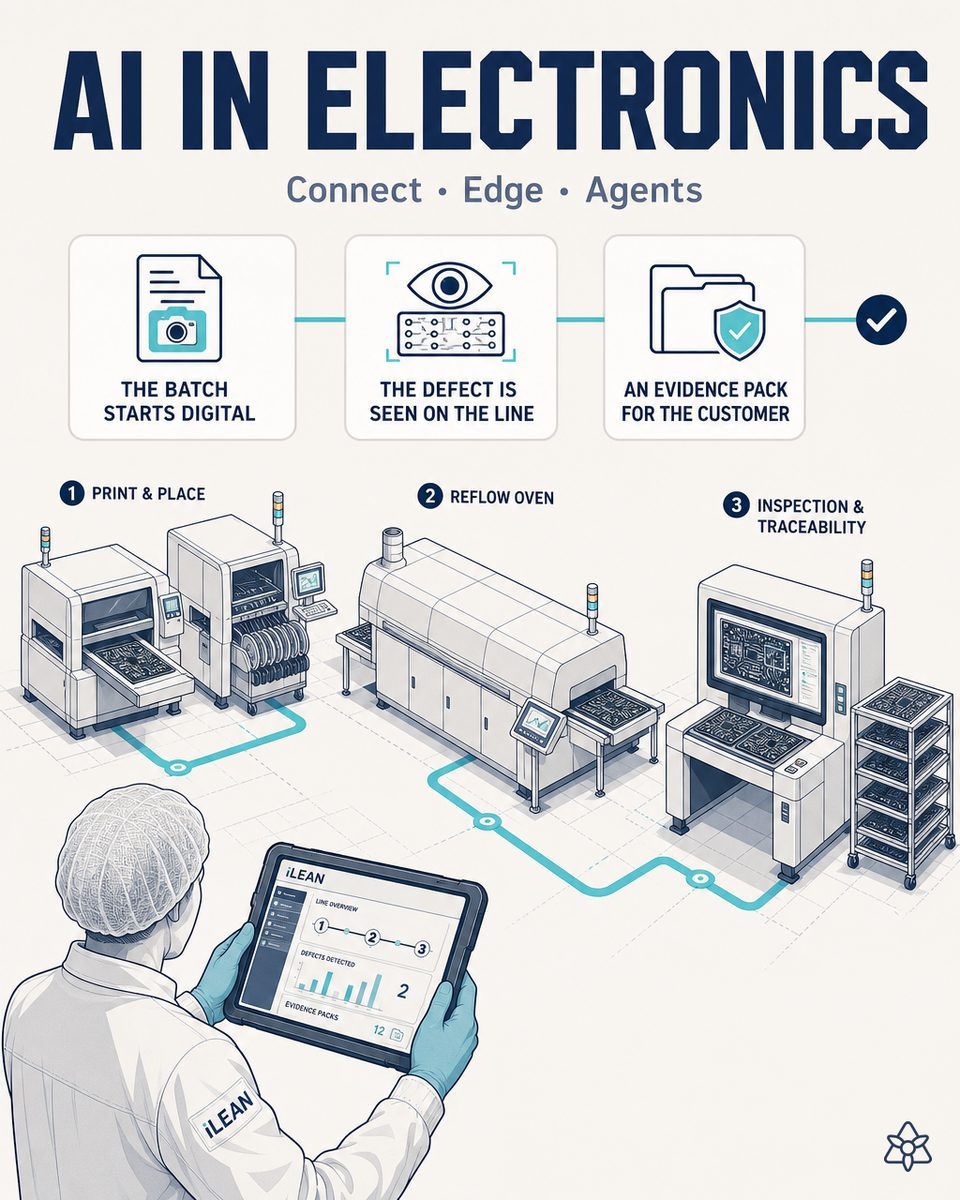
Two modern systems, side by side, with a human in between.
Yield and reject data are read on a local panel and someone transcribes them into the daily report. If the work order changes and no one updates the inspection program, the AOI compares against the wrong program.
- The AOI is capable and the MES is capable, and both have documented interfaces. They simply were never stitched together, because that project never reached the top of the list.
- So yield and reject figures are read off a local panel and somebody transcribes them into the daily report, hours after the boards went through and long after the moment when reacting would have been cheap.
- The expensive failure is the other direction: if the work order changes and nobody loads the matching inspection program, the AOI compares the new board against the previous program.
- In a plant that changes customer program several times a shift, that is not a rare event — it is a permanent exposure, and what escapes is a defect nobody inspected for. The boards pass, the yield looks healthy, and the problem surfaces at the customer's incoming inspection.
Connect stitches the two systems through their APIs — neither one is replaced.
Connect stitches two modern systems together via API. When the MES marks a work order start, it automatically publishes the correct inspection program to the AOI and receives yield and rejects back in real time, with no manual entry in between.
When the MES marks a work order start, the correct inspection program publishes to the AOI automatically and yield comes back in real time. The human step that could go wrong simply stops existing, which is a different thing from training people to be more careful about it.
The isolated AOI versus the stitched AOI
| Aspect | Today | With iLEAN Connect |
|---|---|---|
| Loading the inspection program | By hand, at changeover | Published automatically on work order start |
| Program misalignment | An occasional escape risk | Zero error of human origin |
| Yield and rejects | Read on a panel, typed later | Returned to the MES in real time |
| The daily report | Transcribed hours later | Built from live data |
| Several program changes per shift | More changes, more exposure | More changes, the same exposure: none |
| AOI or MES software | — | Neither is replaced |
Occasional inspection-program misalignments (defect-escape risk) → zero human-origin error in program switching.
Impact estimate — to be validated with your numbers.
The block below is an estimate to be validated against your plant's actual data. We put it forward so the committee has an order of magnitude; we refine it during the assessment.
- Estimated payback 3-6 months, counting only the transcription time and the changeover minutes recovered.
- Zero inspection-program misalignment: the defect escape that costs most is eliminated by construction, not by reminding people.
- Yield per work order and per customer program available live, instead of a figure typed into a report and then argued over in the next morning's meeting.
- And with high program mix, the number of changeovers stops raising the risk of inspecting against the wrong reference, so growth in customers stops meaning growth in exposure.
Payback 3-6 months · zero program misalignment. Estimate to be validated.
And the fair question from the production manager
“Wouldn't a proper integration project be cleaner?” — it would, on the day it reaches the top of the list, and that is precisely the problem: this is the classic modern island still isolated because there was never a window. This stitching replaces neither system, needs no line shutdown and does not compete in that queue. Mapping work order to inspection program is an anchored task where the best models drop below 1.5% error [1].
[1] OpenAI paper "Why Language Models Hallucinate", 2025 — on the reliability of AI in anchored tasks.
What people ask about stitching the AOI to the MES
Do we have to replace the AOI or the MES?
Neither. Connect leans on the documented interfaces both already expose: what the MES publishes on work order start and what the AOI accepts and returns. Nothing is reinstalled and no license is repurchased.
What if the AOI refuses the program?
It is detected, because what comes back is confirmation of the program actually loaded, not of the one requested. Today that failure raises no signal at all and the line runs on for a shift.
Does it cover engineering changes to the inspection program?
Yes, and that is where the exposure is highest: the revision travels with the work order, so running a new BOM revision against the previous inspection program stops being possible rather than becoming less likely.
Do rejects come back classified?
They come back as the AOI classifies them, tied to the work order and the customer program, which is what makes a defect Pareto per program possible without anyone typing. False rejects are visible as such, which is what tells you whether a threshold needs tuning.
Does the same pattern work for ICT or functional test?
Yes. Any modern station with an interface that is fed by hand today fits the same way, and each one added makes the work order's picture more complete. You start with AOI because that is where program misalignment costs most.
More cases from this series
- Component shortage alert in zero secondsiLEAN silently reads a supplier's shortage alert and returns the concrete replanning action.
- Photo the kit traveler at batch startHow an EMS plant digitizes the kitting traveler with a photo: the work order exists in the system at…
- The line lead who dictates hands-freeThe line lead dictates incidents while walking the SMT floor; iLEAN structures them and replies in…
- The quality spreadsheet that flows to the ERP on its owniLEAN watches the quality lab folder and pushes data to the ERP after validation, saving licenses.
- Photo the packing slip, reels to the ERPOne photo of the packing slip and reel labels is enough to push component receiving into the ERP.
- The reflow oven panel starts talkingAn external camera digitizes the thermal profile of an isolated reflow oven, without touching the…
Tell us how many customer program changes your SMT lines run per shift.
We work on your plant's real data, not ours. Assessment with no commitment.
Request estimated ROI within 48h ‹ See all cases of electronics manufacturing services See electronics