Zero field failures, even while multiplying volume
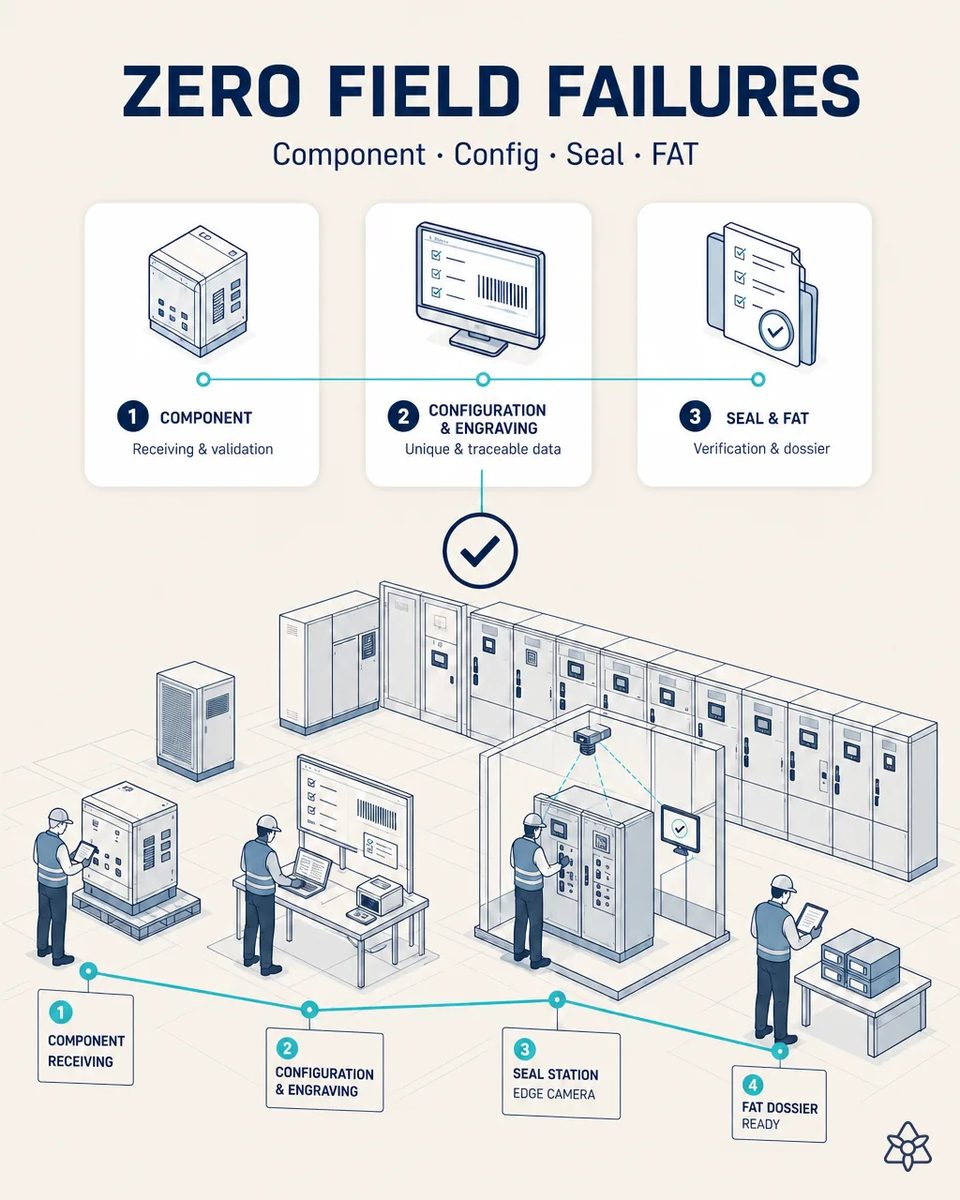
The capital pain of a switchgear and UPS factory mid-expansion is the same everywhere: zero field failures of equipment already installed in a data center. The iLEAN flagship system coordinates 4 cross-checking verification rings, from the component to the final dossier.
A field failure in a data center is never a simple return.
A field failure isn't a consumer-product return — it's the risk of an outage for the end customer, a contractual penalty and, worst case, losing the hyperscale account. That risk grows exactly when the plant is multiplying volume with newly onboarded staff.
- When a switchgear lineup or a UPS fails after installation, it is not a consumer return: it is the risk of an outage for the end customer, a contractual penalty and, in the worst case, losing the hyperscale account.
- Behind it there is rarely a single cause. It is a breaker from a held lot, a busbar setup signed without evidence, a loose joint behind a closed door and a FAT record with a gap — four small deviations, in four different departments.
- Each link on its own passes its own control. Together they produce the unit that fails at the customer's site, months after it left the dock.
- And that risk grows exactly when the plant multiplies volume with newly onboarded staff, whose manual discipline is still being built. More units, more new hands, the same controls: the arithmetic works against you.
Four rings that cross-check — everything above, orchestrated by agents.
Ring 1 (component received with certificate) + Ring 2 (unit configured and engraved per the order, vision-validated) + Ring 3 (defect caught before the cabinet closes) + Ring 4 (FAT dossier that cross-checks the previous three). JIDOKA AI blocks on any mismatch; SMED AI speeds up changeovers so coordination doesn't slow the expansion ramp.
No single ring solves it: each control exists today in some form and units still fail. The strength is in the cross-check, because a concatenation of small deviations shows up as four independent sources that stop agreeing. JIDOKA AI blocks on that mismatch; SMED AI keeps changeovers fast so the coordination does not slow the ramp.
The four verification rings, and what each one stops
| Ring | Cases it draws on | What it stops |
|---|---|---|
| 1 · Component | Breaker receiving (7) + supplier alert (3) | A unit built with an uncertified or held breaker lot |
| 2 · Configuration and nameplate | Busbar validation (10) + nameplate laser (8) | A wrong rating set up or engraved on the unit |
| 3 · Seal | Pre-closing vision (9) + traveler (1) | A wiring or bus joint defect closed inside the cabinet |
| 4 · FAT | FAT dossier (11) + lab spreadsheet (6) | A unit shipped with a gap in its evidence |
| Cross-check of the four rings | All four rings, per serial | Sources that disagree block the release |
| Human signature on every capture | Two-tap verification (5) | Data entering the ERP without a person |
Risk dependent on the manual discipline of a fast-growing workforce → mismatch caught inside the plant, never at the customer.
Zero field failures: estimated impact, to validate with quality and category management.
The block below is an estimate to be validated against your plant's actual data. We put it forward so the committee has an order of magnitude; we refine it during the assessment.
- Estimated payback 6-12 months against the first avoided field incident.
- Protection of a multi-year contractual relationship with the hyperscale customer, worth far more than any single incident or penalty.
- Risk moves from depending on the manual discipline of a fast-growing workforce to mismatches caught inside the plant, never at the customer.
- And when a customer asks about one serial, the four rings answer with evidence from receiving to FAT instead of with a search through binders.
Estimated payback 6-12 months against the first avoided field incident; protects a multi-year contractual relationship with the hyperscale customer, worth far more than any single incident. *Estimate to validate with quality and category management.*
And the fair question from the production manager
“Do we have to deploy all twelve cases before any of this works?” — no, and framing it that way would be the surest way never to start. The rings are built in layers and each case pays on its own. Every cross-check rests on readings that are anchored tasks, where the best models drop below 1.5% error [1], and a mismatch between sources stops the unit for a person to decide, not on model doubt.
[1] OpenAI paper "Why Language Models Hallucinate", 2025 — on the reliability of AI in anchored tasks.
What people ask about the four-ring system against field failures
Which ring do switchgear plants usually build first?
Usually ring 1, starting with breaker receiving and the traveler, because every later cross-check needs to know which component sits in which unit. Each of those cases pays on its own while the next ring is being built.
What does crossing the rings catch that the individual controls miss?
The concatenation: a held breaker lot, a borderline bus joint and a FAT gap each pass alone, but together they disagree, and that disagreement stops the unit before it ships.
What if a ring reports a mismatch that is not real?
JIDOKA AI stops on a verifiable discrepancy between sources, not on model uncertainty. When the doubt is the model's, the case goes to the quality lead, and their decision is recorded with the unit so the next audit can see why it was released.
Does this slow the ramp while volume is growing?
It is designed not to: SMED AI shortens rating changeovers so the extra checks do not cost line capacity during the expansion. The goal is more units, each one verified, not fewer units checked more carefully.
Can the return be estimated per ring before committing?
Yes, with your field incident history, FAT findings and changeover count, the return of each layer is estimated before choosing the order. That estimate is what quality and category management validate before any commitment.
More cases from this series
- The assembly traveler no longer gets lost in paperHow a switchgear factory digitizes its paper assembly traveler with a photo, no habit change.…
- The truck no longer waits while someone typesOne photo of the delivery note and the critical-component certificate is enough to clear the truck and…
- The supplier alert no longer waits hours in an inboxILEAN reads a critical-component supplier's email at zero latency and replans the line before material…
- Nothing enters the central system without a human validating itNothing enters the ERP without a technician validating it with two taps. That's how iLEAN avoids…
- The supervisor's knowledge no longer dies at end of shiftWith an earpiece and Connect, the line supervisor logs incidents while walking between stations — no…
- The lab spreadsheet no longer lives cut off from the ERPILEAN absorbs the lab's test-result spreadsheet in real time and pushes it into the ERP. Up to 80% fewer…
Book the session to design the four verification rings for your switchgear and UPS lines.
We work on your plant's real data, not ours. Assessment with no commitment.
Request estimated ROI within 48h ‹ See all cases of critical datacenter infrastructure See electronics