The defect gets caught before the cabinet closes, not in the field
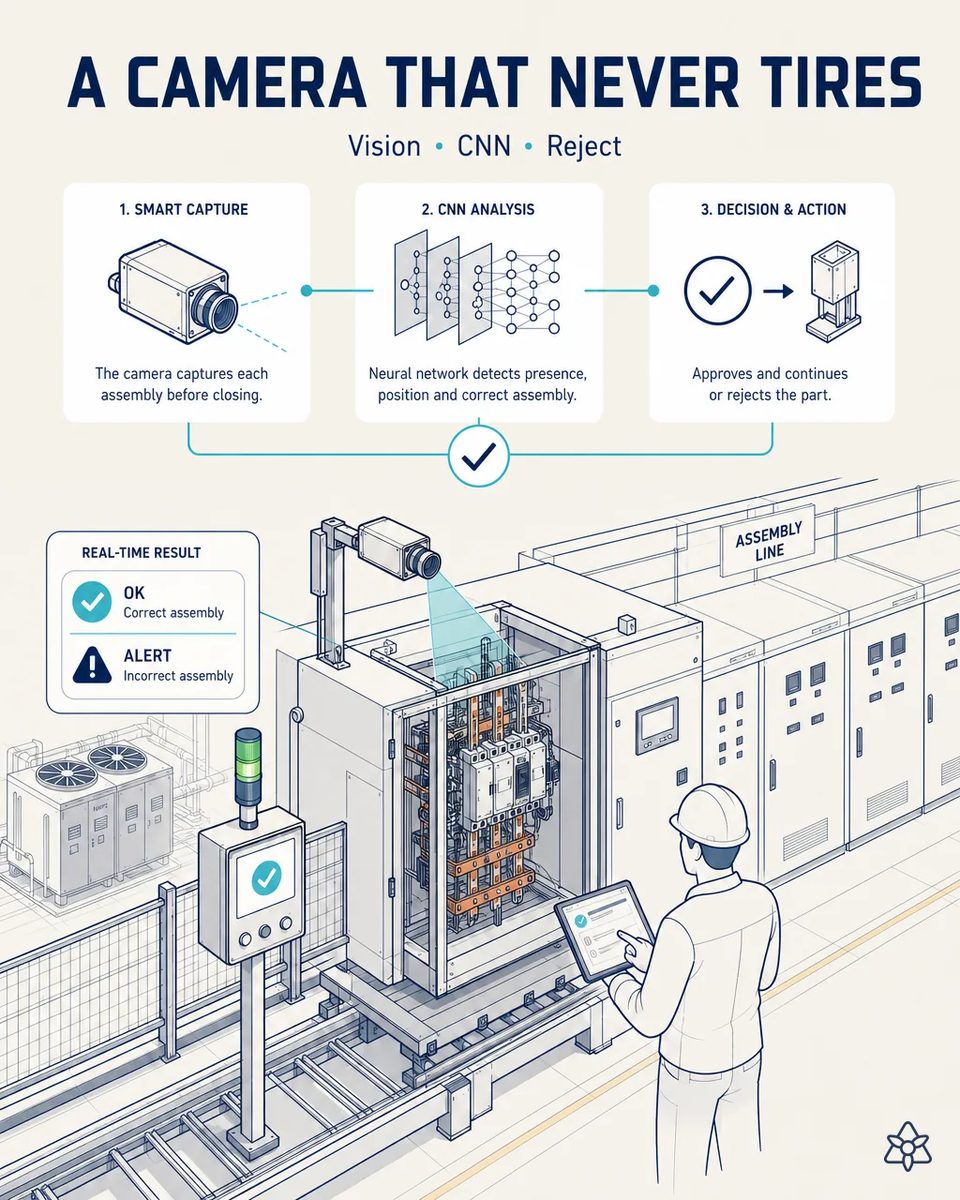
At the pace of a line ramping up new hires, the human eye tires and lets a crossed wire or a loose busbar connection slip through. iLEAN Edge places a camera over the closing station and infers in milliseconds, stopping the unit before the cabinet closes.
Once the cabinet is closed, a wiring defect becomes a data-center problem.
100% human visual inspection is inconsistent, even more so with new hires joining at a fast pace. If the defect makes it inside a closed cabinet, it can turn into a field failure inside a data center — extremely costly to diagnose and repair on site.
- Before the doors and covers go on, someone looks inside the cabinet: wiring routes, bus joints, barrier placement, breaker seating, torque marks on the bolts. 100% human inspection, at line pace.
- The eye tires, and with new hires joining every week it is even less consistent. A crossed control wire or a loose busbar connection gets through late in the shift, on exactly the unit nobody remembers inspecting.
- If it reaches the FAT, it costs rework on a closed, finished unit and a finding in front of the customer. If it gets past the FAT, it becomes a field failure inside a data center.
- Diagnosing and repairing on site, under the customer's outage and access rules, costs many times what catching it at the closing station would have. And it is the kind of incident a hyperscale customer remembers when awarding the next project.
Edge — a camera over the closing station and a model trained on your own cabinets.
Edge — local CNN vision, no image sent to the cloud (latency, cost, customer design confidentiality). Model trained on correct and incorrect examples of the line's specific product.
Inference runs on the line, in milliseconds, and no image of the customer's design leaves the plant. The camera does not replace the technician's eye; it makes sure the eye is not the only barrier at the last moment the interior can be seen. After the door closes, nobody looks again until the customer does.
The closing inspection today versus Edge vision at the closing point
| Aspect | Human inspection | With iLEAN Edge |
|---|---|---|
| Cabinet interiors inspected | Sampled in practice, by fatigue | Every unit at the closing point |
| Crossed control wire | Missed late in the shift | Detected before the doors go on |
| Loose or missing bus joint hardware | Depends on who looks | Classified unit by unit |
| Where a cabinet wiring defect is found | At FAT, or in the field | At the closing station |
| Images of the customer's design | — | Processed locally, never sent out |
| Unclear cases | Passed or argued over | Escalated to the quality lead |
Inconsistent visual sampling → 100% unit inspection at the closing point.
Pre-closing vision: estimated impact, to validate with your rework rate.
The block below is an estimate to be validated against your plant's actual data. We put it forward so the committee has an order of magnitude; we refine it during the assessment.
- Estimated payback 5-12 months, depending on the current rework rate at FAT and after closing.
- Fewer FAT findings and less late-stage rework on closed, finished units, where every hour of rework is the most expensive of the build because covers, barriers and doors have to come off again.
- Inspection goes from inconsistent visual sampling to every unit at the closing point, with an image of each interior kept for the FAT dossier.
- And the defect that would have turned into an on-site repair in a data center stays inside the plant, where fixing it takes a screwdriver and ten minutes instead of a service trip.
Estimated payback 5-12 months depending on current rework rate, reducing FAT findings and late-stage rework. *Estimate to validate.*
And the fair question from the production manager
“What if it stops good cabinets and slows the line?” — false positives are the real risk of any vision system, so the model is trained on correct and incorrect examples of your own product, under that station's lighting. Checking presence and position of known parts is an anchored task, where the best models drop below 1.5% error [1], and unclear cases go to a person instead of stopping the line silently.
[1] OpenAI paper "Why Language Models Hallucinate", 2025 — on the reliability of AI in anchored tasks.
What people ask about inspecting the cabinet before it closes
Does the camera keep up with the closing station takt?
Yes. Inference is local and takes milliseconds per image, without depending on the plant network or the cloud. The technician gets the OK or the alert before reaching for the cabinet door.
How many defect examples are needed to train it?
Fewer than expected, as long as they are real ones from your cabinets. Bring photos of past crossed wires and loose joints and we start there; every escalated case adds to the set. Correct examples are easy: every good cabinet that passes the station is one.
Do images of our customers' designs leave the plant?
No. Everything is processed on the Edge device at the station, which also keeps customer design confidentiality intact. That is often a contractual requirement in this sector, and it removes the latency and cost of sending images out.
Does it handle different switchgear and UPS cabinet types on one line?
Yes. The model switches with the active order, so each cabinet is inspected against its own correct reference rather than a generic one. Low-volume variants are covered by escalating to a person until enough examples exist.
Does it replace the FAT electrical tests?
No. The FAT stays the reference; what changes is that it stops finding wiring defects that could have been seen through an open door. The FAT bay spends its time testing, not reworking.
More cases from this series
- The assembly traveler no longer gets lost in paperHow a switchgear factory digitizes its paper assembly traveler with a photo, no habit change.…
- The truck no longer waits while someone typesOne photo of the delivery note and the critical-component certificate is enough to clear the truck and…
- The supplier alert no longer waits hours in an inboxILEAN reads a critical-component supplier's email at zero latency and replans the line before material…
- Nothing enters the central system without a human validating itNothing enters the ERP without a technician validating it with two taps. That's how iLEAN avoids…
- The supervisor's knowledge no longer dies at end of shiftWith an earpiece and Connect, the line supervisor logs incidents while walking between stations — no…
- The lab spreadsheet no longer lives cut off from the ERPILEAN absorbs the lab's test-result spreadsheet in real time and pushes it into the ERP. Up to 80% fewer…
Bring real defect photos from your cabinets so we can train the model on them.
We work on your plant's real data, not ours. Assessment with no commitment.
Request estimated ROI within 48h ‹ See all cases of critical datacenter infrastructure See electronics