Paraben-free challenge testing with AI — when the natural preservative leaves less margin, the LIMS cannot be a spreadsheet.
Paraben-free cosmetics demand more ISO 11930 challenge test iterations than a traditional formula — and every iteration leaves loose data scattered between the microbiologist's notebook, the LIMS and the formulator's recipe. iLEAN Connect brings them together and prepares the dossier. The person signs; iLEAN simply stops asking them to reconstruct paperwork.
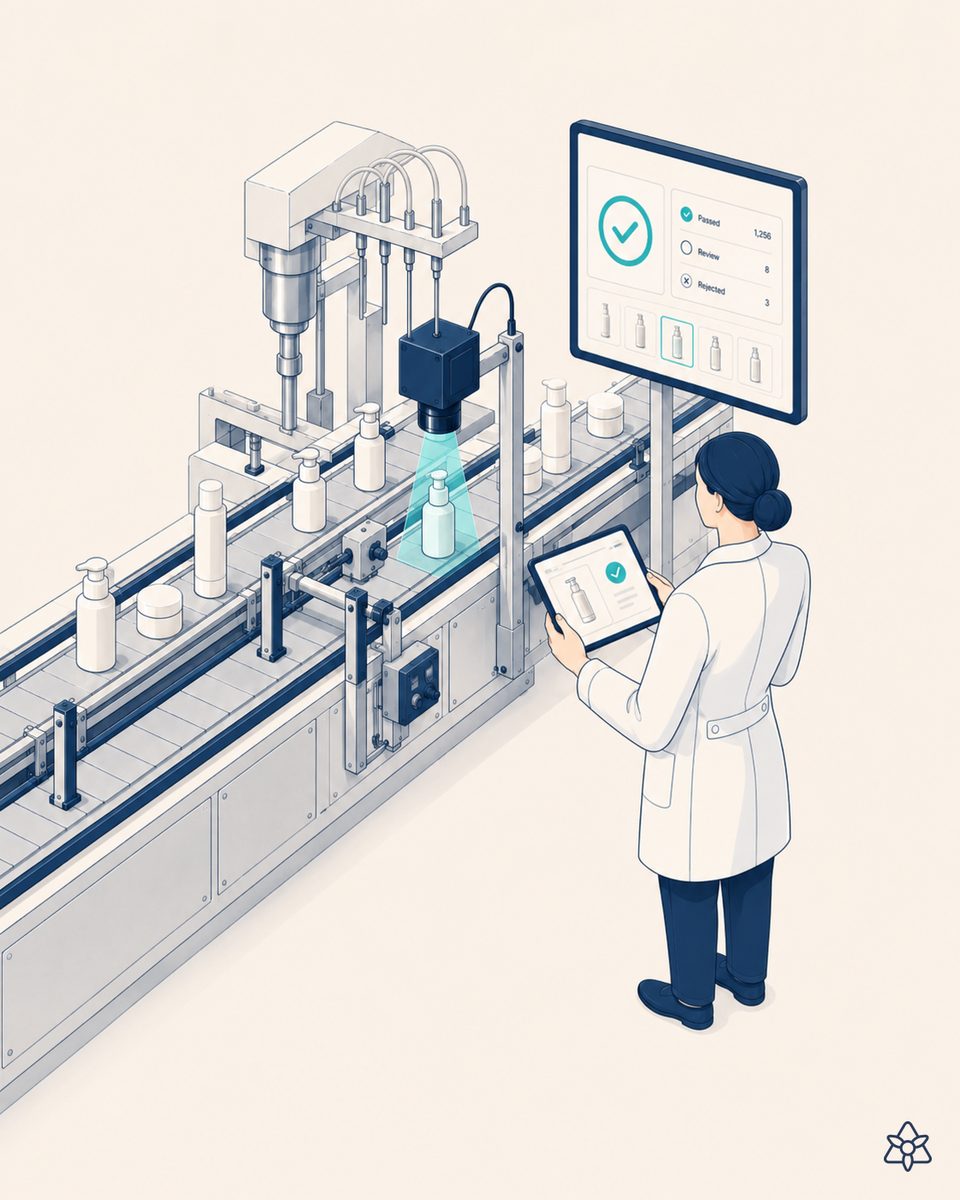
Without parabens the efficacy margin narrows — and the data that proves it usually sleeps in a spreadsheet.
The classic paraben + phenoxyethanol system had been delivering a wide window for decades: it tolerated a careless pH, an imperfect emulsion, a packaging change from marketing. A natural/paraben-free range is not that forgiving. ISO 11930 is still the same — bacteria and fungi counts at day 7, 14 and 28, criteria A and B — but the real window of the formulation narrows and the number of iterations multiplies.
And this is where the operational problem shows up, which is not regulatory but a matter of capture:
- The count — the microbiologist writes it down in their notebook or on a sheet in the isolated LIMS.
- The formula in force at that time — R&D has its version, which does not always match the one that produced the batch.
- The specific packaging of the pilot — because the same natural preservative behaves differently in an airless bottle and in an open jar, and that data point usually lives only in an email from the packaging manager.
When the EU Regulation 1223/2009 auditor arrives or the customer asks for the safety dossier, somebody has to reconstruct those three data points by hand. They almost always get it right — and that "almost" is where a perfectly good formulation falls apart.
iLEAN does not replace the LIMS — it seals the cracks between the notebook, the LIMS and the recipe.
The problem with paraben-free challenge testing is not a lack of information: it is information that lives on islands and that, at the critical moment (the audit, the urgent reformulation because a supplier changed an extract), does not reach the decision-maker in time. iLEAN acts as the putty that fills those gaps, without asking you to change any of your current systems.
Connect captures the count wherever it lives. The Agents cross-reference it with the recipe in force and the ISO 11930 standard. The batch dossier comes out in one click — and the person signs.
The iLEAN pieces applied to the challenge test LIMS:
- Connect — captures the day 7, 14 and 28 count whether it comes from the modern LIMS, from the isolated legacy LIMS or from the microbiologist's physical notebook (photo reading, voice dictation, direct integration depending on the case). And it also captures what comes from outside (the supplier's email with a new extract specification, the importer's WhatsApp with the US retailer's rule) at second zero, without asking anyone to forward anything.
- Agents — cross-reference the count, the formula in force when the test was run, the pilot packaging, the batch in production and ISO 11930. If a formulation changes (a change of extract supplier, a change of packaging) and the data suggests the efficacy margin is approaching the limit, the agent flags it before it goes to the shop floor. The person validates — the agent never decides alone.
- Three safety rings — the critical batch data (the formula that went into production) lives in ring 1, isolated. What comes from outside (a count from an external LIMS, the supplier's email) is validated in ring 2 before it touches ring 1. For CAIO/IT: it fits the AI Act and regulatory traceability without giving up the power of AI on the outside.
Manual LIMS vs. LIMS cross-referenced with iLEAN
| Aspect | LIMS + notebook + spreadsheet | With iLEAN Connect + Agents |
|---|---|---|
| Capturing the count | Physical notebook → manual transcription into the LIMS | Capture by photo, dictation or direct integration |
| Cross-reference with the formula in force | Emails between R&D and microbiology | Unified at second zero, with version control |
| Change of packaging / extract supplier | R&D is told if someone remembers | The agent cross-references the new data with historical efficacy and flags the margin |
| Iterations for a paraben-free formula | Multiplies the paperwork | Multiplies the clean data, not the microbiologist's workload |
| Dossier for the ISO 11930 / 1223/2009 auditor | Reconstructed by hand, weeks | Per-batch dossier, automatic, with notebook + LIMS + packaging |
| The veteran microbiologist's knowledge | Walks out with them the day they retire | Pattern captured as a permanent capability |
Impact estimate for your plant — to be validated with your numbers.
The block below is an estimate to be validated with the specific data of your plant. We put it forward so the committee has an order of magnitude; we refine it during the diagnostic.
- Cosmetics plant with a growing natural/paraben-free range, legacy LIMS or modern LIMS with partial capture, physical notebook still in use by the veteran microbiologist.
- Connect pilot on the LIMS + notebook + integration with the recipe in force in the PLM/ERP. First value expected within a few weeks: the first ISO 11930 dossier that comes out in one click instead of taking a whole morning.
- Indicative payback between 4 and 9 months, depending on the number of challenge tests per year, the cost of late reformulations and the hidden cost of audit hours prepared by hand.
- Hard lever: a single formulation rejected in an audit avoided, or a single production run not put on hold because the data was there in time.
- Expected reduction in dossier preparation time for the auditor of ≥ 30% as soon as the agent picks up the first complete challenge test cycle.
And the microbiology director's reasonable doubt
“What if the AI makes up a count or misreads the notebook?” — hallucination is a problem of free generation, not of anchored tasks. In tasks where the AI merely recontextualizes a data point from one system into another (reading a figure from the notebook or the LIMS and moving it into the dossier), the best models brought error below 1.5% [1]. And even so, what is critical is never decided alone: the microbiologist validates and the quality manager signs. The three safety rings exist precisely for this.
[1] OpenAI paper “Why Language Models Hallucinate”, 2025 — on the reliability of AI in anchored tasks.
What people ask about paraben-free challenge testing in cosmetics
Why does a paraben-free cosmetic demand more challenge testing than a traditional one?
Because natural preservatives (organic acids, alcohols, extracts) have a narrower efficacy window than a paraben/phenoxyethanol system: they depend on pH, on the oil phase, on the packaging and on the base. ISO 11930 is still the same — counts at day 7, 14 and 28 — but the margin for error in formulation is smaller, and that is why the number of iterations (and of LIMS data points) multiplies. Poor capture of that data means a formulation goes into production without the evidence behind it that the auditor expects.
What happens when the challenge test result lives in the microbiologist's spreadsheet?
What always happens with information that lives on an island: when it is needed — an auditor, a complaint, a packaging change from marketing — it is not where it has to be. The microbiologist has their spreadsheet with the counts, the formulation manager has their version of the recipe, quality has the PDF of the signed report, and nobody cross-references the three. iLEAN Connect captures all three — whether they come from the modern LIMS, from the microbiologist's sheet or from the auditor's email — and unifies them without asking you to change any of the three.
Do I have to change my LIMS or my microbiology software to use iLEAN?
No. That is the rule: iLEAN does not force you to throw anything away. Connect has three levels of capture — manual (a photo of the lab notebook), intermediate (reading an isolated legacy LIMS), integrated (if your LIMS has a modern API). The microbiology manager keeps working the way they work; what changes is that the data stops staying on its island and starts being cross-referenced with the formulation, the packaging and the batch on the shop floor.
How does it fit with ISO 11930 and EU Regulation 1223/2009?
ISO 11930 defines the challenge test method; EU Regulation 1223/2009 requires a Product Information File with the safety assessment — and preservative efficacy is one of the pillars of that assessment. iLEAN does not reinvent the standard: it chains the traceability together so that the day the auditor asks for a batch dossier, it comes out in one click with the day 7, 14 and 28 counts, the recipe in force at that time, the packaging used and the signature of whoever validated it. The microbiologist is still the one who signs; iLEAN simply stops asking them to reconstruct paperwork.
How much does it cost to digitize the challenge test LIMS in a cosmetics plant?
The order of magnitude is that of a Connect pilot in a cosmetics plant: an initial investment to integrate the LIMS, capture the microbiologist's notebook and unify the recipe with the batch, plus an annual license. A reasonable payback to present to the committee is in the order of several months — the hard lever is the cost of a single formulation rejected in an audit or a single late reformulation. We ask for your plant's data and send you the estimated ROI in 48h, with your numbers, not ours.
More cases in cosmetics
- Industrial AI for hair color manufacturingTwelve real industrial AI cases in hair-color plants: paperless capture, in-line vision, auditable…
- Labeling the 26 fragrance allergens with AI — Annex III of EU Regulation 1223/2009, cross-checked against label and BOM.How iLEAN Tracer cross-checks BOM, formula and label to verify the 26 fragrance allergens of Annex III…
- Lump detection in the cream emulsion with AI — see the defect before filling, not after packing 60,000 jars.How iLEAN Edge spots lumps and phase separation in anti-aging cream emulsion before filling, holds the…
- OCR of batch and expiry on cosmetic aluminum tubes — curvature and glare cannot cost you a customer rejection.How iLEAN Vision reads inkjet batch and expiry codes on cosmetic aluminum tubes — curved surface,…
- Perfume cap crimping and torque with AI — the fragrance that evaporates escapes through a tenth of a newton.How iLEAN Vision cross-checks crimp vision and perfume cap torque to prevent fragrance evaporation and…
- Industrial AI in personal care contract manufacturingReal AI cases in plants making personal care for third-party brands: capture what is lost today, line…
Tell us your case and in 48h we'll send you the estimated ROI of this AI project for your cosmetics plant.
We work on your plant's real data, not ours. Diagnostic with no commitment.
Request estimated ROI in 48h See cosmetics