Perfume cap crimping and torque with AI — the fragrance that evaporates escapes through a tenth of a newton.
Premium perfume sells on its olfactory note; a cap torque a few tenths below specification lets it escape within weeks, and the customer smells the difference months later. iLEAN Vision cross-checks collar crimp vision and cap torque in milliseconds, and pulls the doubtful unit before palletizing. The person signs every rejection.
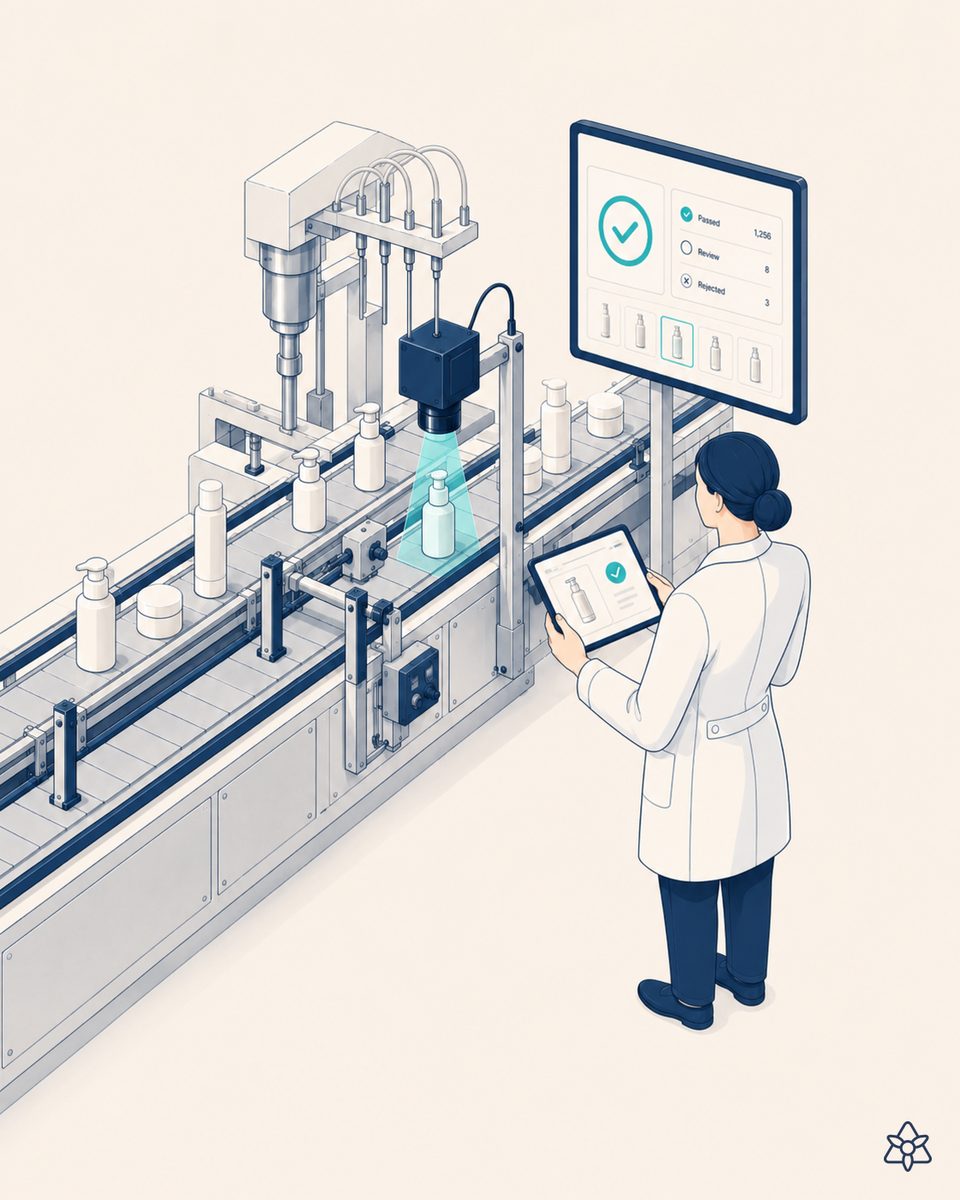
The fragrance does not vanish all at once — it escapes by tenths of a newton, slowly.
A premium perfume is a delicate product in a decorative box. What the customer pays for is not the liquid: it is the balance of top, heart and base notes in the formula. And that balance depends on an airtight closure. A slightly loose collar crimp, a cap torque a few tenths below specification, an asymmetric decorative seating — the unit looks perfect at the end of the line and starts losing its most expensive volatile compounds within a few weeks.
The operational problem, which lives on three familiar islands:
- The closure geometry — collar, cap seating, visible symmetry. Inspected by sampling, usually at the end of the shift.
- The applied torque — set by the capper. If it is modern, it records it. If it is old, it depends on manual calibration and on the operator's feel.
- The return — arrives weeks later, with no way left to trace which run the bottle belonged to. Customer service logs the reason ("the perfume smells like alcohol," "it's not the fragrance I remember"), and nobody closes the loop back to the line.
The classic system (sampling + calibrated capper + visual inspection) works 99% of the time. That 1% is what reaches the customer with less fragrance than they paid for — and the damage is not just the return: it is the internal note in the brand's dossier.
iLEAN does not replace your capper — it closes the loop between the crimp, the torque and the return.
The problem is not a lack of machines: perfumery cappers and crimpers are excellent. The problem is information living on islands that, at the critical moment (the out-of-spec unit that slips through sampling), does not reach the decision-maker in time. iLEAN acts as the putty that fills the gaps between the capper, the visual inspection and the returns desk.
Edge sees the collar. The capper reports the torque. The agent cross-references historical returns. The person signs every rejection.
The iLEAN pieces applied to perfume cap crimping and torque:
- iLEAN Vision (vision-equipped Edge) — a terminal with convolutional neural networks (CNN) on the collar and the cap right after closure. It measures crimp geometry, cap seating, visible symmetry. If something is out of tolerance, it pulls the unit before palletizing. Reaction time in milliseconds. Works without a network — the non-negotiable rule: what is critical cannot depend on WiFi.
- Connect — captures the torque applied by the capper (via modern API, via an added sensor for old cappers, or via inference from power draw if there is no other option). It also captures lost-fragrance returns from after-sales service, whether they arrive by email, web form or transcribed call. Without asking anyone to forward anything.
- Agent — cross-references crimp geometry + torque + historical returns + cap supplier changes. When a correlation shows up (lost-fragrance returns rise in the week the capper was calibrated below the optimal range), the agent says so. Maintenance and quality act on data, not on a hunch.
- Three safety rings — the critical closure parameters live in ring 1. What comes from outside (returns, supplier changes) passes through ring 2. It fits the AI Act and regulatory traceability for IT/CAIO.
Sampling + calibrated capper vs. in-line control with iLEAN Vision
| Aspect | Sampling + visual inspection | With iLEAN Vision + Connect + Agent |
|---|---|---|
| Collar geometry verification | Sampling every N units | 100% in line, in milliseconds |
| Cap torque reading | Capper's system, isolated | Cross-checked at second zero with the visible closure |
| Heavy decorative / magnetic cap | Hard to inspect by eye | CNN trained on real samples of the SKU |
| Return for lost fragrance | No traceability back to the batch | Cross-referenced with the shift and the applied torque |
| Operation without a network | n/a | Edge keeps running on the cabinet's own power |
| File for after-sales and brand | Rebuilt by hand, weeks | Per-batch dossier, automatic, with geometry + torque |
Impact estimate for your plant — to be validated with your numbers.
The block below is an estimate to be validated with the specific data of your plant. We put it forward so the committee has an order of magnitude; we refine it during the diagnostic.
- Premium perfume capping line, multi-SKU, bottles with heavy decorative or magnetic caps, a quantifiable history of returns for lost fragrance.
- iLEAN Vision pilot on one line (camera on the collar + torque reading + actuator + integration with the MES and with the returns system). First value expected within a few weeks: the first shift with 100% verification of geometry and torque.
- Indicative payback between 4 and 9 months, depending on the annual volume of lost-fragrance returns and the average cost of replacement + brand damage.
- Hard lever: a single avoided wave of fragrance returns pays for the pilot. After-sales stops being a black box and becomes a source of line improvement.
- Expected reduction in units with out-of-tolerance closures ≥ 30% as soon as the model has picked up its first full shift.
And the brand director's reasonable doubt
"What if the AI rejects good units with a perfectly closed cap?" — hallucination is a problem of free generation, not of anchored tasks. In tasks where the AI merely measures a geometry and compares it against a known tolerance, the best models brought error below 1.5% [1]. And even so, what is critical is never decided alone: doubtful units go through a validation screen before the actuator. The three safety rings exist precisely for this.
[1] OpenAI paper “Why Language Models Hallucinate”, 2025 — on the reliability of AI in anchored tasks.
What people ask about perfume cap crimping and torque
Why does a bad crimp make the perfume evaporate?
The closure of a perfume bottle is the boundary between the alcohol carrying the fragrance and the outside air. If the collar crimp or the cap torque sits a few tenths of a newton-meter below specification, the unit looks perfect at the end of the line and starts losing its olfactory note within weeks — the alcohol and the volatile compounds escape through the seal. The customer opens the box months later, in a boutique or at home, and smells a perfume that is not the one they paid for. A guaranteed return, and a customer who ties the disappointment to the brand, not to the cap.
How does iLEAN control the collar crimp and the cap torque at the same time?
iLEAN Vision installs two readings in parallel: (1) machine vision (CNN) on the collar and the cap right after closure — it measures crimp geometry, cap seating, visible symmetry; (2) a reading of the torque applied by the capper itself (if it is modern, through its own system; if it is old, through an added sensor or by inference from power draw). It cross-checks the two readings in milliseconds. If the geometry is correct but the torque is low, the actuator pulls the unit before palletizing. If the torque is right but the geometry betrays poor seating, same thing.
Does the system work on bottles with magnetic caps or large decorative caps?
Yes, and that is exactly the typical premium-perfume problem: large, heavy decorative caps, magnetic caps, caps with asymmetric weight and shape. Here the CNN model is trained on real samples from your line — not on generics. For torque, on cappers with magnetic caps the control shifts to vision-based seating verification (presence, alignment, visible seal) since the closing force is set by the magnet. The rule is the same: the model learns from your plant.
Does it catch the problem before palletizing, not just afterwards?
Yes. The Edge piece on the capping line verifies unit by unit before packing — the actuator pulls the doubtful unit before it enters the case. Evaporation returns are born from units that passed a sampling inspection: sampling lets through the few units that are out of specification, and evaporation is a cumulative phenomenon that takes weeks to show. Verifying 100% in line is what shuts the door on that return.
How much does vision + torque control cost on a perfume line?
The order of magnitude is that of an Edge vision pilot on the capping line, plus the integration with the capper (or an added sensor if the capper is old) and with the MES. Plus an annual license. A reasonable payback is several months — the hard lever is the avoided cost of evaporation returns and the associated brand damage. We ask for your plant's data — including the history of returns for lost fragrance — and send you the estimated ROI in 48h, with your numbers.
More cases in cosmetics
- Lump detection in the cream emulsion with AI — see the defect before filling, not after packing 60,000 jars.How iLEAN Edge spots lumps and phase separation in anti-aging cream emulsion before filling, holds the…
- Paraben-free challenge testing with AI — when the natural preservative leaves less margin, the LIMS cannot be a spreadsheet.How iLEAN Connect digitizes the ISO 11930 challenge test LIMS in paraben-free cosmetics with natural…
- OCR of batch and expiry on cosmetic aluminum tubes — curvature and glare cannot cost you a customer rejection.How iLEAN Vision reads inkjet batch and expiry codes on cosmetic aluminum tubes — curved surface,…
- Industrial AI in personal care contract manufacturingReal AI cases in plants making personal care for third-party brands: capture what is lost today, line…
- Multi-batch cosmetic PIF: the dossier ready when the authority calls, not weeks later.How iLEAN Agents compiles the cosmetic Product Information File batch by batch from your ERP, MES and…
- Shampoo viscosity out of range: correct it in line, not as scrap at the end of the shift.How iLEAN Edge reads an in-line shampoo and hair-mask viscometer, cross-references recipe and…
Tell us your case and in 48h we'll send you the estimated ROI of this AI project for your perfume line.
We work on your plant's real data, not ours. Diagnostic with no commitment.
Request estimated ROI in 48h See cosmetics