Labeling the 26 fragrance allergens with AI — Annex III of EU Regulation 1223/2009, cross-checked against label and BOM.
The 26 fragrance allergens of Annex III of 1223/2009 (and the new ones added by delegated regulations) must appear in the INCI when they exceed the threshold in the final product — but the information travels between fragrance supplier, formulation, regulatory and packaging, and one broken link means a batch packed with an undeclared allergen. iLEAN Tracer cross-checks formula, BOM and label before packing and holds the batch when something does not add up. The regulatory lead signs.
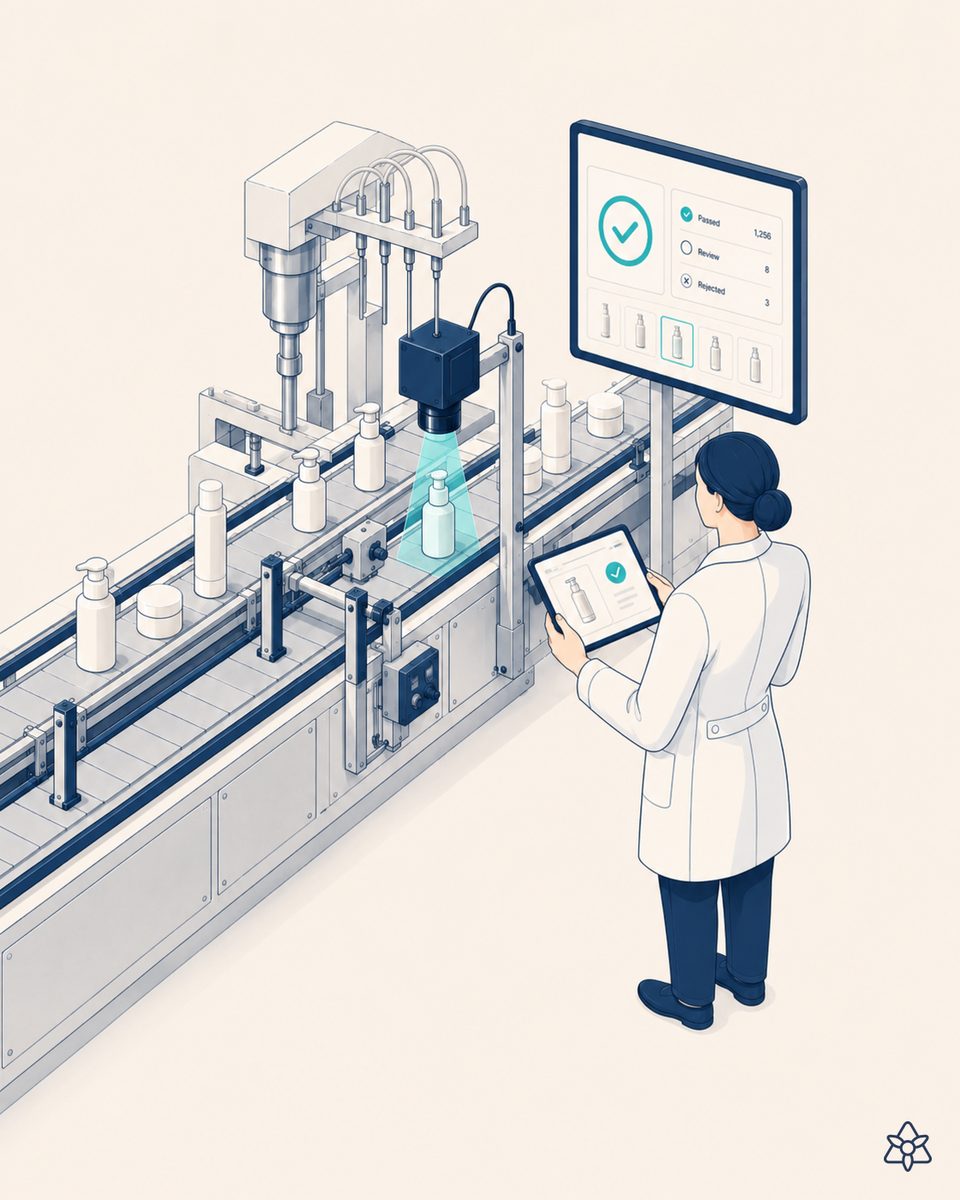
The allergen information passes through four pairs of hands before it reaches the label.
Compliance with Annex III of EU Regulation 1223/2009 does not fail because people do not know the rule — it fails because of a broken information chain:
- The fragrance supplier sends the composition and allergen percentages in a PDF attached to an email. Every time they adjust the formula (an ingredient change, a reformulation driven by an IFRA restriction), they send a new PDF that can take days to reach regulatory.
- Formulation calculates the allergen's final concentration in the product from the batch's fragrance percentage — if the batch's percentage went up or down for an intensity adjustment, the calculation changes, and so does the INCI list.
- Regulatory updates the product's INCI list. If the supplier's new composition arrived after the current batch's labels were printed, there is a mismatch.
- Packaging and the print house produce the label with the version current in their system, which is not always regulatory's latest.
The typical result of the broken chain: a batch packed with an above-threshold allergen not declared in the INCI. The claim arrives as Safety Gate (formerly RAPEX), a recall from the EU market, and brand damage. The classic system works 99% of the time. That 1% is what ends up on the consumer portal — and each case costs time and money that are never recovered.
iLEAN Tracer seals the information flow between supplier, formula and label.
The Annex III problem is not a missing procedure — it is information scattered across four pairs of hands and four systems that do not talk to each other at second zero. iLEAN acts as the putty that seals those cracks, without asking you to change your PLM, your ERP, your regulatory system or the print house.
Tracer reads the supplier's PDF as soon as it arrives. It cross-checks it against the batch formula and against the printed label that Edge captures in line. If an allergen exceeds the threshold and is not in the INCI, the batch is held. The regulatory lead signs.
The specific piece for this pain:
- iLEAN Tracer — iLEAN's rule-driven traceability layer, specialized in cosmetic compliance. It keeps the Annex III table versioned by market (EU, UK, others), receives the fragrance supplier's composition as soon as it arrives (Connect reads the attachment on the buyer's email, without asking anyone to forward anything), calculates the allergen's final concentration per batch and compares it against the current INCI list.
- iLEAN Connect — captures the supplier's email at second zero, reads the attached PDF/Excel with the fragrance composition, extracts allergens and percentages; and captures the BOM and the fragrance percentage from the ERP/PLM. Bidirectional: if a new allergen comes in through a delegated regulation, the agent prepares the notice back to the supplier through the same channel — the person signs.
- iLEAN Edge — a vision-equipped terminal on the packing line. It reads the INCI printed on the label (OCR + CNN) and cross-checks it against the list calculated by Tracer. If an above-threshold allergen is missing, it holds the batch before the packaging closes. It works without a network.
Regulatory management via Excel vs. automatic cross-checking with iLEAN Tracer
| Aspect | Excel + PLM + manual label control | With iLEAN Tracer + Connect + Edge |
|---|---|---|
| Arrival of the supplier's composition | Manual email, forwarded to regulatory | Automatic capture of the PDF at second zero |
| INCI recalculation after a fragrance % change | Manual, risk of mismatch with the batch in progress | Automatic the moment the BOM changes |
| Printed label verification | Visual, by sample at the start of the batch | Edge reads and cross-checks 100% of the batch |
| Versions of the Annex III list | A PDF in the regulatory folder | A living table, versioned by market |
| CPNP file / product dossier | Rebuilt when the inspector calls | Built batch by batch, ready to hand over |
| Safety Gate / RAPEX risk | Post-market detection | Hold before packing |
Impact estimate for your plant — to be validated with your numbers.
The block below is an estimate to be validated with the specific data of your regulatory operation. We put it forward so the committee has an order of magnitude; we refine it during the diagnostic.
- A cosmetics brand with a multi-market fragranced range (EU, UK, international), 50-200 live SKUs, 1-3 main fragrance suppliers.
- Tracer + Connect pilot on the supplier → formulation → regulatory flow + Edge on the packing line of the main fragranced range. First value expected within a few weeks (the capture of the supplier's PDF starts delivering value from day one).
- Indicative payback between 4 and 9 months, depending on the annual number of fragrance composition changes and the average regulatory management cost per SKU.
- The hard lever is the avoided cost of a single Safety Gate recall (product pulled from the shelf, label reprinting, brand damage). One avoided recall pays for the pilot.
And the regulatory lead's reasonable doubt
"What if the AI misreads the supplier's PDF and miscalculates an allergen?" — hallucination is a problem of free generation, not of anchored tasks. In tasks where the AI merely recontextualizes a piece of data from one system to another (reading the PDF, extracting the allergen percentage, calculating the final concentration with the BOM), the best models brought error below 1.5% [1]. And even so, what is critical is never decided alone: Tracer proposes the calculated INCI list, the regulatory lead signs. The three safety rings exist precisely for this.
[1] OpenAI paper “Why Language Models Hallucinate”, 2025 — on the reliability of AI in anchored tasks.
What people ask about the 26 fragrance allergens and Annex III
What does Annex III of EU Regulation 1223/2009 require for the 26 fragrance allergens?
Annex III of EU Regulation 1223/2009 requires the 26 fragrance allergens (citral, limonene, linalool, geraniol, eugenol, citronellol, etc.) to be declared on the cosmetic product's label when their concentration exceeds 0.001% in leave-on products or 0.01% in rinse-off products. The SCCS review and recent delegated regulations have extended the list — some brands already declare more than 26 in markets that have adopted the extensions. The obligation is met in the label's ingredient list (INCI) and must match the product's CPNP documentation.
Why does manual control fail between the fragrance supplier's formula and the printed label?
Because the information flow crosses several systems and hands: the fragrance supplier sends the composition with the allergens in a PDF or Excel; the formulation lead calculates the final concentration in the product from the fragrance percentage in the batch; the regulatory lead updates the INCI list; the packaging department generates the artwork; the print house produces the label. One change in the fragrance percentage or in the supplier's composition that does not reach packaging in time, and the batch's label ships with an undeclared allergen — the typical case that ends up in RAPEX/Safety Gate.
How does iLEAN Tracer cross-check the fragrance formula against the batch label?
iLEAN Tracer is iLEAN's traceability layer that connects three sources at second zero: the supplier's PDF/Excel with the composition and allergen percentages (Connect reads it even if it is the attachment on the buyer's email), the batch formula in the ERP/PLM with the fragrance percentage, and the INCI list on the printed label that Edge captures with in-line vision. The agent calculates which of the 26 (or more) Annex III allergens exceed the threshold in the final product and verifies that they appear in the declared INCI. If one is missing, it holds the batch before packing.
What about the delegated regulations that extend the list beyond the 26?
The Annex III list is updated by successive delegated regulations: new substances come in, others change threshold. iLEAN Tracer keeps the reference table versioned by market (EU, post-Brexit UK, international markets with their own equivalent lists). When the regulatory lead uploads a new version, the agents recalculate the batches in progress and warn if any current label has become obsolete. Following the Official Journal is not the plant operation's responsibility — Tracer translates it into concrete action.
Does it also feed the product's CPNP file?
Yes. Every time a batch passes Tracer's verification, a record is kept: composition of the fragrance used, fragrance percentage in the batch, the calculated list of the 26+ allergens, the printed INCI list, the label image captured by Edge, and the regulatory lead's signature. That record is direct material for the Cosmetic Product Notification Portal and for the Cosmetic Product documentation of EU Regulation 1223/2009. The audit folder builds itself, batch by batch — it is not rebuilt when the inspector calls.
More cases in cosmetics
- Eyeshadow and blush compaction with AI — the crack is born in the press and paid for by the customer on the shelf.How iLEAN Edge controls compaction press force on eyeshadows and blushes to prevent cracks, waste and…
- AI against premium perfume counterfeiting — the bottle that leaves the plant twice should never leave at all.How iLEAN Tracer serializes with GS1 DataMatrix and uses vision to verify the unique code on every…
- Industrial AI for hair color manufacturingTwelve real industrial AI cases in hair-color plants: paperless capture, in-line vision, auditable…
- Lump detection in the cream emulsion with AI — see the defect before filling, not after packing 60,000 jars.How iLEAN Edge spots lumps and phase separation in anti-aging cream emulsion before filling, holds the…
- Paraben-free challenge testing with AI — when the natural preservative leaves less margin, the LIMS cannot be a spreadsheet.How iLEAN Connect digitizes the ISO 11930 challenge test LIMS in paraben-free cosmetics with natural…
- OCR of batch and expiry on cosmetic aluminum tubes — curvature and glare cannot cost you a customer rejection.How iLEAN Vision reads inkjet batch and expiry codes on cosmetic aluminum tubes — curved surface,…
Tell us your case and in 48h we'll send you the estimated ROI of this AI project for your cosmetic compliance.
We work on your regulatory operation's real data, not ours. Diagnostic with no commitment.
Request estimated ROI in 48h See cosmetics