Five rings between the weighing room and the pallet
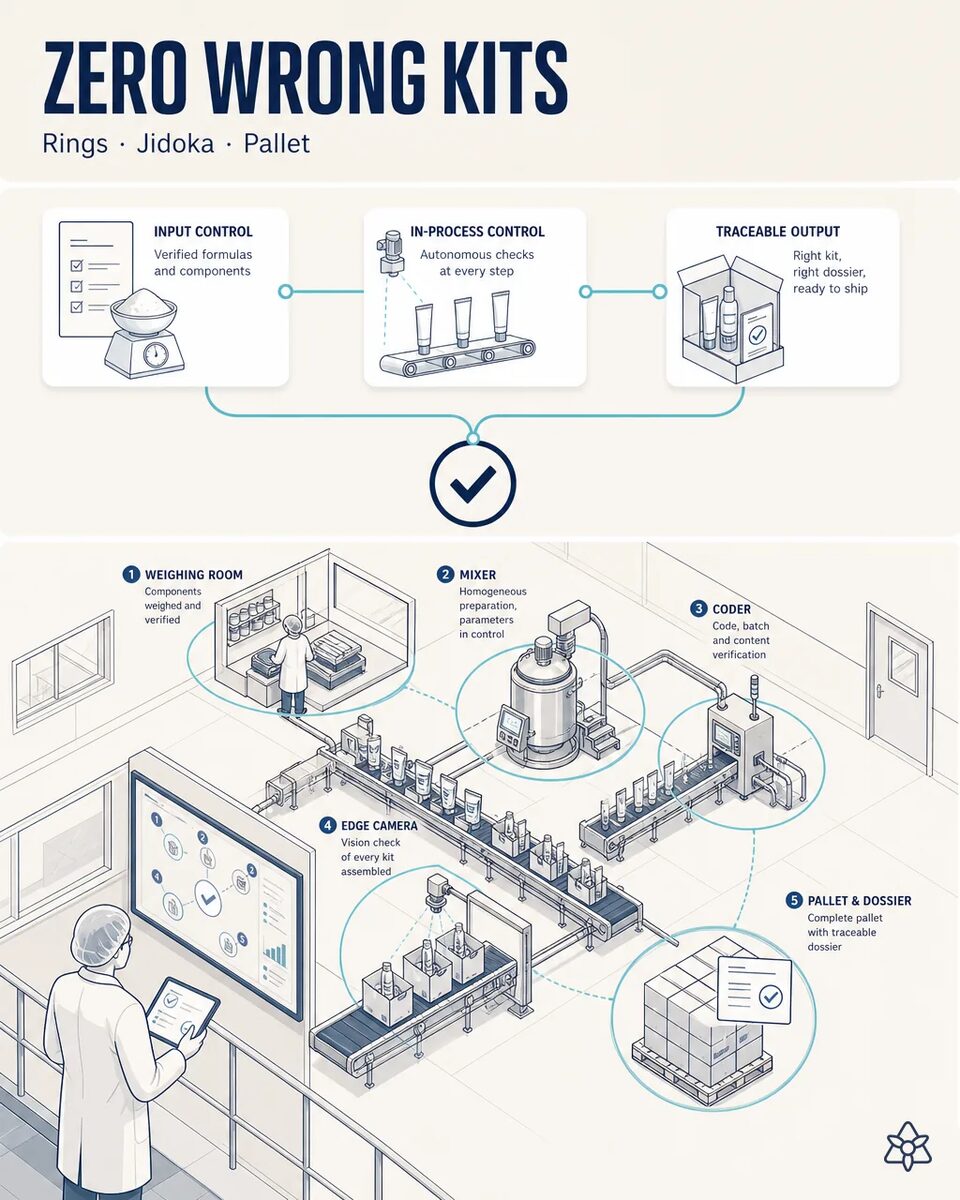
The capital pain of any hair-color factory is the same: zero recalls from a wrong kit. A kit going out with the wrong shade, a miscoded lot, the wrong expiry, a developer volume different from what the carton declares or a leaflet that does not match the market. The flagship system coordinates the previous eleven pieces into five verification rings that cross-check each other: if the five do not agree, the line stops before the pallet leaves the plant.
The worst possible failure, for three reasons at once.
It is the worst possible failure for three reasons. It is silent: it is not caught in the plant, it is caught in the market. The product is a chemical in contact with skin. And if it has crossed into another country, the incident multiplies by the number of jurisdictions involved. A cosmetics recall in mass retail is not a rework cost: it is recovery operations across thousands of points of sale, notification to each market's health authority, the reference frozen, public exposure of the brand and renegotiation with the retailer. The direct cost is high; the indirect cost, on a brand asset built over decades, is of another order. And one digit is enough.
- It is silent: it is not caught in the plant, it is caught in the market.
- The product is a chemical in contact with skin, so the scale of the incident is not set by the cost of the product.
- And if it has crossed into another country, it multiplies by the number of jurisdictions involved.
- A recall in grocery retail is not a rework cost: it is recovery operations across thousands of points of sale, notification to each market's health authority, the reference suspended, public brand exposure and renegotiation with the retailer.
- The failure modes are concrete: wrong shade, mis-coded batch, wrong expiry, a developer of a different volume than the carton declares, or a leaflet that does not match the market.
Five rings that cross-check — if they do not agree, the line stops.
No single ring solves the problem: the strength is in the cross-check. Five independent sources contradicting each other are an alarm; a single source is an assumption, however reliable it looks.
- Ring 1 · Origin (cases 1 and 7): the active order and the photographed weighings define which shade, which formula and which raw-material lots make up the bulk. Traceability is born correct, not reconstructed.
- Ring 2 · Process (cases 2 and 6): the mixer curve read off the panel and the lab result confirm the bulk is the shade it claims to be, with deviation measured against the standard. Bulk off standard never reaches the line.
- Ring 3 · Coding (case 8): the coder prints on tube, bottle and carton what the ERP publishes from the active order, with no intermediate typing and with confirmation back.
- Ring 4 · Line (cases 9 and 10): the Edge camera reads what the coder has just printed and verifies that the three kit elements match each other and match the active order, on top of verifying closure and fill. If anything fails to match, JIDOKA AI stops the line. And that same Edge guarantees the line started clean of the previous shade.
- Ring 5 · Evidence (case 11): every pallet leaves with a dossier cross-referencing the four previous rings, with a photo of the coded kit and a quality signature. If tomorrow you have to investigate one specific unit, the dossier already exists.
- SMED AI accelerates the shade changeover so that coordinating five rings is not paid for in OEE: the system already knows which shade is coming, which cleaning it requires and which data set to publish to the coder, and prepares it while the line is still running the previous shade.
- Humans in command across all five rings: iLEAN stops, proposes and documents; a person always releases.
The five rings, and what each one closes
| Ring | Which cases it draws on | What failure it closes |
|---|---|---|
| 1 · Origin | Order and weighing (1) + receiving (7) | Doubt about which shade and raw materials make up the bulk |
| 2 · Process | Mixer panel (2) + laboratory (6) | Bulk that is not the shade it claims to be |
| 3 · Coding | Coder to ERP (8) | Batch, expiry or market wrongly printed |
| 4 · Line | Seal vision (9) + shade changeover (10) | A kit whose three elements do not agree |
| 5 · Evidence | Evidence pack (11) | Traceability that has to be rebuilt after the incident |
Estimated impact — to validate with your own numbers.
The block below is an estimate to be validated against your plant's actual data. We put it forward so the committee has an order of magnitude; we refine it during the assessment.
- Estimated payback 6-12 months, but the reference is not the operational saving.
- The reference is the avoided cost of the first recall: in grocery retail with exported product it runs into hundreds of thousands of euros of direct cost.
- And the associated brand damage is of another order of magnitude, with no defined ceiling.
- From a latent risk only measured once it materializes, to a discrepancy caught on the line rather than in the market.
the benchmark is not operational saving, it is the avoided cost of the first recall, which in mass retail with exported product runs into hundreds of thousands of euros of direct cost plus brand damage of another order of magnitude. Estimated payback of 6 to 12 months against that first avoided recall, and permanent protection afterwards. *Estimate to validate with quality management and plant management*.
And the fair question from the production manager
«Do we have to deploy all twelve cases to get this?» — no, and framing it that way would be the way never to start. The rings are built in layers and each case pays for itself from the first month. A plant that starts with receiving and the coder already has half of ring 1 and all of ring 3, without committing to a two-year project.
[1] OpenAI paper "Why Language Models Hallucinate", 2025 — on the reliability of AI in anchored tasks.
What people ask about the complete system
Where do you start?
With the case that has the shortest payback and fewest dependencies, which in this matrix is usually the coder or raw material receiving. What matters is that each layer pays on its own.
What if a ring flags a false discrepancy?
JIDOKA AI stops on a verifiable discrepancy between sources, not on model uncertainty. When the doubt is the model's, the case is escalated to a person rather than stopping the line.
Does it replace the ERP we already have?
No. Ring 1 rests precisely on the ERP's order being the truth. iLEAN does not replace those systems: it cross-checks them against each other and against what actually happens on the line.
Does it cover the leaflet and destination market?
Yes, and it is one of the failure modes that most justifies the case: a leaflet that does not match the market is a regulatory nonconformity, not just a packaging error.
Can the return be estimated before committing?
Yes, and that is what we propose: with your numbers on shade changeovers, reject rate and the cost of recent incidents, the return per layer is estimated before deciding the order.
More cases from this series
- The audit stops costing person-weeksEvery critical change generates its dossier as it happens. Agents reorganises it by standard and flags…
- Batch start-up stops living on a sheet of paperThe manufacturing order and weighing sheet captured in one photo: the batch exists in central memory at…
- One mistyped digit cannot be allowed to cost a recallShade, lot and expiry travel from the active order to the coder with no intermediate typing, and the…
- Traceability is born at the dock, or it is not born at allPhoto of the delivery note, the lot labels and the certificate of analysis: everything enters the ERP…
- Shift knowledge stops dying at the end of the shiftHe dictates what he sees without breaking stride: iLEAN structures the issue against the active line,…
- The lab spreadsheet reaches the ERP on its owniLEAN reads the batch control sheet as it is saved, validates it and posts it to the ERP. Up to 80%…
Tell us what a recall of one reference in grocery retail would cost you today.
We work on your plant's real data, not ours. Assessment with no commitment.
Request estimated ROI within 48h ‹ See all cases of hair color See cosmetics