Batch start-up stops living on a sheet of paper
Every batch of color cream starts in the weighing room with two pieces of paper: the manufacturing order — shade, formula, quantity — and the weighing sheet, where the technician writes by hand the lot of every raw material and the amount actually weighed. They are the DNA of the batch and the first evidence a GMP auditor asks for. With Connect, two photos at line start and the batch already exists in the central system, with nobody changing their routine.
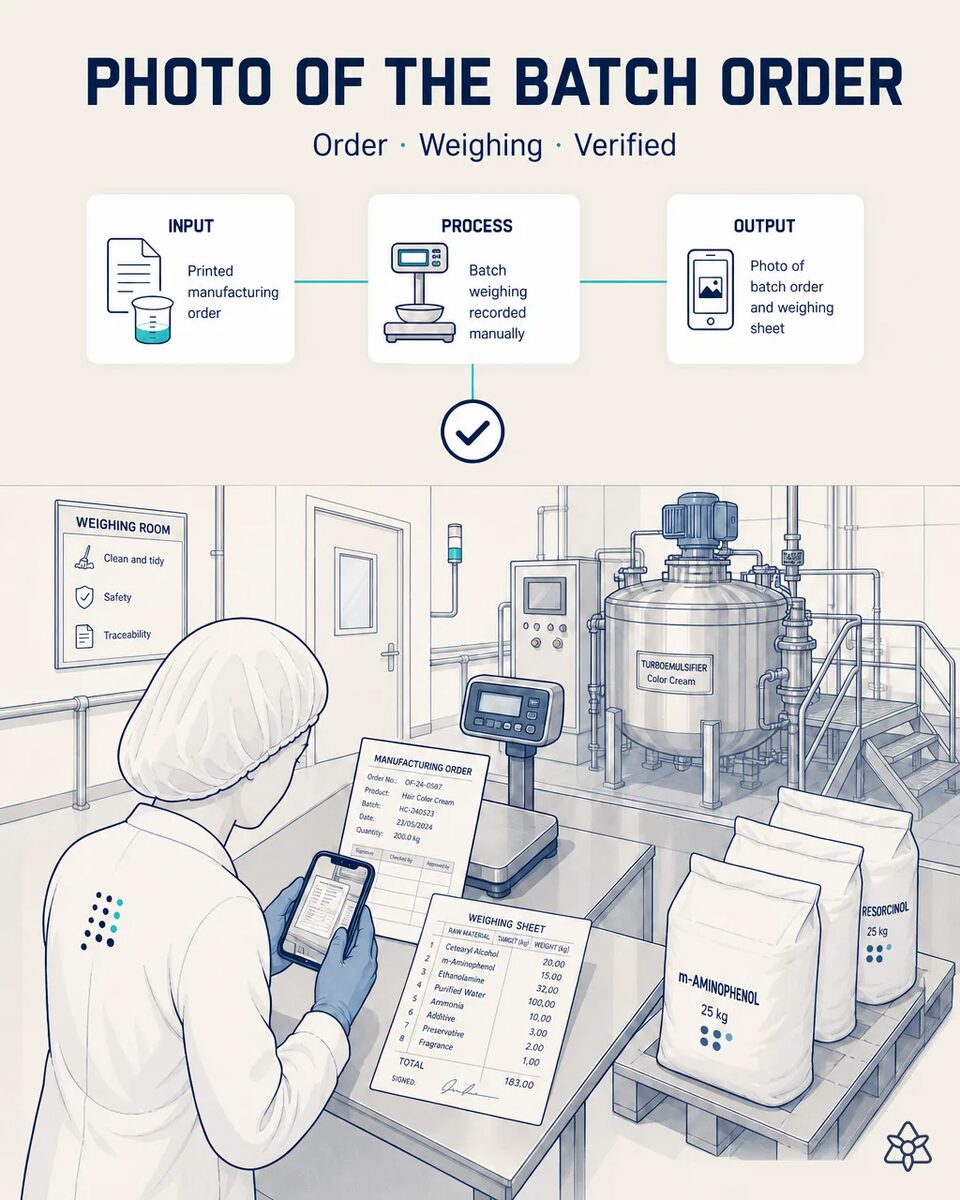
The most valuable part of the document is the part written by hand.
The manufacturing order is printed from the ERP and annotated by hand as soon as there is a real deviation: a substituted raw-material lot, an adjusted quantity, a supervisor's remark. That handwriting is the most valuable part of the document, because it is where what actually happened gets recorded — and it is exactly the part that lives in no system. Four to eight hours, or a whole shift, can pass before anybody digitises those sheets. Meanwhile the batch exists physically but does not exist in the data. And when months later somebody has to investigate why a shade came out off standard, the reconstruction starts by hunting for paper in a filing cabinet.
- The production order prints from the ERP, but what actually happened is written on top of it by hand: the substituted raw material lot, the adjusted quantity, the supervisor's note.
- That handwritten note is the first evidence a GMP auditor asks for, and it is exactly the part that lives in no system.
- For four to eight hours, or the whole shift, the batch exists physically but does not exist in the data.
- Months later, when someone has to investigate why a shade came out off-standard, the reconstruction starts by hunting for paper in a filing cabinet.
Connect in photo mode — the technician keeps filling in the same paperwork.
Connect in photo-of-the-analogue mode. The technician photographs the order and the weighing sheet with a phone or the weighing-room tablet. A grounded LLM recognises the structure of the document and extracts the fields: shade, formula code, quantity, lot of each raw material, actual weight, deviation from theoretical, technician signature and handwritten remarks. The result goes through the early human verification tablet and, once signed, is stored in central memory tied to the batch identifier. Flow: photo → structured extraction → visual summary on the tablet → technician ✓ → central memory → retrievable by batch number, with the image of the original sheet attached as evidence.
The habit change is zero, and in a GMP weighing room that is not about convenience: it is the only way the record still exists in month six. Anything that asks for typing between weighings gets filled in at the end of the shift, from memory.
Start-up on paper versus start-up captured
| Aspect | Today, on paper | With iLEAN Connect |
|---|---|---|
| When the batch exists in data | 4-8 h later, or at shift close | Second zero |
| The handwritten note | Lost, or filed unread | Extracted and tied to the batch |
| Raw material → product traceability | Rebuilt by hand | A graph that builds itself |
| GMP start-up evidence | Available weeks later | Available the same day |
| Investigating an off-standard shade | Starts by hunting for paper | Starts with the data in front of you |
| The weighing technician's routine | — | Unchanged: two photos |
Estimated impact — to validate with your own numbers.
The block below is an estimate to be validated against your plant's actual data. We put it forward so the committee has an order of magnitude; we refine it during the assessment.
- Estimated payback 4-9 months, depending on the number of batches per day.
- Transcription and filing time recovered by the production supervisor.
- From 4-8 h of latency between the paper and the system, down to second zero.
- Start-up evidence available the same day instead of weeks later.
estimated payback of 4 to 9 months depending on batches per day, counting the transcription and filing time recovered by the manufacturing supervisor. *Estimate to validate*.
And the fair question from the production manager
«What if it misreads a raw material lot?» — reading fields from a document with a known structure is an anchored task, where the best models drop below 1.5% error [1]. But the real answer is the other one: the extracted summary goes to the tablet and a person confirms or corrects it before it crosses into the system. In a GMP environment that is not optional, and here it is the architecture.
[1] OpenAI paper "Why Language Models Hallucinate", 2025 — on the reliability of AI in anchored tasks.
What people ask about digitizing batch start-up
Do we have to change the weighing sheet?
No, and that is the condition. The sheet is tied to that plant's approved procedure, and changing it drags documentation revalidation behind it. Vision reads the document structure exactly as it is today.
Does it recognize handwriting from several technicians?
Yes, because the model is not asked to guess free text: it is asked to fill fields on a form it already knows. A low-confidence field is flagged on the tablet for a person to confirm.
Does it hold up as evidence for a GMP auditor?
Yes, and it improves on what exists: alongside the structured fields, the image of the original signed document stays attached, so any later query shows the real paper rather than a transcription.
Do we need ERP integration from the start?
No. The case works from the first batch against iLEAN's central memory, and the push into the ERP is connected afterwards. That is how you get value in weeks instead of waiting for an integration project.
What about batches already produced?
They can be digitized in bulk if having the history queryable is worth it, but it is not a requirement: the case starts paying from the first start-up captured.
More cases from this series
- The audit stops costing person-weeksEvery critical change generates its dossier as it happens. Agents reorganises it by standard and flags…
- One mistyped digit cannot be allowed to cost a recallShade, lot and expiry travel from the active order to the coder with no intermediate typing, and the…
- Traceability is born at the dock, or it is not born at allPhoto of the delivery note, the lot labels and the certificate of analysis: everything enters the ERP…
- Shift knowledge stops dying at the end of the shiftHe dictates what he sees without breaking stride: iLEAN structures the issue against the active line,…
- The lab spreadsheet reaches the ERP on its owniLEAN reads the batch control sheet as it is saved, validates it and posts it to the ERP. Up to 80%…
- No datum enters the system unseen by a humanNothing the AI captures enters the system unsigned. Two taps on a tablet, and the gesture itself…
Tell us how many hours pass today between weighing a batch and the data reaching the system.
We work on your plant's real data, not ours. Assessment with no commitment.
Request estimated ROI within 48h ‹ See all cases of hair color See cosmetics