One mistyped digit cannot be allowed to cost a recall
The coder is the last physical piece before the customer, and on a kit it does not print one datum but three — tube, developer bottle and carton — which all have to match each other. It usually has an API but sits isolated from the ERP, so at every shade change somebody keys the lot into its panel. With iLEAN it is stitched to the ERP: the active order publishes lot, expiry and destination-market data with no intermediate typing.
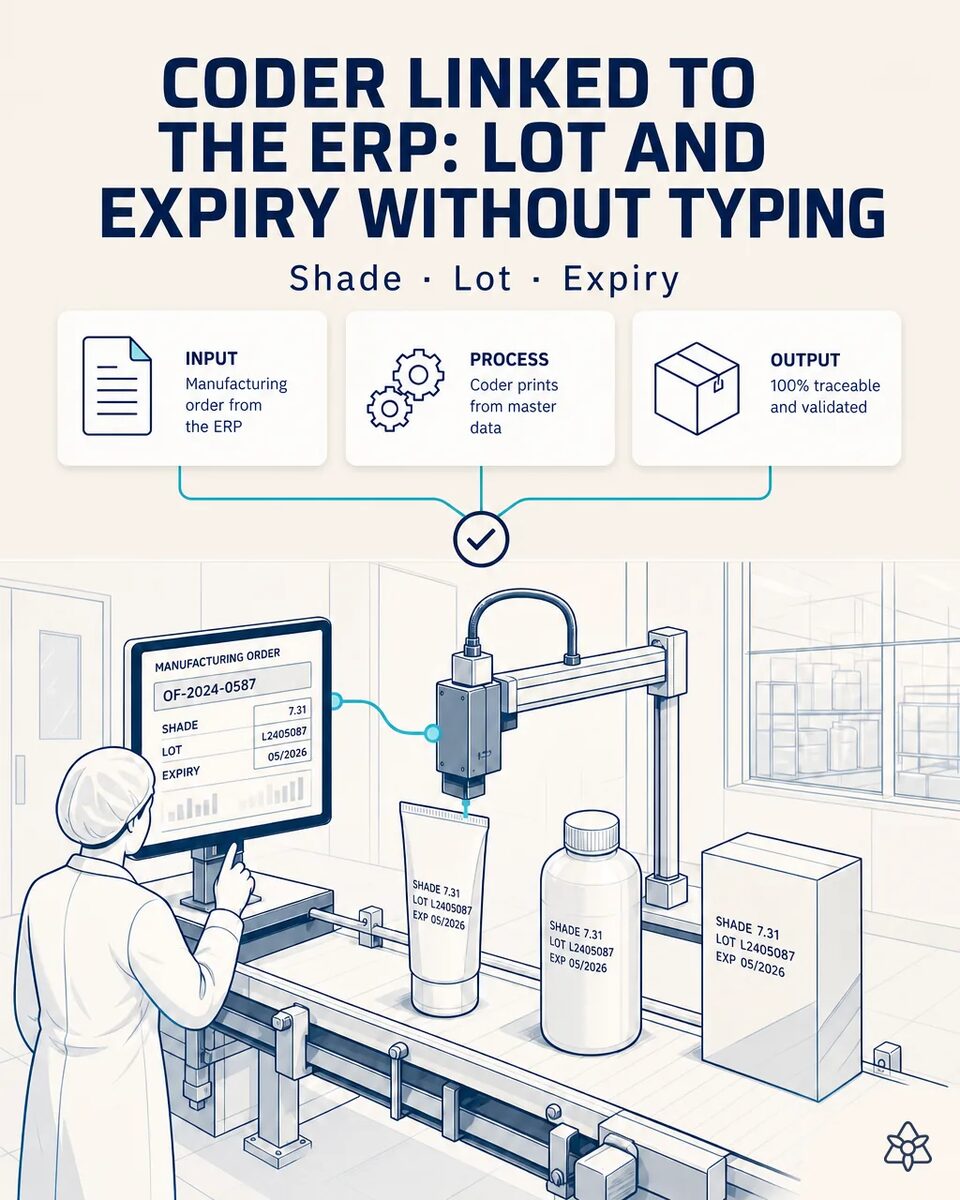
A thirty-second operation, and a recall if it goes wrong.
Manual typing on the coder panel is still the standard method, not because integration is impossible, but because "integrating it properly" has never been a priority against producing. The risk is asymmetric: the operation costs thirty seconds and its failure costs a recall. One wrong digit and half a production run goes out miscoded. Caught, it is rework; missed, it is a recall. And with a portfolio of hundreds of shades and several destination markets, the frequency of change — and therefore of typing — is enormous.
- In a kit the coder does not print one datum: it prints three — tube, developer bottle and carton — which also have to agree with each other.
- Typing on its panel is still the standard method, not because integration is impossible, but because it has never been a priority against producing.
- The risk is asymmetric: the operation costs thirty seconds and its failure costs a recall. Caught, it is rework; missed, it is a recall.
- With hundreds of shades and several destination markets, the frequency of changeovers — and therefore of typing — is very high.
Connect stitches two modern systems through APIs, replacing neither.
Connect stitches two modern systems through their APIs, replacing neither. When the ERP marks the order as started, it automatically publishes to the coder the lot, the expiry date and the data set matching the destination market. The shade change stops being a keystroke on the floor and becomes a state change in the ERP. And the coder returns confirmation of what it actually printed, stored per batch as evidence.
The machine returns confirmation of what it actually printed, not of what it was asked to print. That difference is what turns the coding record into evidence instead of an assumption filed next to a retained sample.
The isolated coder versus the stitched coder
| Aspect | Today | With iLEAN Connect |
|---|---|---|
| Keystrokes per shade changeover | One per kit element | Zero |
| Tube, bottle and carton agreeing | Depends on typing the same thing three times | Guaranteed from the order |
| Coding errors per year | Several, some with recall risk | Zero of human origin |
| What was actually printed | Rebuilt from a retained sample | Automatic per-batch record confirmed by the machine |
| Destination market data | Typed | Published from the live order |
| Either system | — | Neither is replaced |
Estimated impact — to validate with your own numbers.
The block below is an estimate to be validated against your plant's actual data. We put it forward so the committee has an order of magnitude; we refine it during the assessment.
- Estimated payback 3-6 months — among the fastest, because the machine already ships an API and the integration effort is low.
- A sharp reduction in recall risk from wrong coding, which is the most frequent failure mode in this product family.
- From several typing errors a year — some with rework — to zero of human origin.
- An automatic per-batch record of what the machine confirmed it printed.
fast payback, estimated 3 to 6 months, and a drastic reduction in recall risk from miscoding, which is the most frequent failure mode in this product family. *Estimate to validate*.
And the fair question from the production manager
«Isn't a classic integration cleaner?» — it is, once the project reaches the top of the list, and that is exactly the problem: it has not for years, because there is always something more urgent than producing. This stitching replaces neither system and does not touch the coder's program, so it competes for neither the shutdown window nor a large project budget.
[1] OpenAI paper "Why Language Models Hallucinate", 2025 — on the reliability of AI in anchored tasks.
What people ask about connecting the coder
Do we have to replace the coder or the ERP?
Neither. Connect leans on the API the coder already has and on what the ERP publishes when the order starts. It is stitching, not replacement.
What if the coder fails to print?
It is detected, because what comes back is confirmation of what was actually printed. Today that failure raises no signal: the system assumes what was requested was printed.
Does it cover all three kit elements?
Yes, and that is the reason the case exists in this product family: tube, developer bottle and carton have to agree, and today that depends on typing the same thing three times.
What about data that changes by destination market?
It travels from the live order as one more data set, which is where it belongs. It is one of the points where manual typing fails most often.
Can the loop be closed with vision?
Yes, and it is the natural pairing with the in-line vision case: the camera reads what the coder has just printed and checks it against the live order.
More cases from this series
- The audit stops costing person-weeksEvery critical change generates its dossier as it happens. Agents reorganises it by standard and flags…
- Batch start-up stops living on a sheet of paperThe manufacturing order and weighing sheet captured in one photo: the batch exists in central memory at…
- Traceability is born at the dock, or it is not born at allPhoto of the delivery note, the lot labels and the certificate of analysis: everything enters the ERP…
- Shift knowledge stops dying at the end of the shiftHe dictates what he sees without breaking stride: iLEAN structures the issue against the active line,…
- The lab spreadsheet reaches the ERP on its owniLEAN reads the batch control sheet as it is saved, validates it and posts it to the ERP. Up to 80%…
- No datum enters the system unseen by a humanNothing the AI captures enters the system unsigned. Two taps on a tablet, and the gesture itself…
Tell us how many times a batch code is typed into a machine panel today.
We work on your plant's real data, not ours. Assessment with no commitment.
Request estimated ROI within 48h ‹ See all cases of hair color See cosmetics