Traceability is born at the dock, or it is not born at all
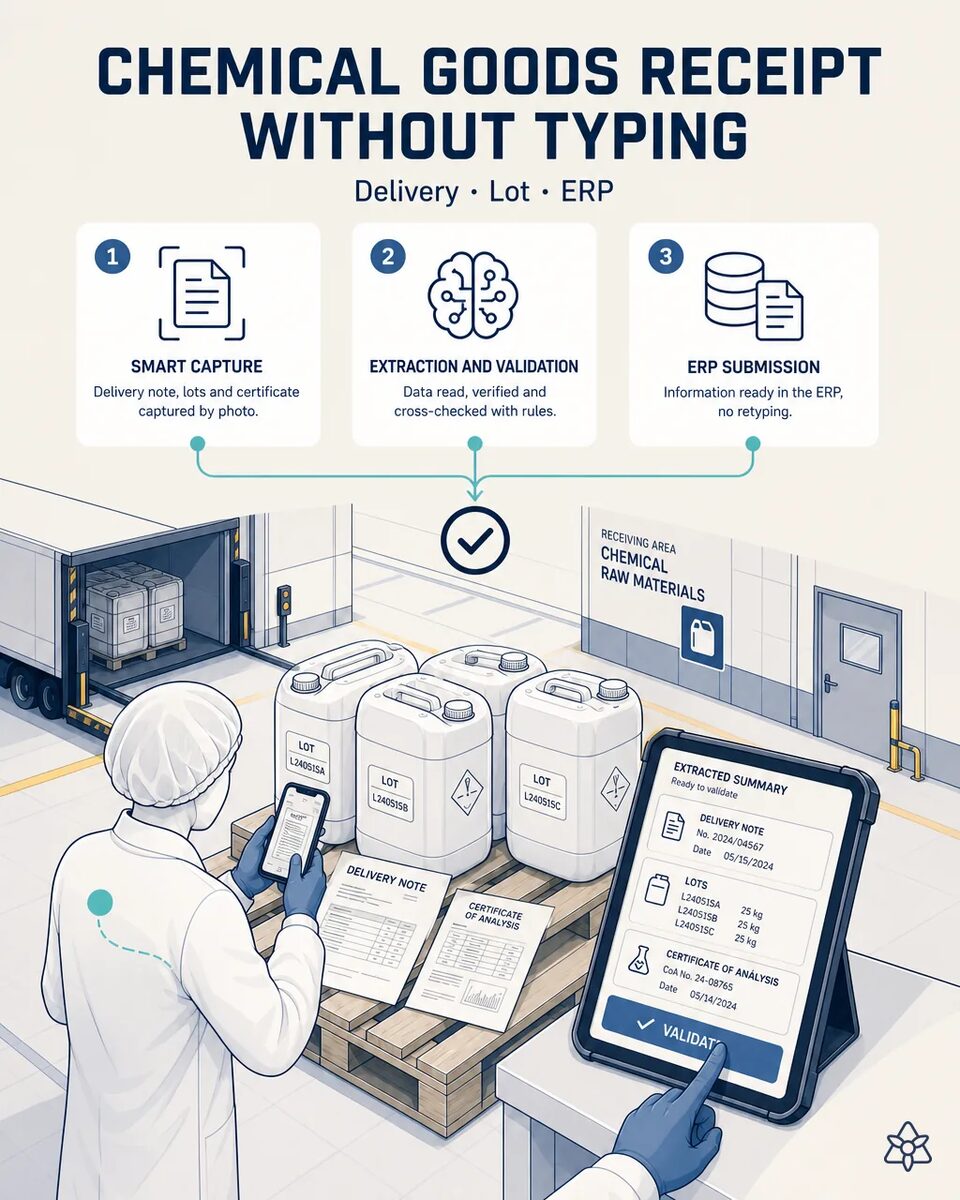
The truck arrives with oxidation dyes, alkalising agent, peroxide or packaging material. The goods-in supervisor faces a two-page delivery note with fifteen or twenty lines, the lot labels on every pallet and the certificate of analysis for each raw material. He has to sign and on top of that key it all into the ERP. With Connect: three photos, one validation tap, everything in.
There are only two ways out, and both are bad.
Chemical raw-material receipt is where the traceability of everything the plant makes afterwards is born. And it is the point under the most time pressure: carrier waiting, dock occupied, and one person acting as a human scanner. There are only two bad ways out. Either the truck waits forty-five minutes charging demurrage, or it gets typed in a hurry and the lots end up badly linked, which surfaces months later in a quality investigation that can no longer be closed. The certificate of analysis, meanwhile, ends up in a folder of PDFs nobody ever cross-references with the lot.
- Chemical raw material receiving is where the traceability of everything the plant later makes is born, and it is the point under most time pressure.
- Either the truck waits forty-five minutes racking up demurrage, or it gets typed in a hurry and the lots end up badly linked.
- The second path does not raise an error at the time: it surfaces months later, in a quality investigation that can no longer be closed.
- The certificate of analysis, meanwhile, ends up in a folder of PDFs nobody ever cross-references with the lot it certifies.
Connect in photo mode — without asking the supplier to change its delivery note.
Connect in photo-of-the-analogue mode. Vision AI recognises the delivery note's layout without asking the supplier to change theirs, and extracts the tabular structure. From the pallet labels it reads GS1-128, QR, barcode or plain text by OCR. From the certificate of analysis it extracts the analytical parameters and ties them automatically to the raw-material lot. Validation with one tap on the dock's industrial tablet, then posted to the ERP through the API.
What really changes is not the speed: it is that the certificate of analysis stops being a loose PDF and becomes tied to the raw material lot and, transitively, to every product batch that used it.
Today's receiving versus captured receiving
| Aspect | Today | With iLEAN Connect |
|---|---|---|
| Truck held at the dock | 45 minutes | Under 10 |
| Lot linking | Wrong or late | At the moment of unloading |
| Certificate of analysis | A loose PDF in a folder | Tied to the lot and to the products that used it |
| Pallet labels | Typed | GS1-128, QR, barcode or plain text |
| Delivery note format | One per supplier | Recognized without asking for changes |
| Receiving and warehouse licenses | Two or three | One, the supervisor who validates |
Estimated impact — to validate with your own numbers.
The block below is an estimate to be validated against your plant's actual data. We put it forward so the committee has an order of magnitude; we refine it during the assessment.
- 💰 CFO angle: the receiving and warehouse module typically requires two or three active licenses. With Connect only the supervisor validates with a tap, without entering the ERP: typical 50-70 % reduction in recurring licenses.
- From 45 minutes of truck held at the dock to under 10, truck after truck.
- Raw material traceability linked at unloading, not rebuilt months later.
- The certificate of analysis goes from dead file to evidence cross-referenceable with every product batch.
CFO angle — direct ERP license saving: the goods-in and warehouse module typically requires two or three active licences (goods-in supervisor, backup, supervisor). With Connect only the supervisor validates with one tap without entering the ERP. Typical reduction of 50-70% in goods-in/warehouse module licences, plus avoiding the bulk-capture module many ERPs sell separately, plus the direct saving on carrier demurrage. Estimated payback of 3 to 8 months, plus the recurring annual saving. *Estimate to validate*.
And the fair question from the production manager
«Does it read a dirty or creased label at the dock?» — most pallet labels carry standard symbology, which is direct reading; flat optical recognition only comes in when the label is printed without it. In that case it is an anchored task and the best models drop below 1.5% error [1]. And above all there is the cross-check: if label and delivery note disagree, the discrepancy is highlighted rather than resolved silently.
[1] OpenAI paper "Why Language Models Hallucinate", 2025 — on the reliability of AI in anchored tasks.
What people ask about digitizing goods receipt
Does it work with each supplier's delivery note?
Yes. Every chemical supplier has its own format and the model recognizes the table structure without needing a template per supplier and without asking anyone to change theirs.
Is the certificate of analysis read too?
Yes, and that is the part that adds most value: the declared values end up tied to the lot, so a later investigation does not have to go hunting for the PDF in another folder.
What if the truck brings more packages than the note says?
The discrepancy between labels and delivery note is highlighted on screen before the receiving supervisor validates. Today nobody does that cross-check with a truck waiting.
Do we need a barcode scanner?
Not necessarily: a photo from the phone or industrial tablet is enough. If the plant already has scanners that work well, they integrate just the same.
Can we start with receiving alone?
Yes, and it is usually a good starting point: the result is visible from the first truck and it does not depend on the other pieces being deployed.
More cases from this series
- The audit stops costing person-weeksEvery critical change generates its dossier as it happens. Agents reorganises it by standard and flags…
- Batch start-up stops living on a sheet of paperThe manufacturing order and weighing sheet captured in one photo: the batch exists in central memory at…
- One mistyped digit cannot be allowed to cost a recallShade, lot and expiry travel from the active order to the coder with no intermediate typing, and the…
- Shift knowledge stops dying at the end of the shiftHe dictates what he sees without breaking stride: iLEAN structures the issue against the active line,…
- The lab spreadsheet reaches the ERP on its owniLEAN reads the batch control sheet as it is saved, validates it and posts it to the ERP. Up to 80%…
- No datum enters the system unseen by a humanNothing the AI captures enters the system unsigned. Two taps on a tablet, and the gesture itself…
Tell us how long it takes today to book in a raw material truck.
We work on your plant's real data, not ours. Assessment with no commitment.
Request estimated ROI within 48h ‹ See all cases of hair color See cosmetics