No datum enters the system unseen by a human
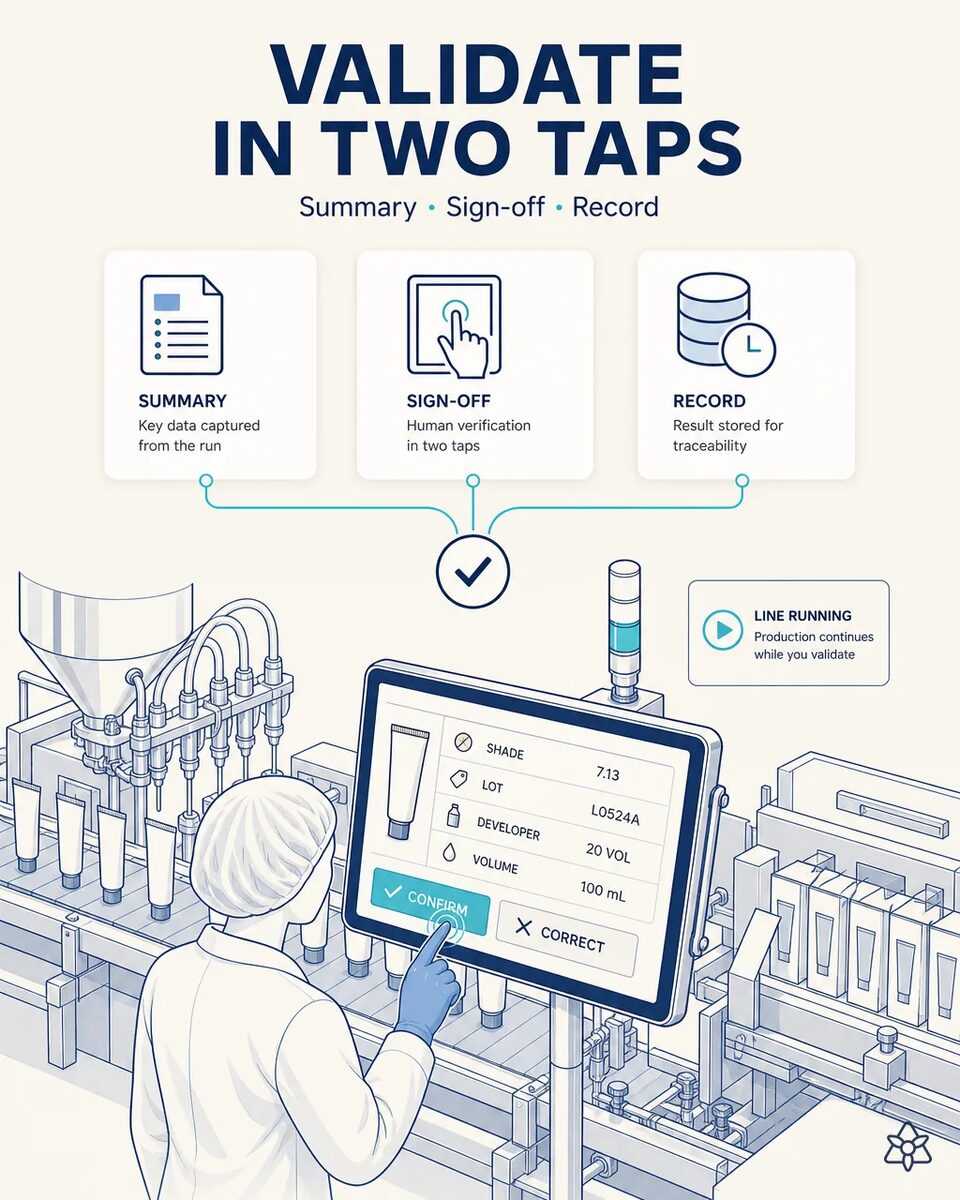
What separates iLEAN from an autonomous AI agent that pushes data in unsigned is this: nothing it captures enters the central system without a human having seen it first. In a GMP plant that is not a preference, it is non-negotiable. It takes the form of an industrial tablet at the line with a two-second visual summary and two buttons: confirm or correct.
The dead end: either unvalidated data, or data never captured.
The fear that "AI will push data in on its own and then somebody has to clean the master" is not a cultural prejudice: it is a perfectly legitimate quality objection. A process datum with no traceability of who validated it is worthless as evidence in front of a cosmetics GMP auditor. But the operator does not want to type either, and every data-entry screen you add is time she is not on the line. That is the dead end: either unvalidated data contaminating the master, or data never captured out of mistrust.
- The fear that AI will write data on its own and leave someone cleaning up the master is not a cultural prejudice: it is a legitimate quality objection.
- A process datum with no traceability of who validated it does not work as evidence before a cosmetics GMP auditor.
- But the operator does not want to type either, and every data entry screen added is time not spent on the line.
- Hence the dilemma that blocks so many projects: either unvalidated data contaminating the master, or data never captured out of distrust.
Connect with early human verification — two seconds and two buttons.
Connect in early-human-verification mode. Every capture — the parsed order, the issue dictated by voice, the supplier alert, the closed mixer curve — goes through the tablet with a visual summary before crossing into the master. The interface is designed to validate in two seconds, not to enter data: large numbers, highlighted differences, two buttons. And the side effect is the most valuable part: every validation is signed with user, timestamp and exactly what was on screen. The two-second gesture that stops the master from being contaminated is, at the same time, the evidence the auditor asks for.
The signature stops being a bureaucratic bottleneck and becomes a two-tap gesture that also generates the evidence the auditor will ask for later. The same movement solves the quality problem and the compliance one.
The three ways of resolving it, compared
| Aspect | Autonomous AI | Operator types it |
|---|---|---|
| Data validated | No | Yes |
| Operator time | Zero | Minutes per capture |
| Risk to the master | High | Low |
| Actually done on the line | — | Late or after the fact |
| Evidence for a GMP auditor | No signature | Signature with no context |
| Approvable by the board | No | Yes, but unused |
An enabling piece — no payback of its own, and stated as such.
The block below is an estimate to be validated against your plant's actual data. We put it forward so the committee has an order of magnitude; we refine it during the assessment.
- This case has no payback of its own and there is no sense calculating one: it is the piece that enables the whole matrix.
- Without early human verification, in a GMP environment the other eleven pieces do not get signed off by the board.
- It removes the dilemma between unvalidated data and uncaptured data: data is captured and signed, with a latency of seconds.
- Strategic and compliance value: it turns "the AI writes data" into "the AI prepares and a person signs".
enabling piece of the whole matrix, with no payback of its own. Without early human verification, in a GMP environment the other eleven pieces never get signed. Strategic and compliance value.
And the fair question from the production manager
«If a person has to validate in the end, what is the AI saving?» — the work is not in deciding, it is in assembling. Today somebody searches, measures, transcribes and only then decides. With the verification gate they only do the last part: they reach a screen with everything assembled and the deviations highlighted, and confirm or correct. And every correction is stored, so the system learns where extraction is failing.
[1] OpenAI paper "Why Language Models Hallucinate", 2025 — on the reliability of AI in anchored tasks.
What people ask about human verification
How long does it really take the operator?
The summary is designed to be read in two seconds and resolved in two taps. If a control costs minutes, it ends up being filled in after the fact, and that is precisely the failure this case closes.
Can the AI write to the master without a signature?
No, and it is not a configuration option: it is the architecture. Every capture passes through the tablet before crossing into the central system.
What is stored when the operator corrects it?
The correction, with who made it and when. It serves as a trail for the auditor and as feedback so extraction improves at that specific point.
Does a tablet signature count as GMP evidence?
What summary was shown, who confirmed it and when are all recorded, which is exactly what a paper signature lacks today: the current signature proves somebody signed, not what they saw.
Does it apply to every capture in the matrix?
Yes: the parsed order, the issue dictated by voice, the supplier alert and the closed mixer curve all pass through the same gate before reaching the master.
More cases from this series
- The audit stops costing person-weeksEvery critical change generates its dossier as it happens. Agents reorganises it by standard and flags…
- Batch start-up stops living on a sheet of paperThe manufacturing order and weighing sheet captured in one photo: the batch exists in central memory at…
- One mistyped digit cannot be allowed to cost a recallShade, lot and expiry travel from the active order to the coder with no intermediate typing, and the…
- Traceability is born at the dock, or it is not born at allPhoto of the delivery note, the lot labels and the certificate of analysis: everything enters the ERP…
- Shift knowledge stops dying at the end of the shiftHe dictates what he sees without breaking stride: iLEAN structures the issue against the active line,…
- The lab spreadsheet reaches the ERP on its owniLEAN reads the batch control sheet as it is saved, validates it and posts it to the ERP. Up to 80%…
Tell us what objection your board raised the last time AI on the floor came up.
We work on your plant's real data, not ours. Assessment with no commitment.
Request estimated ROI within 48h ‹ See all cases of hair color See cosmetics