The leak is not discovered in the customer's home
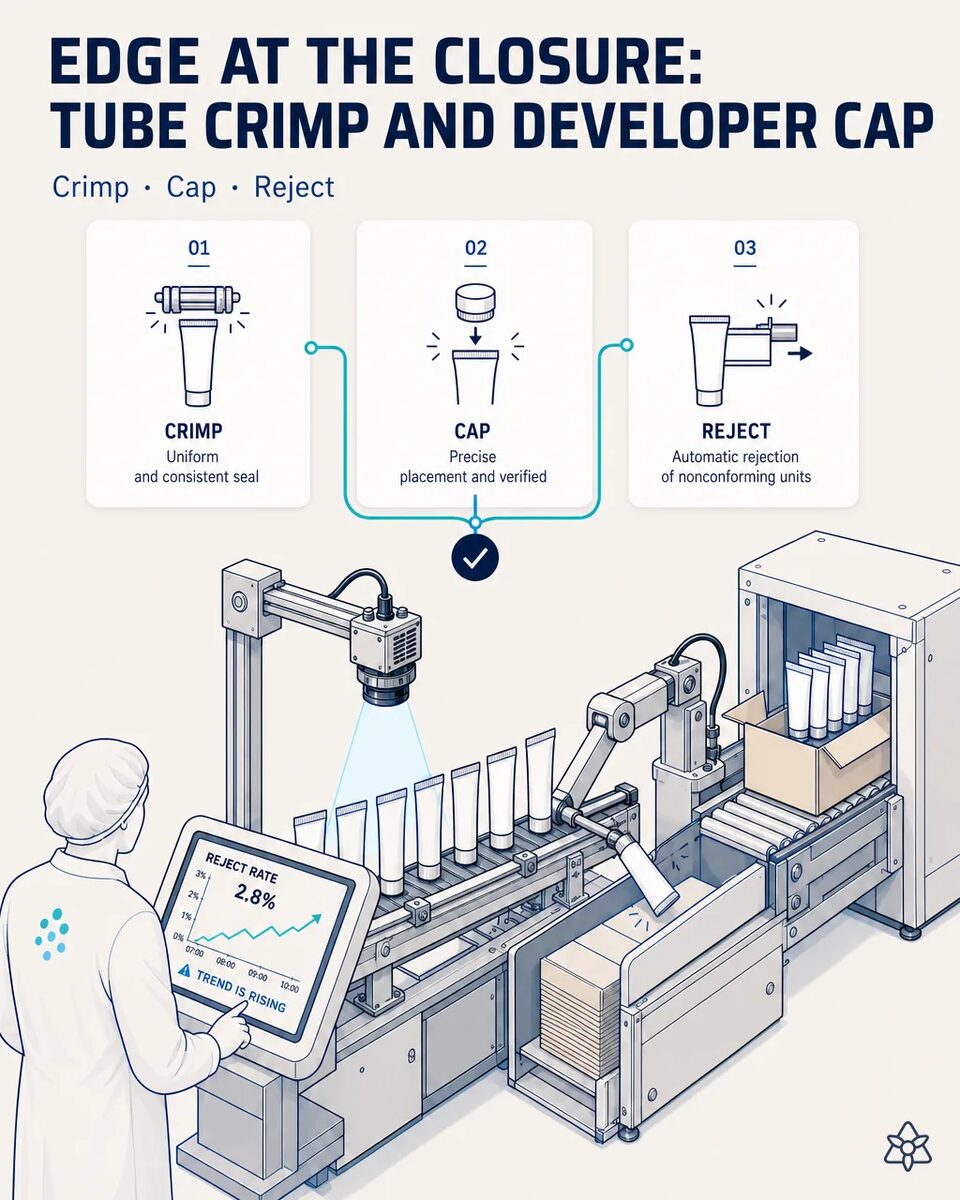
At line speed the human eye cannot verify every tube crimp and every developer cap. And the defect is not cosmetic: an incomplete crimp is color cream leaking inside the carton, and a badly seated cap is peroxide leaking. Edge puts a camera over each closure point, infers per unit in milliseconds and rejects the defective one before the cartoner.
Sampling detects jaw drift late by definition.
Control today is by sampling, with periodic visual inspection and a destructive test every so many units. Between two samples a whole batch can go through with the crimping jaw out of adjustment. And jaw drift is gradual, so sampling detects it late by definition. The defect, moreover, shows up days later: the leak migrates inside the closed carton and is discovered at the point of sale or in the customer's home. Unsellable product at best; a consumer safety incident and a retailer claim at worst.
- An incomplete crimp is a leak of colorant mass inside the carton. A badly seated cap is a peroxide leak. This is not a cosmetic defect.
- Control today is by sampling, with periodic visual inspection and a destructive test every X units: between two samples a whole batch can run with the crimp jaw out of adjustment.
- Jaw drift is gradual, so sampling always catches it late.
- And the defect shows up days later: the leak migrates inside the sealed carton and is found at the point of sale or in the customer's home.
- Unusable product at best; a consumer safety incident and a retailer complaint at worst.
Edge — local vision at the line, with no image sent to the cloud.
Edge. Local CNN vision on a plant GPU — sending no image to the cloud, because of latency, cost and bandwidth — with a model trained on the plant's real formats: crimp geometry, presence and legibility of the code, cap seating, bottle fill level. Inference per unit at real line speed, rejection before cartoning — which is where the defect stops being recoverable — and an automatic alert when the reject rate starts to drift, which is the signal that the jaw needs adjusting before it produces defective units.
Inference resolves in milliseconds on a plant GPU. No image goes to the cloud, and that is not a preference: it is latency at line cadence, traffic cost, and not moving product imagery off the site.
Today's sampling versus Edge control
| Aspect | Sampling control | With iLEAN Edge |
|---|---|---|
| Coverage | 1-2 % of units | 100 % |
| Crimp jaw drift | Caught after a batch | Caught in the first few dozen units |
| Where the leak is found | Point of sale or customer's home | Before the cartoner |
| Cost of the defective unit | The whole kit, already assembled | The tube, before the kit is built |
| Destructive test | Every X units | Kept, but no longer the only net |
| Defect evidence | None | Image tied to batch and shift |
Estimated impact — to validate with your own numbers.
The block below is an estimate to be validated against your plant's actual data. We put it forward so the committee has an order of magnitude; we refine it during the assessment.
- Estimated payback 5-12 months, depending on your current reject rate.
- The rework cost avoided is that of the complete kit — tube, bottle, carton and components — not just the defective tube.
- Fewer retailer complaints from leaks at the point of sale.
- From 1-2 % sampling to 100 % control of units, at real cadence.
estimated payback of 5 to 12 months depending on the current reject rate and the rework cost of the complete kit — which includes tube, bottle, carton and components, not just the defective tube — plus the reduction in retailer claims. *Estimate to validate*.
And the fair question from the production manager
«What if the camera rejects good units?» — the false positive is the real risk of any vision system, which is why the model is trained on the plant's actual formats — crimp geometry, presence and legibility of the marking — and not on a generic model. Borderline units are not simply rejected: they are escalated for a person to decide, and every decision feeds back into training.
[1] OpenAI paper "Why Language Models Hallucinate", 2025 — on the reliability of AI in anchored tasks.
What people ask about vision on the seal
How many units are needed to train it?
Fewer than people usually fear, because the defect catalog of a seal is known and repetitive. What is needed is that they be real parts from your formats, not a generic set.
Does it keep up with line cadence?
Yes: inference is local and resolves in milliseconds per unit. It does not depend on the plant network or the cloud, which is what Edge means.
Does it replace the destructive test?
No, and it should not be framed that way. The destructive test remains the reference; what changes is that it stops being the only net and starts confirming what vision is already seeing unit by unit.
Does it cover the developer cap too?
Yes, it is the second sealing point and gets its own camera. They are different failure modes and are trained separately.
Does it warn before defective units start coming out?
That is the part with the most value: seeing one hundred percent, jaw drift shows up as a trend in the first few dozen units, not once a batch is already compromised.
More cases from this series
- The audit stops costing person-weeksEvery critical change generates its dossier as it happens. Agents reorganises it by standard and flags…
- Batch start-up stops living on a sheet of paperThe manufacturing order and weighing sheet captured in one photo: the batch exists in central memory at…
- One mistyped digit cannot be allowed to cost a recallShade, lot and expiry travel from the active order to the coder with no intermediate typing, and the…
- Traceability is born at the dock, or it is not born at allPhoto of the delivery note, the lot labels and the certificate of analysis: everything enters the ERP…
- Shift knowledge stops dying at the end of the shiftHe dictates what he sees without breaking stride: iLEAN structures the issue against the active line,…
- The lab spreadsheet reaches the ERP on its owniLEAN reads the batch control sheet as it is saved, validates it and posts it to the ERP. Up to 80%…
Tell us how many leak complaints you have had in the last twelve months.
We work on your plant's real data, not ours. Assessment with no commitment.
Request estimated ROI within 48h ‹ See all cases of hair color See cosmetics