The "line is clean" signature stops being an act of faith
Shade changeover is the dominant operational event in a hair-color plant: the line changes constantly and every change demands a cleaning whose effectiveness decides whether the first batch of the next shade comes out on standard or contaminated. With Edge, fixed cameras at each critical point compare the current state against the reference state, and the line does not start until all of them pass and the quality supervisor signs off on that evidence.
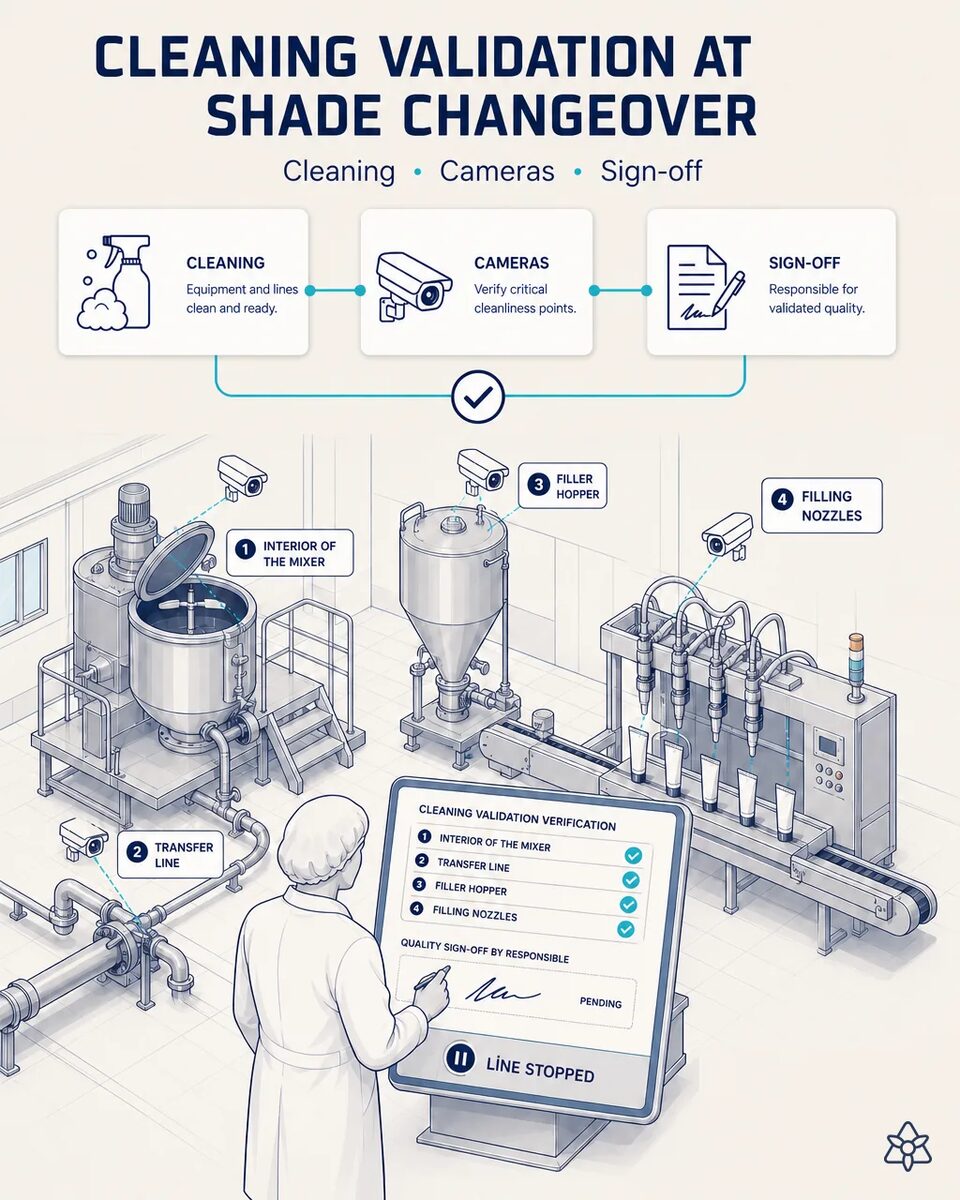
The changeover concentrates three problems at once.
A contaminated shade is not always visible to the naked eye in the bulk. But it is perfectly visible on the consumer's head, which is the worst possible place to find it. Changeover concentrates three problems at once. It is the biggest sink of OEE, because the line is stopped. It is the biggest quality risk, through shade cross-contamination. And it is where the pressure to start pushes against the rigour of verification — exactly the scenario where a human signature without objective evidence is most fragile. On top of that comes low reproducibility between shifts: every team cleans and verifies to its own criterion.
- It is the biggest OEE sink, because the line is stopped for its duration.
- It is the biggest quality risk, through cross-contamination of shade. And a contaminated shade is not always visible in the bulk: it is visible on the consumer's head, which is the worst possible place.
- It is where pressure to restart pushes against the rigor of verification — exactly the scenario where a signature with no objective evidence is weakest.
- And reproducibility between shifts is low: each team cleans and verifies to its own criterion, with no shared reference.
Edge with JIDOKA AI — the line does not start until every point reports OK.
Edge plus JIDOKA AI. Fixed industrial cameras at the critical points — mixer interior and discharge, transfer lines, filler hopper and nozzles, dosing head — with a CNN trained to distinguish "clean for the next shade" from "residue of the previous shade", including the places where residue hides. Active blocking of the start until all cameras pass plus quality sign-off on that evidence. One effect that surprises people: this shortens the changeover instead of lengthening it. Today verification time is estimated "just in case", with margin; with objective evidence you know when it is genuinely ready.
The camera does not decide alone: it gives conformity point by point and the quality supervisor signs over that evidence. What changes is not who decides, it is what they decide on — from an impression under pressure to an objective comparison against the reference state.
Today's shade changeover versus the validated changeover
| Aspect | Today | With iLEAN Edge |
|---|---|---|
| What authorizes start-up | A blind signature under pressure | Point-by-point conformity, then a signature on it |
| Cleaning criterion | Varies between shifts | Single and reproducible |
| Verification time | Estimated with a margin | Real |
| Cross-contamination of shade | Found on the consumer | Blocked before start-up |
| Critical points reviewed | The ones there is time for | All of them, always the same |
| Evidence for audit | The signature | Before and after photo of each point |
Estimated impact — to validate with your own numbers.
The block below is an estimate to be validated against your plant's actual data. We put it forward so the committee has an order of magnitude; we refine it during the assessment.
- Estimated payback 6-12 months, depending on how many shade changeovers you run per week.
- Protection against the first contaminated batch: its destruction or rework cost plus the investigation it drags behind it.
- Reduced changeover time, which today is estimated with a margin because nobody knows how long verification really takes.
- A single, reproducible cleaning criterion across shifts, which is half the problem and does not get solved with more procedure.
estimated payback of 6 to 12 months depending on the number of shade changes per week, counting protection against the first contaminated batch — with its destruction or rework cost and its investigation — plus the reduction in changeover time. *Estimate to validate*.
And the fair question from the production manager
«What if the camera blocks the line for no reason and stops my production?» — that is the right objection, because a false stop during a changeover costs real money. Conformity is checked against the reference state for that specific point and, in case of doubt, the system does not block silently: it escalates to the quality supervisor, who signs on the evidence. It stops on a verifiable discrepancy, not on model uncertainty.
[1] OpenAI paper "Why Language Models Hallucinate", 2025 — on the reliability of AI in anchored tasks.
What people ask about validating the shade changeover
How many cameras are needed?
As many as cover the critical points of that specific changeover, defined at commissioning: mixer interior and discharge, transfer lines, filler hopper and nozzles, dosing head.
Doesn't it make the changeover longer?
The check itself takes seconds. What lengthens the changeover today is the margin added because nobody knows how long verification really takes; with objective evidence that margin can be trimmed.
Does it tell shade residue from an old stain?
That is exactly what is trained: the model learns to distinguish relevant residue from the rest, using that plant's real points and shades.
Can validation be skipped in an emergency?
An exception can be defined with a supervisor signature, and it is recorded as such. What cannot happen is starting up with no trace of who decided to skip it.
What is left for the audit?
The before and after photo of each control point, time-stamped and with the signature of whoever validated. That is exactly what has to be rebuilt today when an auditor asks for a quarter's cleaning records.
More cases from this series
- The audit stops costing person-weeksEvery critical change generates its dossier as it happens. Agents reorganises it by standard and flags…
- Batch start-up stops living on a sheet of paperThe manufacturing order and weighing sheet captured in one photo: the batch exists in central memory at…
- One mistyped digit cannot be allowed to cost a recallShade, lot and expiry travel from the active order to the coder with no intermediate typing, and the…
- Traceability is born at the dock, or it is not born at allPhoto of the delivery note, the lot labels and the certificate of analysis: everything enters the ERP…
- Shift knowledge stops dying at the end of the shiftHe dictates what he sees without breaking stride: iLEAN structures the issue against the active line,…
- The lab spreadsheet reaches the ERP on its owniLEAN reads the batch control sheet as it is saved, validates it and posts it to the ERP. Up to 80%…
Tell us how many shade changeovers you run per week and how long verification takes.
We work on your plant's real data, not ours. Assessment with no commitment.
Request estimated ROI within 48h ‹ See all cases of hair color See cosmetics