The twenty-year-old machine that finally speaks
The turbo-emulsifier where the color cream is made is the chemical heart of a hair-color plant and is usually between ten and twenty years old. Its panel shows what decides whether the batch comes out right: temperature ramp and hold, vacuum, rotor-stator speed, phase timing and pH. And it is connected to nothing. An external camera pointed at the panel is enough for the plant to hold the process curve of every batch in central memory, without touching the machine's control logic.
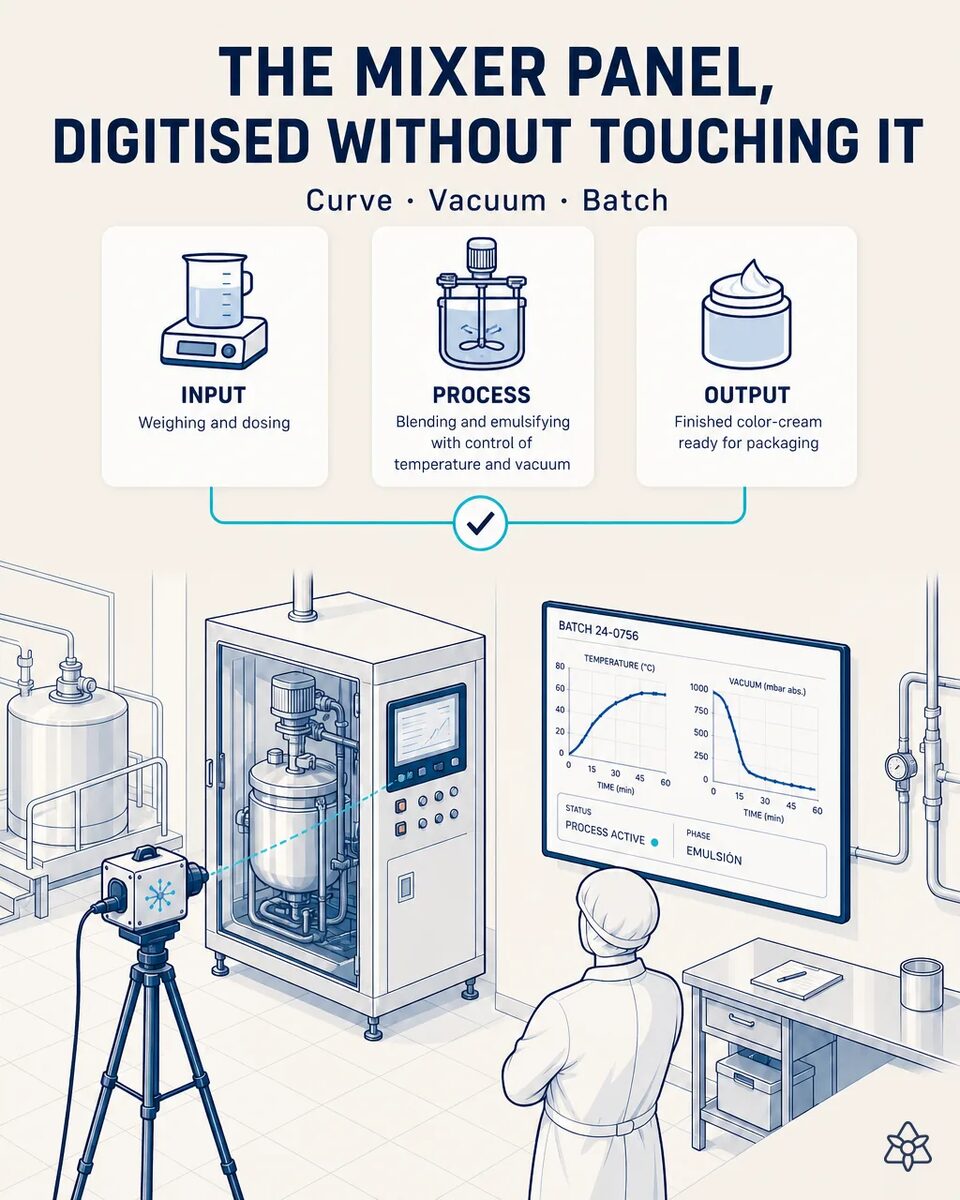
The data that explains the deviation dies when the screen rotates.
Replacing the machine means seven-figure capex and weeks of downtime, so the reasonable decision has always been to leave it alone. The price of that decision is that the panel data dies as soon as the screen rotates, and all that survives is the single reading somebody copied by hand at one moment of the phase. The consequence is very concrete for whoever has to close a deviation: when the lab returns an out-of-range viscosity, a phase separation or a shade that does not match the standard, correlating that result with what the machine actually did is impossible. Deviations get closed with hypotheses instead of data, and the same deviation comes back.
- The panel shows what determines whether the batch comes out right: temperature ramp and hold, vacuum, rotor-stator speed, phase time and pH.
- All of it disappears the moment the screen rotates. The only thing that survives is the one-off note somebody copied by hand at a particular moment.
- When the laboratory returns an out-of-range viscosity, a phase separation or a shade that does not match the standard, correlating it with what the machine did is impossible.
- Deviations get closed with no real root cause, and what has no cause happens again.
- The obvious way out is blocked by its price: replacing the machine is seven-figure capex and weeks of downtime.
Connect in photo mode on the panel — without touching the machine's control.
Connect in photo-on-panel mode. A fixed industrial camera points at the screen and captures every few seconds. OCR plus a grounded LLM interprets each frame, rebuilds the full time curve of the batch and cross-references the ERP to know which order and which shade were in the machine at that moment. Without touching the original control system, without revalidating the equipment, without opening its electrical cabinet. The curve becomes available per batch and can be crossed with the lab result.
The camera does not connect to the machine's control system and installs nothing on it. In a GMP plant that matters more than it sounds: there is no control change to revalidate, and the mixer's qualified status is the same as the day before.
Replacing the mixer versus reading its panel
| Aspect | Replacing the machine | With iLEAN Connect |
|---|---|---|
| Investment | Seven-figure capex | Industrial camera and commissioning |
| Production downtime | Weeks | None: installed while running |
| Machine qualification | Starts over | Untouched: control not modified |
| Process curve per batch | Yes, from zero history | Yes, from the first batch captured |
| Closing a deviation | Without objective data | With the batch curve in front of you |
| Parameters recorded | Three handwritten notes | A complete time series |
Estimated impact — to validate with your own numbers.
The block below is an estimate to be validated against your plant's actual data. We put it forward so the committee has an order of magnitude; we refine it during the assessment.
- Estimated payback 5-10 months.
- Fewer batches reprocessed because of a physicochemical deviation.
- Avoiding or indefinitely deferring the replacement capex of a manufacturing vessel.
- From zero correlation between curve and deviation, to root cause analysis per batch in minutes on objective data.
estimated payback of 5 to 10 months from the reduction in batches reworked for physico-chemical deviation, plus the avoidance or deferral of manufacturing-equipment replacement capex. *Estimate to validate*.
And the fair question from the production manager
«Is a camera watching a screen reliable enough for a quality investigation?» — it would not be if the model were asked to interpret an arbitrary image. Here it is an anchored task: fixed screen, fields in known positions and expected physical ranges, where the best models drop below 1.5% error [1]. And the system discards any frame whose value falls outside the possible range instead of accepting it.
[1] OpenAI paper "Why Language Models Hallucinate", 2025 — on the reliability of AI in anchored tasks.
What people ask about reading the mixer panel
Does it affect the machine's qualification?
No. The camera looks at the panel from outside: it does not connect to the controller, no software is installed on it and its program is not modified. There is nothing to revalidate.
What if the panel cycles through screens?
That is designed for. Capture cadence and optics are set to the rotation, and the system identifies which screen it is looking at before extracting any value from it.
What happens if somebody stands in front of it?
The frame is discarded and that instant is marked as having no reading. The value is not interpolated or invented, which is what would invalidate the record for an investigation.
Does it work for the other old machines in the plant?
Yes: the same pattern serves the premixer, the developer reactor or the packaging tunnel. You start with the mixer because it is the chemical heart and where the most expensive deviation sits.
How much history before it is useful?
To investigate a specific deviation, having the batch in question captured is enough. To detect machine drift you need some weeks, which is how long the trend takes to draw itself.
More cases from this series
- The audit stops costing person-weeksEvery critical change generates its dossier as it happens. Agents reorganises it by standard and flags…
- Batch start-up stops living on a sheet of paperThe manufacturing order and weighing sheet captured in one photo: the batch exists in central memory at…
- One mistyped digit cannot be allowed to cost a recallShade, lot and expiry travel from the active order to the coder with no intermediate typing, and the…
- Traceability is born at the dock, or it is not born at allPhoto of the delivery note, the lot labels and the certificate of analysis: everything enters the ERP…
- Shift knowledge stops dying at the end of the shiftHe dictates what he sees without breaking stride: iLEAN structures the issue against the active line,…
- The lab spreadsheet reaches the ERP on its owniLEAN reads the batch control sheet as it is saved, validates it and posts it to the ERP. Up to 80%…
Tell us which critical machine you have today with no data output.
We work on your plant's real data, not ours. Assessment with no commitment.
Request estimated ROI within 48h ‹ See all cases of hair color See cosmetics