Automated IMDS for components — the declaration stops eating the hours of the people who have the fewest to give.
IMDS eats hours of qualified people on every NPI — quality and environmental engineers who should be doing something else. iLEAN automates the declaration from the BOM and the material data, chases the suppliers who do not answer, and leaves the draft ready for human review. ELV/REACH covered with no dedicated team.
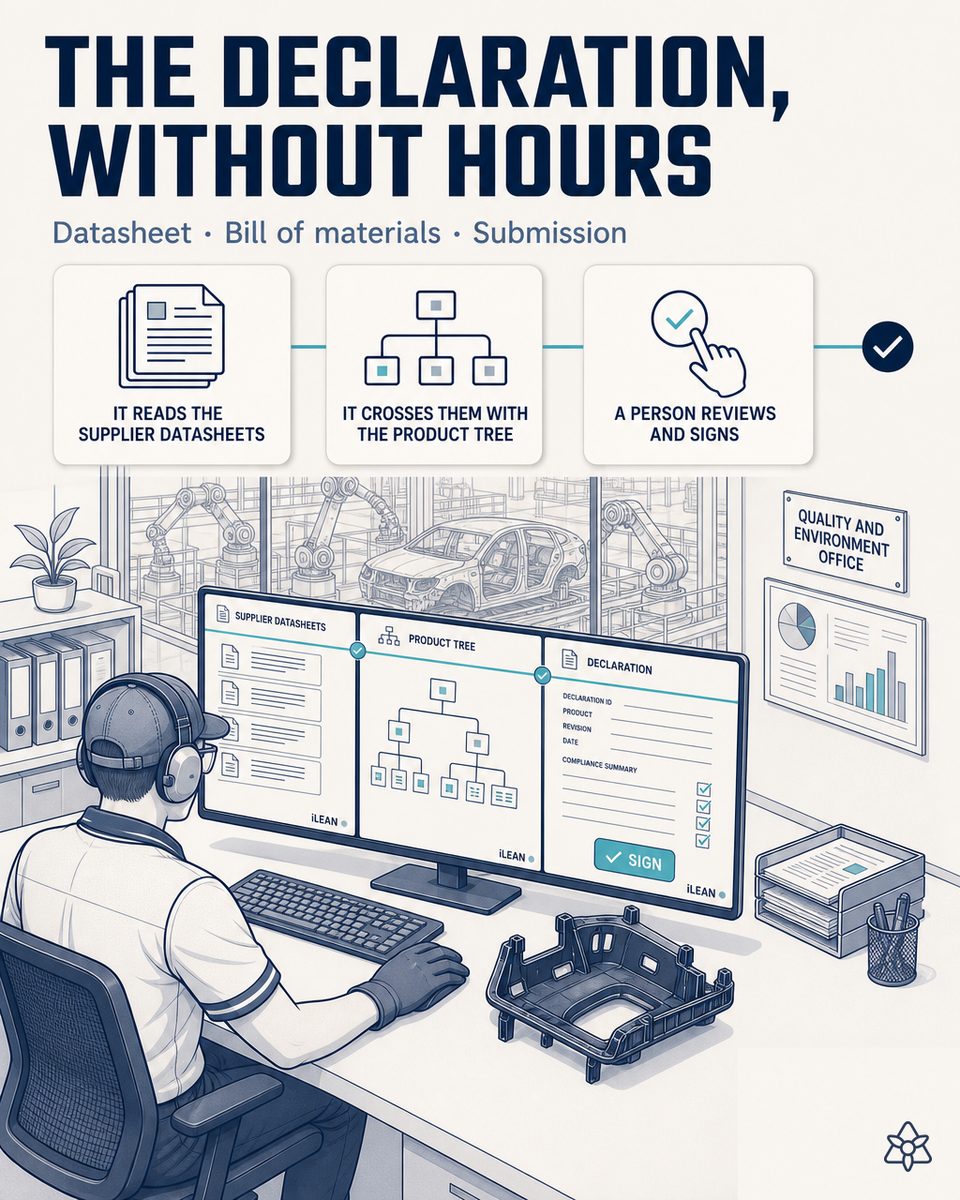
A declaration that is 80% chasing suppliers and 20% engineering.
IMDS is not hard — it is heavy. The IMDS owner in a tier-1 supplier spends most of their time on tasks that are nothing like what they trained for:
- Chasing the supplier who does not answer, or who answers with a scanned PDF of a material data sheet in their own format, in a language that is not the IMDS one, signed by someone who no longer works there.
- Reconciling two systems that do not talk to each other: the BOM in the PLM/ERP on one side, the material data sheets and certificates on the other, and the OEM's IMDS portal in the middle.
- Repeating the same work on every NPI — most part numbers use the same materials as last year from the same supplier, but somebody has to type it in again, ask again, sign again.
The result: the declaration arrives late, the OEM blocks invoicing, and the engineer — who knows about environmental compliance — spends the day in Outlook. IMDS is not handled badly because people do not know how; it is handled badly because they have no time.
iLEAN does not replace the IMDS engineer — it takes away the two hours of Outlook and leaves the two hours of judgment.
IMDS is a textbook case of the two classic gaps: the information lives in islands (BOM over here, material data sheet over there, the supplier's answer in an email) and nobody operates them (because doing it by hand takes hours and scarce people). iLEAN acts as the putty that stitches together the BOM, the material data sheets and the supplier answers, and composes the IMDS draft before the person sits down to review it.
Connect reads the BOM and the certificates whatever channel they come through. The agent chases the supplier on their own channel. Writer composes the IMDS draft on validated data. The person reviews and signs — never the other way round.
The iLEAN pieces applied to IMDS for automotive components:
- iLEAN Tracer — a structured base of part numbers and their materials: each part with its composition, its supplier, its batch, its declaration history. Built once with the data you already have (PLM, ERP, technical data sheets) and enriched afterwards with every new supplier answer.
- Connect — captures the BOM from the PLM/ERP, the material certificates at goods receipt (PDF, email, supplier portal), and the suppliers' answers when they respond to the reminder. Email, WhatsApp, SharePoint — everything comes in and becomes extractable data. For PDFs in a supplier's own format, the agent extracts the fields as an anchored task (it does not invent).
- iLEAN Brain + Writer — the agent walks through the NPI's BOM, looks up for each component the last valid declaration (same supplier + same material + no change), generates the reminder for the missing ones, and once it has the data composes the IMDS draft in the format the OEM asks for. The engineer receives the draft with the source of every field linked; they review, adjust anything that does not match, and sign. The system sends nothing to the OEM without a human signature.
Manual IMDS vs. agent-composed IMDS with iLEAN
| Aspect | Classic process (Outlook + IMDS portal) | With iLEAN Connect + Brain + Writer |
|---|---|---|
| Chasing a supplier who does not answer | Manual, reminders in Outlook, follow-up lost | An agent that writes, follows up and files the answer |
| Reuse of a valid previous declaration | Search the archive, type it in again | Reused automatically if supplier + material did not change |
| Material data sheet in a proprietary PDF | Open them one by one, copy data by hand | Anchored extraction (it does not generate, it reads and reformats) |
| Composing the declaration | Engineer fills in form after form | Draft composed with linked sources; the person reviews |
| ELV / REACH coverage | Separate work, one report per regulation | Same material base; immediate answer to both |
| Time per NPI | Days to weeks of a qualified engineer | Hours of review, not hours of typing |
Impact estimate for your plant — to be validated with your numbers.
The block below is an estimate to be validated with the specific data of your plant. We put it forward so the committee has an order of magnitude; we refine it during the deep dive.
- Tier-1 supplier with 100-500 active part numbers, 30-150 material suppliers, an NPI every few months, an IMDS team of 1-3 people (typically overloaded).
- Connect + agent pilot on a family with an NPI in progress. First value expected within a few weeks: the first agent-composed declaration, reviewed and accepted by the OEM.
- A reasonable reduction of person-time per declaration of ≥ 70% in the pilot, mainly by eliminating the rewriting of recurring declarations and the manual chasing of suppliers.
- Indicative payback between 4 and 9 months, measured in person-hours saved plus the reduced risk of invoicing being blocked by a late declaration.
And the quality / environmental director's reasonable doubt
“What if the agent declares the wrong material and the OEM approves it by mistake?” — composing an IMDS entry from an existing BOM and existing material data sheets is a textbook anchored task (the AI reformats data that is already there, it does not invent it). On that kind of task the best models brought error below 1.5% [1]. And even so, no IMDS entry goes out to the OEM without the person reviewing and signing. The three safety rings exist precisely for this: the agent composes, the engineer decides.
[1] OpenAI paper “Why Language Models Hallucinate”, 2025 — on the reliability of AI in anchored tasks, where the AI reformats or recontextualizes data already present in the system.
What people ask about automated IMDS with AI
What is IMDS and why is it mandatory?
IMDS (International Material Data System) is the automotive industry system where suppliers declare to OEMs the exact material composition of every part they ship — chemistry, mass, percentages — in order to comply with the ELV directive (end-of-life vehicles), REACH (chemical substances) and other circularity rules. Without an IMDS entry approved by the OEM, the part does not enter car production. In other words: it is not optional, it is a precondition for invoicing.
How does it connect to the existing BOM?
iLEAN Connect reads the BOM straight from the PLM/PDM or the ERP — whether that is SAP, Teamcenter, Windchill, a vertical tool or a spreadsheet in a shared folder. The agent walks through it component by component and identifies which ones already have an approved material data sheet and which ones are missing. For the missing ones, Writer drafts the declaration from the information that does exist (material family, technical specifications, previous declarations from the same supplier) and leaves it ready for the responsible person to review and submit.
What about suppliers who do not answer, or answer badly?
That is probably the biggest pain in the IMDS process — and the easiest to automate. iLEAN Connect keeps the suppliers on a list and runs an agent that writes to them (email, supplier portal, whatever each one uses), follows up, files the answer when it arrives, and re-extracts the data from the technical data sheet they attach even when it comes as a scanned PDF or in the supplier's own format. When a recurring supplier always delivers the same material with the same composition, the agent learns it and proposes the declaration without asking again. The person validates and signs — the agent never sends anything to the OEM on its own.
Does it also cover ELV and REACH, or only IMDS?
It covers all three, and whatever comes next. IMDS is the format; ELV and REACH are the regulations IMDS serves. The material database iLEAN builds along the way (the real composition of each part number, declarable substances, thresholds exceeded) is reused to answer a REACH question (does this part contain any SVHC above 0.1%?) or to prepare an ELV declaration (recyclable percentage, restricted substances). You build it once and reuse it for every regulatory question in the sector.
Is the saving really measurable?
Yes, and it is one of the few cases where ROI is calculated in hours of a highly qualified person. IMDS is typically handled by a quality or environmental engineer with deep sector knowledge — their time is expensive and scarce. Each NPI can take them from several hours to several days, multiplied by every new part number and every supplier change. Cutting that time by ≥ 70% in a pilot is perfectly achievable (estimate to be validated with your numbers). The lever is not hiring fewer people — it is freeing that person up for real environmental work instead of filling in forms.
More cases in automotive
- Alloy wheel quality control with AI — pull the bad part before plating, not after.How iLEAN cross-references Edge vision over alloy wheel casting and machining, porosity X-ray and…
- Aluminum casting control with AI — porosity is invisible at demolding; finding it at the leak test means paying twice.iLEAN detects porosity and shrinkage at demolding and correlates the defect with injection parameters —…
- Aluminum FSW welding with AI — a kissing bond is invisible to the eye and shows up in the destructive test two days later.iLEAN combines FSW torque, force and temperature to detect defects in automotive aluminum instantly.
- Industrial AI cases in automotive body structural assemblyReal-world AI cases for stamping, forming and welding automotive structural parts: Connect, Edge and…
- Industrial AI for automotive electronic panel and switch plantsTwelve industrial AI cases in control panel, switch and column module plants: SMT, unit traceability and…
- Industrial AI in automotive fluid transfer and air coupling plantsTwelve real industrial AI cases in fluid line and air coupling plants: Connect, Edge and Agents working…
Tell us your case and in 48h we'll send you the estimated ROI of this automated IMDS project for your plant.
We work on your plant's real data, not ours. Diagnostic with no commitment.
Request estimated ROI in 48h See automotive