Scrap receiving enters the ERP with a photo, not with typed lines
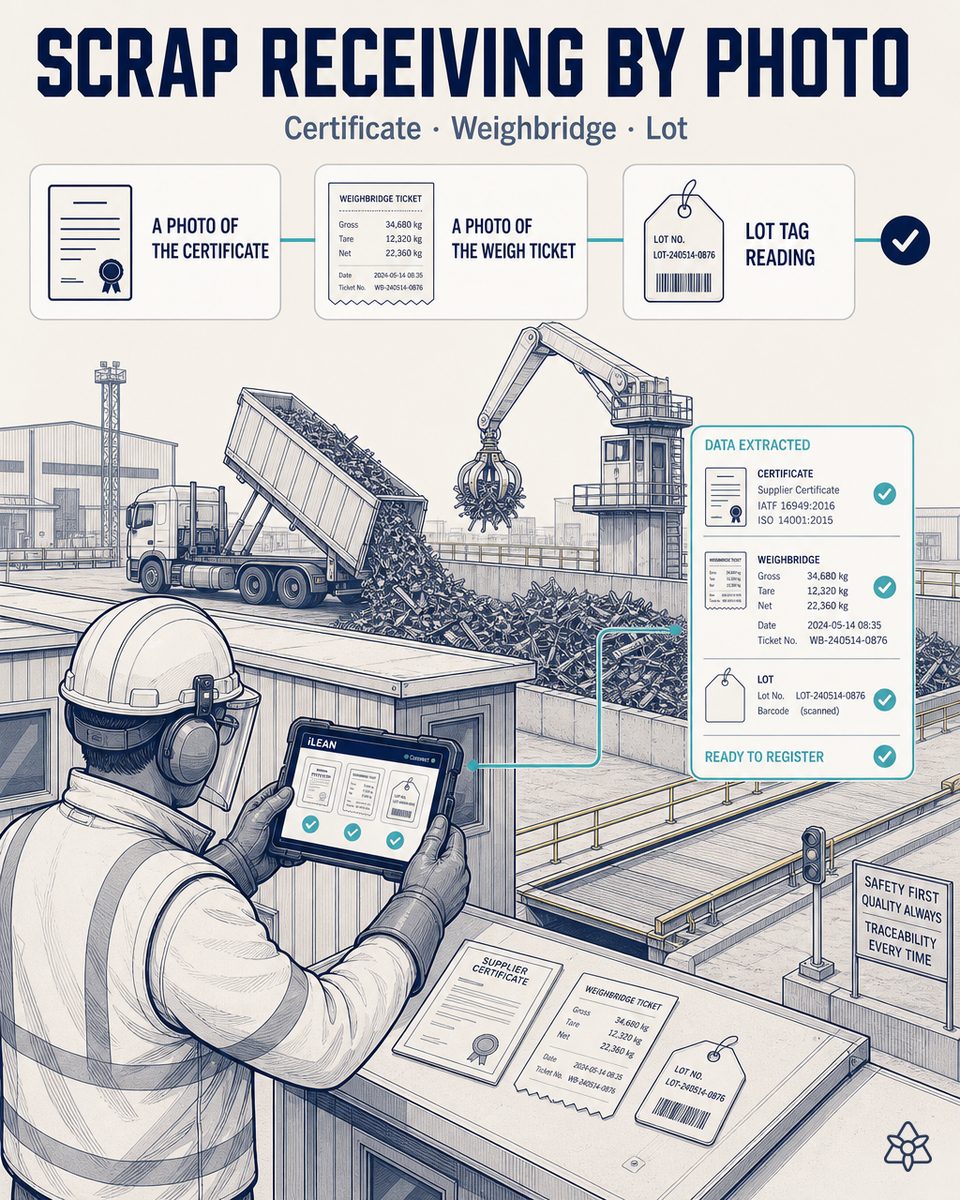
At scrap receiving the yard manager gets the supplier certificate, the weighbridge ticket and the lot tags. Instead of typing into the MM module grade by grade, they take a photo with the tablet. iLEAN Connect digitizes in seconds, validates with one tap and pours it into the ERP. The truck stops blocking the yard.
Scrap receiving is where the yard gets blocked — and where the chemistry deviation is born that appears weeks later.
In a long steel plant, every scrap truck arrives with its certificate, crosses the weighbridge and unloads, and today all of that entry goes through the yard manager's keyboard:
- The supplier certificate — the mix of scrap grades with their percentages, typed grade by grade into the MM module while the truck waits 30-45 minutes charging demurrage in the yard.
- The weighbridge ticket — inbound and outbound weights cross-checked by hand against the certificate and the order, with the carrier waiting on the record to leave.
- The lot tags — jotted down in haste to release the truck as soon as possible, exactly when getting a grade wrong is easiest.
And if the yard manager types fast, miscategorized grades get in. A wrong grade is not visible in the yard or in the basket: it appears weeks later as an unexplained chemistry deviation in the heat. And the traceability of the non-radioactivity certificate breaks when the paper gets lost between trucks — precisely the document you have to be able to show if the origin of a load is ever investigated.
Connect in photo-over-analog mode — certificate, weighbridge ticket and tags into the ERP with certificate→basket→heat traceability, no typing.
Scrap receiving needs no new workstation in the yard and no change to supplier paperwork. It needs the certificate that already arrives in the truck cab, the ticket the weighbridge already prints and the tags the lots already carry to enter the ERP at zero latency, with the right grade mix. That is what Connect does in photo-over-analog mode.
The yard manager photographs the certificate, the weighbridge ticket and the tags with the industrial tablet. AI vision extracts the grade mix, the weights and the lots, cross-checks them against each other and against the order, and after one validation tap everything is poured into the ERP MM and WM modules — the truck never waited on typing.
How Connect photo mode works at receiving in a long steel plant:
- A photo of the supplier certificate — AI vision recognizes each supplier's certificate format, without asking them to change theirs and with no predefined templates, and digitizes the grade mix by OCR in seconds.
- A photo of the weighbridge ticket — OCR on the standard ticket template: inbound and outbound weights extracted and cross-checked against the certificate without typing a figure.
- Lot tag reading — Connect reads the barcode or QR of each tag with the tablet camera, with no dedicated scanner.
- One-tap validation — the yard manager reviews what was extracted on the industrial tablet; if a grade does not match the certificate or a figure falls below the confidence threshold, Connect flags it before the tap. The person decides, not the system.
- Transfer to MM and WM over API — after validation, the receipt is recorded in the ERP MM and WM modules with certificate→basket→heat traceability from minute zero: every load, with its photographed certificate and its lot, tied to its receipt.
Scrap receiving with manual typing vs. receiving digitized with Connect
| Aspect | Classic receiving with manual typing | With iLEAN Connect photo |
|---|---|---|
| Truck time in the yard | 30-45 min, charging demurrage | 5 min — photo and one-tap validation |
| Recording the certificate | Grade mix typed grade by grade into the MM module | A photo of the certificate — automatic OCR extraction |
| Weighbridge ticket | Weights cross-checked by hand against certificate and order | OCR on the standard template, automatic cross-check |
| Lot tags | Jotted down in haste, error-prone | Barcode or QR with the tablet camera |
| Grade errors | Hidden — surface weeks later as an unexplained chemistry deviation | Zero — flagged and corrected in the yard |
| Certificate→basket→heat traceability | Broken — the paper gets lost between trucks | Closed by photo and API, protecting against the radioactivity risk |
Impact estimate for your plant — to be validated with your own numbers.
The block below is an estimate to be validated against your plant's actual data. We put it forward so the committee has an order of magnitude; we refine it during the assessment.
- Long steel plant with an electric furnace receiving scrap from several suppliers: inbound weighbridge, unloading yard, dozens of trucks a week, one certificate with its grade mix per load.
- Connect photo pilot on receiving — just the yard's industrial tablet, with no construction work and no new supplier integration. It starts after the first kick-off meeting.
- The ERP MM/WM modules today require 3-4 users with an active license to type in receipts. With Connect only 1 validator remains: typical reduction of 50-70% in MM/WM module licenses. Estimate to be validated.
- Indicative payback of 3 to 8 months, plus a recurring saving on licenses and the elimination of carrier demurrage in the yard. Estimate to be validated against your data.
- On top of the hard CFO lever — fewer MM/WM licenses, a recurring annual saving defensible in committee, and fewer truck hours charging demurrage — comes the avoidance of the costs of the chemistry deviation from miscategorized grades and of the lost certificate, measurable from the first month of the pilot. Estimate to be validated.
And the fair question from the plant manager
"What if the system misreads a scrap grade or ties a certificate to the wrong truck?" — hallucination is a problem of free generation, not of anchored tasks. In tasks where the AI merely recontextualizes a specific figure from one medium to another (reading the printed certificate, the weighbridge ticket and the lot tags and extracting their fields), the best models brought the error below 1.5% [1]. And even then, the critical call is not made alone: if a grade does not match the certificate or a figure falls below the confidence threshold, Connect holds the receipt and the person validates with one tap on the tablet. The three safety rings exist precisely for this.
[1] OpenAI paper "Why Language Models Hallucinate", 2025 — on the reliability of AI in anchored tasks.
What people ask about scrap receiving in a long steel plant
Does Connect recognize the scrap certificate even when every supplier uses a different format?
Yes, with no predefined templates and without asking the supplier to change their format. AI vision recognizes the layout of each certificate — the grade listing from a waste manager, each recycler's own document, the certificate that arrives stapled to the weighbridge ticket — and extracts scrap grades, percentages, weights and lots the same way in every case. When a new supplier enters the panel, Connect learns their format over the first receipts and the yard manager's flow does not change: a photo of the certificate, a photo of the ticket and the tags, and one validation tap on the tablet.
How does Connect protect the traceability of the non-radioactivity certificate?
The certificate is photographed and tied over API to the ERP receipt at the moment of receiving: truck, weighbridge ticket, lot and supplier. The certificate→basket→heat chain stops depending on a paper that can get lost between trucks: if weeks later the origin of a load has to be evidenced or a heat's traceability reconstructed, the document is recovered from the ERP within seconds. Connect does not replace the detection portals at the plant entrance; it guarantees that the document backing each load stays filed, legible and tied to its lot from minute zero, reinforcing the defense against the radioactivity risk.
How does Connect keep a badly recorded grade mix from ending in a chemistry deviation?
Because the grade error stops slipping in through fast typing. AI vision extracts the mix of scrap grades with their percentages from the certificate, cross-checks it against the weighbridge ticket weight and against the order, and if a grade does not add up or a figure falls below the confidence threshold, it flags it on the tablet before the validation tap. A miscategorized grade gets corrected in the yard — it does not appear weeks later as an unexplained chemistry deviation in the heat that forces correcting the charge with more expensive ferroalloys and opening an origin investigation with no paper left to consult.
What changes for the carrier in the scrap yard?
Nothing in how they work: they cross the weighbridge, hand over the certificate and wait for the receipt to be recorded before unloading and leaving. What changes is how long that wait lasts and what it costs. Instead of 30-45 minutes with the demurrage clock running while the yard manager types the mix grade by grade into the MM module, they wait for the certificate and the ticket to be photographed, the lot tags to be read and the one-tap validation: about 5 minutes. The carrier installs nothing, needs no app and does not change how they hand over the paperwork.
How is the 50-70% saving on MM/WM module licenses calculated?
Scrap receiving today usually requires 3-4 users with an active license for the ERP MM/WM modules to type in certificates, tickets and tags. With Connect the capture is done by the photo and only 1 validator keeps a license: from 3-4 users to 1, a typical reduction of 50-70% in that module's licenses. The calculation is made with the real per-user annual rate of your plant's ERP contract — that produces a recurring annual saving defensible in committee, on top of the truck hours without demurrage and the avoided costs of the chemistry deviation. Estimate to be validated against your numbers during the assessment.
More cases from this series
- Every heat ships with its audit dossier already madeEvery heat ships with its auditable dossier: charge mix, chemistry, rolling record and certificates,…
- The coil marker stitched to the active order, with no retypingHeat number, grade and customer travel from the active order to the coil marker with no retyping: the…
- The customer alert, read within seconds instead of hoursOrder changes, quality alerts and scrap supply delays are read, classified and cross-checked against the…
- The electric arc furnace panel already talks — without touching its PLCA camera reads the electric arc furnace panel and every heat carries its real energy and power-on curve…
- Heat startup in the melt shop, digitized with a photographThe heat startup sheet is photographed and the heat exists in the central system at zero latency: scrap…
- The lab spreadsheet poured into the ERP, without retypingChemistry and mechanical readings move from the lab spreadsheet into the ERP with no retyping — and…
A Connect pilot in your scrap yard — it starts after the first kick-off meeting.
We work on your plant's real data, not ours. Assessment with no commitment.
Request estimated ROI within 48h ‹ See all 12 long steel cases See steel