Zero foreign material in the bag
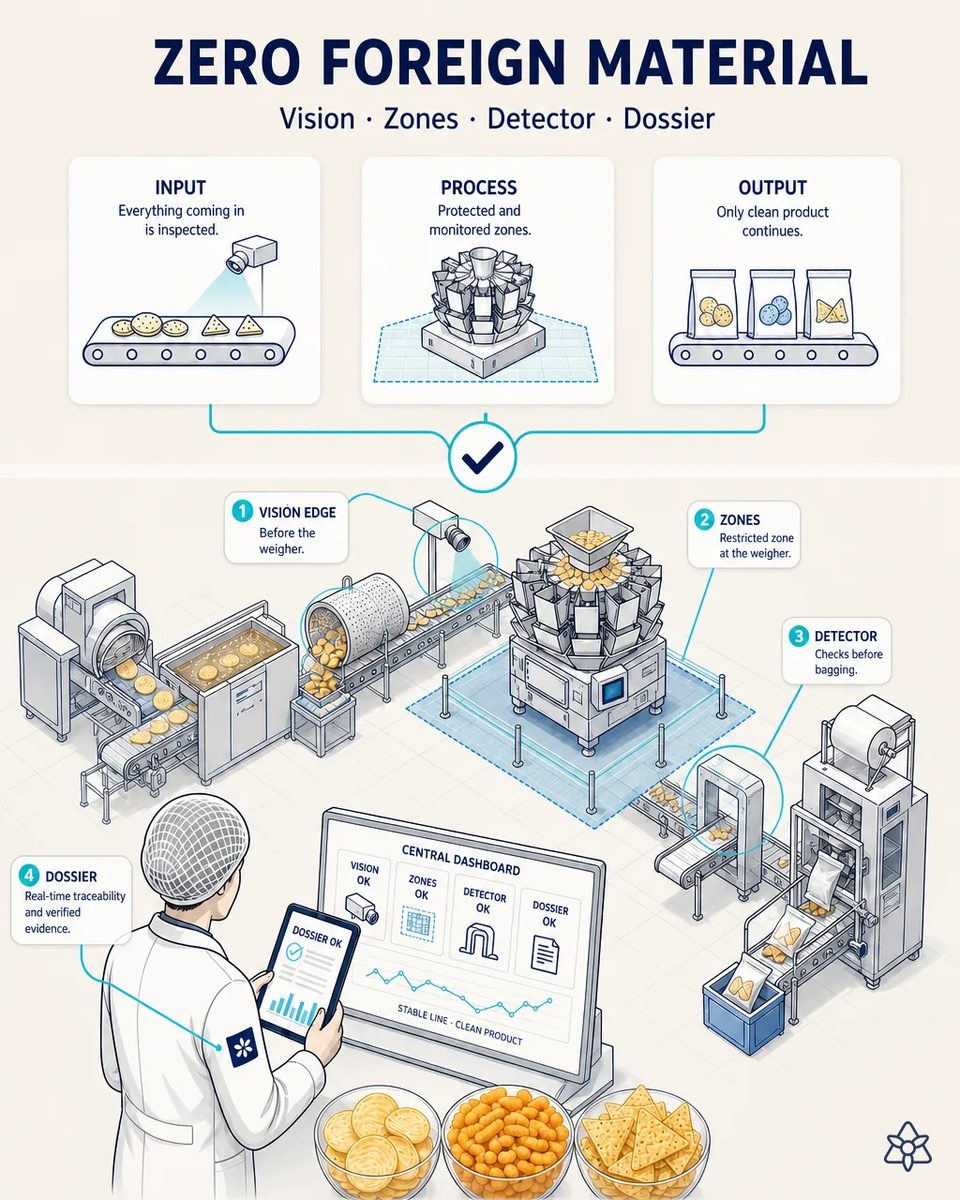
The core pain of a savory snack plant is foreign material: a piece of plastic, wood, cardboard, a stone that came with the potatoes or a belt fragment. A single such complaint costs consumer trust, recalls and extraordinary audits. First ring: an Edge camera before the weigher spots pieces that are not product and rejects them. Second ring: a zone camera on the weigher platform sees whether a hopper is left open or an off-protocol access happens, without identifying anyone, and alerts the supervisor.
The metal detector covers metal. Everything else goes through.
The core pain of a savory snack plant is foreign material: a piece of plastic, wood, cardboard, a stone that came with the potatoes or a belt fragment. A single such complaint costs consumer trust, recalls and extraordinary audits. Metal detectors and magnets cover metal. But plastic, wood, paper or rubber go straight through, and human visual inspection cannot keep up with line speed.
- The core pain of a savory snack plant is foreign material: a piece of plastic, wood, cardboard, a stone that came with the potatoes or a belt fragment.
- A single such complaint costs consumer trust, recalls and extraordinary audits from retailers, and it can reach social media before it reaches quality. One incident can undo years of brand building.
- Metal detectors and magnets cover metal. Plastic, wood, paper or rubber go straight through, and human visual inspection cannot keep up with line speed.
- When a finding does happen, nobody can say whether it came from the field, receiving, a maintenance job or an open hopper at the weigher.
Four coordinated rings — vision, zones, detector and dossier.
First ring: an Edge camera before the weigher spots pieces that are not product and rejects them. Second ring: a zone camera on the weigher platform sees whether a hopper is left open or an off-protocol access happens, without identifying anyone, and alerts the supervisor. Third ring: metal detector and vision rejects are stitched to the lot in the ERP; if they repeat, JIDOKA AI proposes stopping the line and the supervisor decides. Fourth ring: Agents leaves every lot with its evidence dossier.
No ring is enough on its own: each covers what the others cannot see. The strength is in the coordination, because a vision reject, an open hopper and a metal detector trip on the same lot tell a story that no single control can. And every finding is sent back to where it started.
The four rings against foreign material, and what each one closes
| Ring | Where it acts | What it closes |
|---|---|---|
| 1 · Edge vision | Belt before the multihead weigher | Plastic, wood, cardboard and stones the detector misses |
| 2 · Hygienic zones | Weigher platform | Open hoppers and off-protocol access, without identifying anyone |
| 3 · Detector linked to the lot | Metal detector and vision rejects in the ERP | Repeated rejects that call for JIDOKA AI to propose a stop |
| 4 · Evidence dossier | Every lot, via Agents | Where each finding came from: field, receiving, maintenance or people |
| Input from earlier cases | Receiving (7), start-up (1), changeover (10) | The origin of the potatoes and the state of the line |
| Who decides a stop | The supervisor | JIDOKA AI proposes; a person decides |
Foreign material is stopped on the line, not at the consumer, and every finding goes back to its source: field, receiving, maintenance or people. Estimated payback of six to twelve months against the first complaint or recall avoided; estimate to be validated with quality and plant management.
Impact estimate — to be validated with your numbers.
The block below is an estimate to be validated against your plant's actual data. We put it forward so the committee has an order of magnitude; we refine it during the assessment.
- Estimated payback 6-12 months against the first complaint or recall avoided; estimate to be validated with quality and plant management.
- Foreign material is stopped on the line, not at the consumer, and every reject is kept with its lot, so the evidence of what was caught is as complete as what was shipped.
- Every finding goes back to its source, field, receiving, maintenance or people, so the fix lands where the problem starts.
- Extraordinary audits after a complaint become a query on the dossier instead of a week of reconstruction, and the retailer gets an answer backed by images and records.
Payback 6-12 months against the first complaint or recall avoided (estimate to be validated)
And the fair question from the production manager
“Can a camera really tell a piece of brown cardboard from a dark potato chip?” — it is trained on your own product and on real contaminant samples under that belt's lighting, which makes it an anchored task, where the best models drop below 1.5% error [1]. And it is not alone: the metal detector, the zone camera and the dossier cross-check each other, and any stop is decided by the supervisor, not by the model.
[1] OpenAI paper "Why Language Models Hallucinate", 2025 — on the reliability of AI in anchored tasks.
What people ask about zero foreign material in snack bags
Does this replace the metal detector or the X-ray?
No. The metal detector stays as the reference for metal. iLEAN adds vision for what it cannot see and links every reject to the lot, so repeated trips become a pattern instead of a count on a shift sheet.
Does the zone camera at the weigher identify operators?
No. It detects situations, an open hopper or an access outside the protocol, without identifying anyone, and alerts the supervisor so the situation is corrected on the spot. The images are about the equipment, not the people.
What about stones and soil that arrive with the potatoes?
They are the first source to cut: receiving captures the grower and the sampling, and Edge vision before the weigher catches what got past washing, peeling and the slicer. When stones repeat, the grower gets the evidence.
Do all four rings have to be installed together?
No. They are built in layers and each case pays on its own. Many plants start with Edge vision before the weigher and add the zones, the detector link and the dossier afterwards.
How is the return estimated before committing in a snack plant?
With your complaint history, the cost of the last foreign material incident and your volume per line, we estimate the return of each ring before deciding the order. The first ring is usually chosen by where the last complaint came from.
More cases from this series
- Food safety audit, always readyiLEAN Agents assembles the food safety dossier per lot: cleanings, metal detector, weights and…
- Camera-validated flavor changeoverEdge cameras on drum, hopper and belts: the snack line does not start the new flavor until cleaning is…
- The continuous fryer panel, read by a cameraA camera reads the fryer panel without touching the PLC and stores the oil curve per lot to link it with…
- The lab spreadsheet flows into the ERP on its owniLEAN reads the quality spreadsheet (moisture, oil, salt, color) and, after validation, pushes it to the…
- Line tablet: validated in two tapsEverything iLEAN captures goes through a line tablet: the operator confirms in two taps before data…
- Potato lot alert: re-plan before the fryeriLEAN reads the potato supplier alert, cross-checks it with active orders and proposes re-planning…
Tell us what your last foreign material complaint cost you.
We work on your plant's real data, not ours. Assessment with no commitment.
Request estimated ROI within 48h ‹ See all cases of savory snacks See food industry