Potato lot alert: re-plan before the fryer
In a potato chip plant the raw material rules: dry matter, reducing sugars and size change with the field, the variety and storage time. A lot with high sugars comes out of the fryer too dark. With iLEAN Connect the procurement mailbox and WhatsApp number are in copy. As soon as the alert comes in, the system extracts supplier, lot, dry matter and sugars, and cross-checks them against active orders.
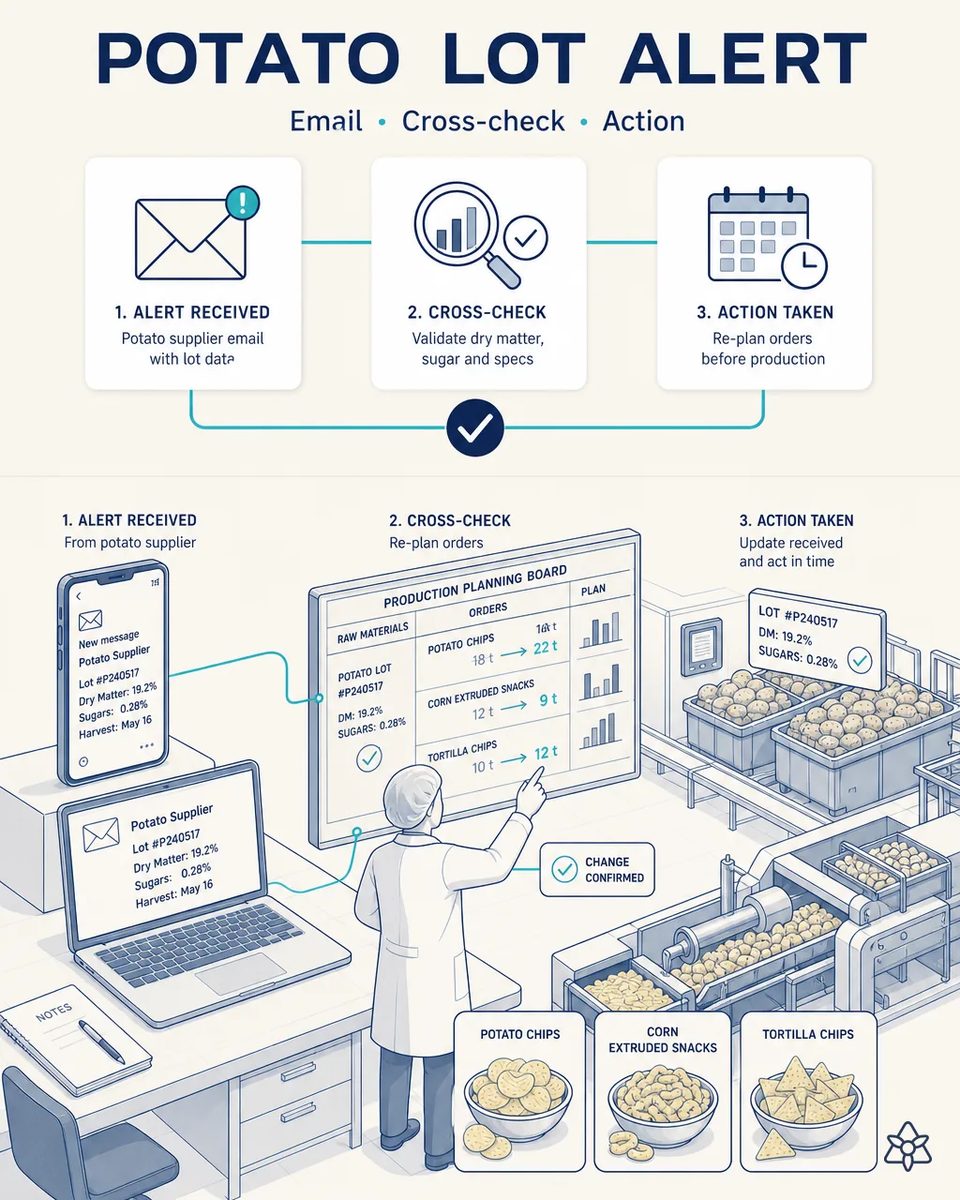
The raw material changes every week, and the warning reaches one person.
In a potato chip plant the raw material rules: dry matter, reducing sugars and size change with the field, the variety and storage time. A lot with high sugars comes out of the fryer too dark. The grower or the storage site warns by email or WhatsApp to one specific person, who reads it hours later, when that lot is already peeled and sliced. Result: color scrap, rework and blind fryer adjustments.
- In a potato chip plant the potato rules: dry matter, reducing sugars and size change with the field, the variety and the weeks in storage, and no recipe can ignore that.
- A lot with high reducing sugars comes out of the continuous fryer too dark, and dark chips also carry more acrylamide risk, which quality has to keep under control lot after lot, season after season.
- The grower or the storage site warns by email or WhatsApp to one specific buyer, who reads it hours later, when that lot is already peeled and sliced.
- The result is color scrap, rework and blind fryer adjustments on the line, while the lot that would have fried well is still waiting in the warehouse.
Connect in silent-copy mode — the procurement channels, read the moment they arrive.
With iLEAN Connect the procurement mailbox and WhatsApp number are in copy. As soon as the alert comes in, the system extracts supplier, lot, dry matter and sugars, and cross-checks them against active orders. The planner gets a proposal: move that lot to a product less sensitive to color or adjust the fryer profile, and pull another lot forward. The planner decides and confirms; iLEAN only prepares the decision.
Knowing sooner is only half of it. What changes the day is the cross-check: which orders that lot was going to feed and which other lot can take its place. That is what reaches the planner, already prepared, with the original message one tap away and the affected orders already listed.
An alert in one inbox versus an alert crossed with the plan
| Aspect | Today | With iLEAN Connect |
|---|---|---|
| Grower or storage warning | Read when the buyer is free | Read the moment it arrives |
| Dry matter and sugar values | Buried in the message | Extracted per lot |
| Orders affected | Worked out by hand, if at all | Listed automatically |
| The high-sugar lot | Discovered at the fryer exit | Moved before the slicer |
| Fryer profile | Adjusted blind | Adjustment proposed with data |
| Who decides the re-plan | Whoever reads it first | The planner — iLEAN prepares |
Less color scrap and fewer stops for lack of suitable raw material. Estimated payback of three to seven months depending on alert frequency; estimate to be validated.
Impact estimate — to be validated with your numbers.
The block below is an estimate to be validated against your plant's actual data. We put it forward so the committee has an order of magnitude; we refine it during the assessment.
- Estimated payback 3-7 months, depending on how often growers and storage sites send alerts.
- Less color scrap: unsuitable lots go to products less sensitive to color or get a different fryer profile before the first bag is filled, which is when changing course is still cheap.
- Fewer stops for lack of suitable raw material, because the replacement lot is pulled forward in time instead of in a rush at the end of the shift, with the slicer already waiting.
- From hours of lag between the warning and the plant reacting to seconds, at any hour the message arrives.
Payback 3-7 months · from hours of lag to seconds (estimate to be validated)
And the fair question from the production manager
“Is the AI going to re-plan my lines on its own?” — no. It reads the alert, extracts supplier, lot, dry matter and sugars, and proposes; the planner decides and confirms. Pulling those values out of a message is an anchored task, where the best models drop below 1.5% error [1], and the proposal shows the original message next to it so the planner can check the source before moving a single lot.
[1] OpenAI paper "Why Language Models Hallucinate", 2025 — on the reliability of AI in anchored tasks.
What people ask about potato lot alerts
Does it read our buyers' personal email?
No. iLEAN sits in copy on a dedicated procurement mailbox and a company WhatsApp number. It only sees what growers and storage sites send to those channels, and nothing else in anyone's inbox. Buyers keep their own email as it is.
Which values does it extract from a grower's message?
Supplier, lot, variety, dry matter, reducing sugars, size and any defect mentioned. If a value is missing, the proposal says so instead of guessing, and the planner can ask the grower for it before the lot reaches the slicer.
Does it also cover corn for extruded snacks and tortilla chips?
Yes. A corn supplier warning about moisture or a delayed delivery is read the same way and crossed with the orders that corn was meant to feed on the extruder or the tortilla chip line. The cross-check is the same; only the quality values change.
What does the planner actually receive?
A short proposal: which orders are affected, which product is less sensitive to color, which lot can be pulled forward and what fryer profile adjustment makes sense. The planner accepts, edits or discards it, and that decision is stored with the lot for the next time the same grower warns, so patterns per supplier and per storage site become visible.
What if the alert comes as a PDF lab report attached to the email?
Attachments are read as well. Storage sites often send fry tests and sugar analyses as PDFs, and those are exactly the values that decide whether a lot is fit for chips.
More cases from this series
- Food safety audit, always readyiLEAN Agents assembles the food safety dossier per lot: cleanings, metal detector, weights and…
- Camera-validated flavor changeoverEdge cameras on drum, hopper and belts: the snack line does not start the new flavor until cleaning is…
- The continuous fryer panel, read by a cameraA camera reads the fryer panel without touching the PLC and stores the oil curve per lot to link it with…
- The lab spreadsheet flows into the ERP on its owniLEAN reads the quality spreadsheet (moisture, oil, salt, color) and, after validation, pushes it to the…
- Line tablet: validated in two tapsEverything iLEAN captures goes through a line tablet: the operator confirms in two taps before data…
- Potato and corn receiving with one photoPhotograph the scale ticket and quality sample: iLEAN extracts lot, weight and defects and, after one…
Tell us how many potato lots last season came out of the fryer too dark.
We work on your plant's real data, not ours. Assessment with no commitment.
Request estimated ROI within 48h ‹ See all cases of savory snacks See food industry