The continuous fryer panel, read by a camera
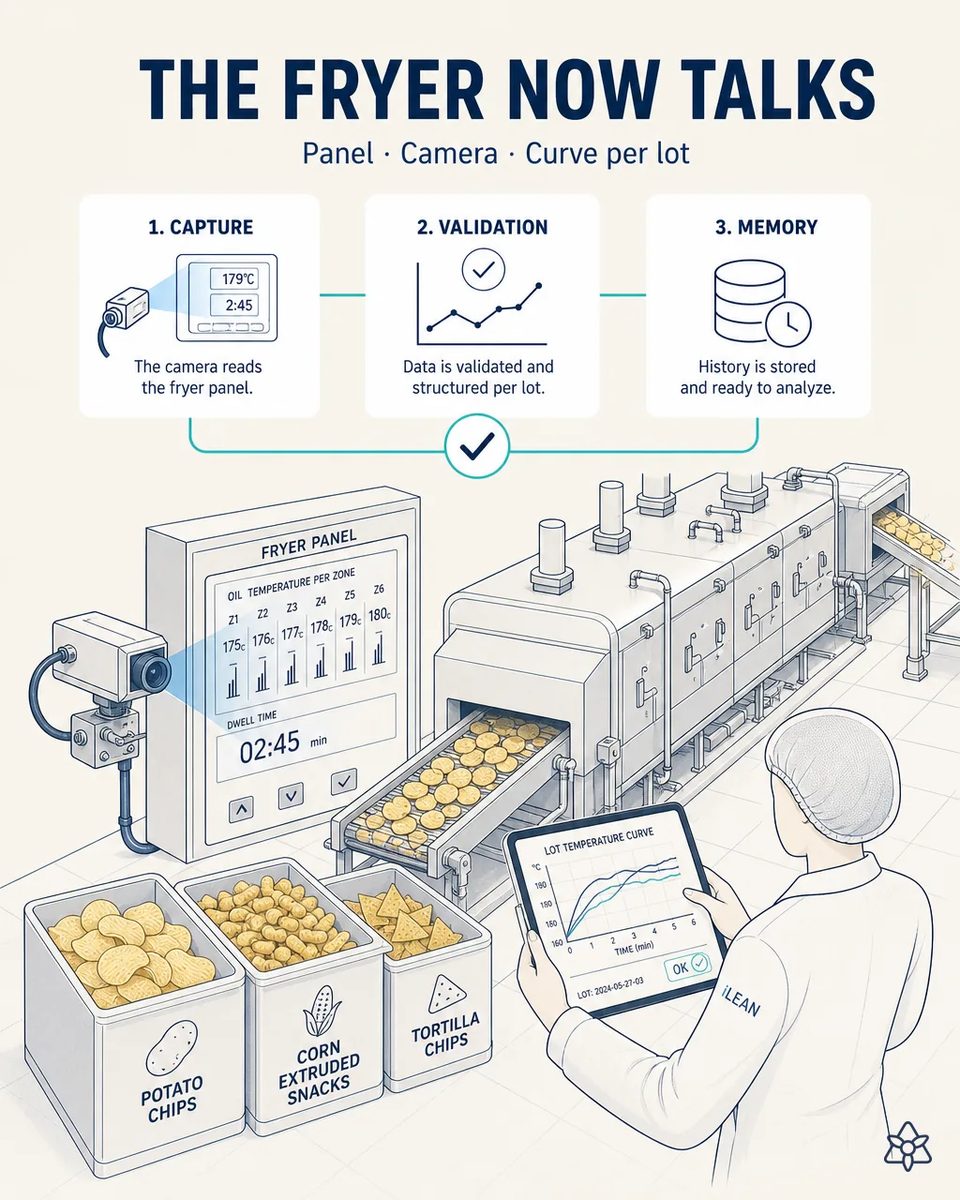
The continuous fryer is the most expensive asset and the one that decides color, moisture and oil content of every chip. Its panel shows oil temperature per zone, dwell time and alarms, but in many plants it is an old control with no network. iLEAN Connect mounts an external camera in front of the panel. It reads the screen every few seconds, interprets the values with an anchored model and builds the temperature curve per lot, without touching the PLC or the OEM warranty.
The machine that decides every chip leaves no history behind.
The continuous fryer is the most expensive asset and the one that decides color, moisture and oil content of every chip. Its panel shows oil temperature per zone, dwell time and alarms, but in many plants it is an old control with no network. Replacing the control costs a lot of money and days of downtime. Meanwhile the screen scrolls on and nobody keeps the curve: when a burnt lot or a dark-chip complaint arrives, there is no way to correlate it with what the fryer did.
- The continuous fryer is the most expensive asset on the line and the one that decides color, moisture and oil content of every chip that goes into a bag, and also how fast the frying oil degrades.
- Its panel shows oil temperature per zone, dwell time and alarms, but in many plants it runs an old control with no network and no data export, often by the OEM's own design. Opening it up is not an option maintenance will sign.
- Replacing the control means a large CAPEX and days without frying. Meanwhile the screen scrolls on and the curve is lost every few seconds, shift after shift.
- When a burnt lot or a dark-chip complaint arrives, there is no way to see whether zone 3 dropped, the belt sped up or the frying oil was due for a top-up.
Connect reading the panel from outside — nothing is installed on the fryer.
iLEAN Connect mounts an external camera in front of the panel. It reads the screen every few seconds, interprets the values with an anchored model and builds the temperature curve per lot, without touching the PLC or the OEM warranty. The curve sits in central memory next to the lot and the lab results. The production manager sees in minutes whether the burning matched a temperature drop or a speed change.
The camera looks at the screen the way an operator would, only every few seconds and without getting tired. The fryer's PLC, its software and its OEM warranty stay exactly as they are, which is what makes the case approvable by maintenance. And the curve lands next to the lab results of the same lot, which is where it becomes useful.
A fryer that forgets versus a fryer on record
| Aspect | Today | With iLEAN Connect |
|---|---|---|
| Oil temperature per zone | On screen, then gone | A curve stored per lot |
| Dwell time and belt speed | Noted once per shift, at best | Read every few seconds |
| A burnt lot | Blamed on the potatoes | Matched to the fryer behavior |
| The PLC and OEM warranty | — | Untouched |
| Control retrofit | Next year's CAPEX | Can be postponed |
| Curve next to the lab results | Impossible | Same screen, same lot |
Root cause per lot in minutes, less scrap from burnt product and a control replacement that can be postponed. Estimated payback of five to ten months; estimate to be validated.
Impact estimate — to be validated with your numbers.
The block below is an estimate to be validated against your plant's actual data. We put it forward so the committee has an order of magnitude; we refine it during the assessment.
- Estimated payback 5-10 months.
- Root cause of a burnt or dark lot in minutes instead of a meeting full of hypotheses about potatoes, oil and operators. The discussion moves from opinions to a curve everyone can see.
- Less scrap from burnt product once the temperature drops and speed changes that cause it become visible to the production manager.
- And the control retrofit CAPEX can be deferred, because the data it would have given you is already coming in from the camera.
Payback 5-10 months · control retrofit CAPEX deferred (estimate to be validated)
And the fair question from the production manager
“Can a camera on a greasy screen really be trusted?” — the panel has fixed fields in known positions and the values move inside a known physical range, so this is an anchored task, where the best models drop below 1.5% error [1]. A frame that is unreadable, fogged by steam or out of range is discarded instead of stored, and the camera housing is chosen for the fryer environment. A gap in the curve is better than a false point.
[1] OpenAI paper "Why Language Models Hallucinate", 2025 — on the reliability of AI in anchored tasks.
What people ask about reading the continuous fryer panel
Does the fryer OEM have to be involved?
No. Nothing is connected to the PLC and no software is installed on the machine, so the warranty and the OEM service contract are not affected. Maintenance usually signs off in the first meeting for that reason, and installation takes hours, not a planned stop.
What about steam and oil mist in front of the screen?
They are a design condition, not a surprise. The camera goes in a housing suited to the area and frames that are not readable are discarded instead of producing false values in the curve.
Can the curve be tied to acrylamide or color results?
Yes: the curve is stored next to the lot and the lab results, so the quality team can see whether high color readings line up with a hotter zone or a slower belt. That is the analysis nobody can do today, because the curve was never kept long enough to compare.
How often does the camera read the panel in a snack plant?
Every few seconds, which is enough to rebuild a temperature curve per zone and catch drops that the shift sheet, filled in once or twice, never shows. The rate is tuned to the fryer's own dynamics, so a short dip after a frying oil top-up is not missed. Zones are read separately, so a single cold zone stands out.
Does it read the fryer alarms as well?
It reads what appears on the screen, alarms included, and stores them with their time. That is how a burnt lot gets linked to the alarm nobody wrote down because the line was busy.
More cases from this series
- Food safety audit, always readyiLEAN Agents assembles the food safety dossier per lot: cleanings, metal detector, weights and…
- Camera-validated flavor changeoverEdge cameras on drum, hopper and belts: the snack line does not start the new flavor until cleaning is…
- The lab spreadsheet flows into the ERP on its owniLEAN reads the quality spreadsheet (moisture, oil, salt, color) and, after validation, pushes it to the…
- Line tablet: validated in two tapsEverything iLEAN captures goes through a line tablet: the operator confirms in two taps before data…
- Potato lot alert: re-plan before the fryeriLEAN reads the potato supplier alert, cross-checks it with active orders and proposes re-planning…
- Potato and corn receiving with one photoPhotograph the scale ticket and quality sample: iLEAN extracts lot, weight and defects and, after one…
Tell us which continuous fryer you run and we will tell you whether its panel can be read.
We work on your plant's real data, not ours. Assessment with no commitment.
Request estimated ROI within 48h ‹ See all cases of savory snacks See food industry