Weighers and checkweighers stitched to the ERP
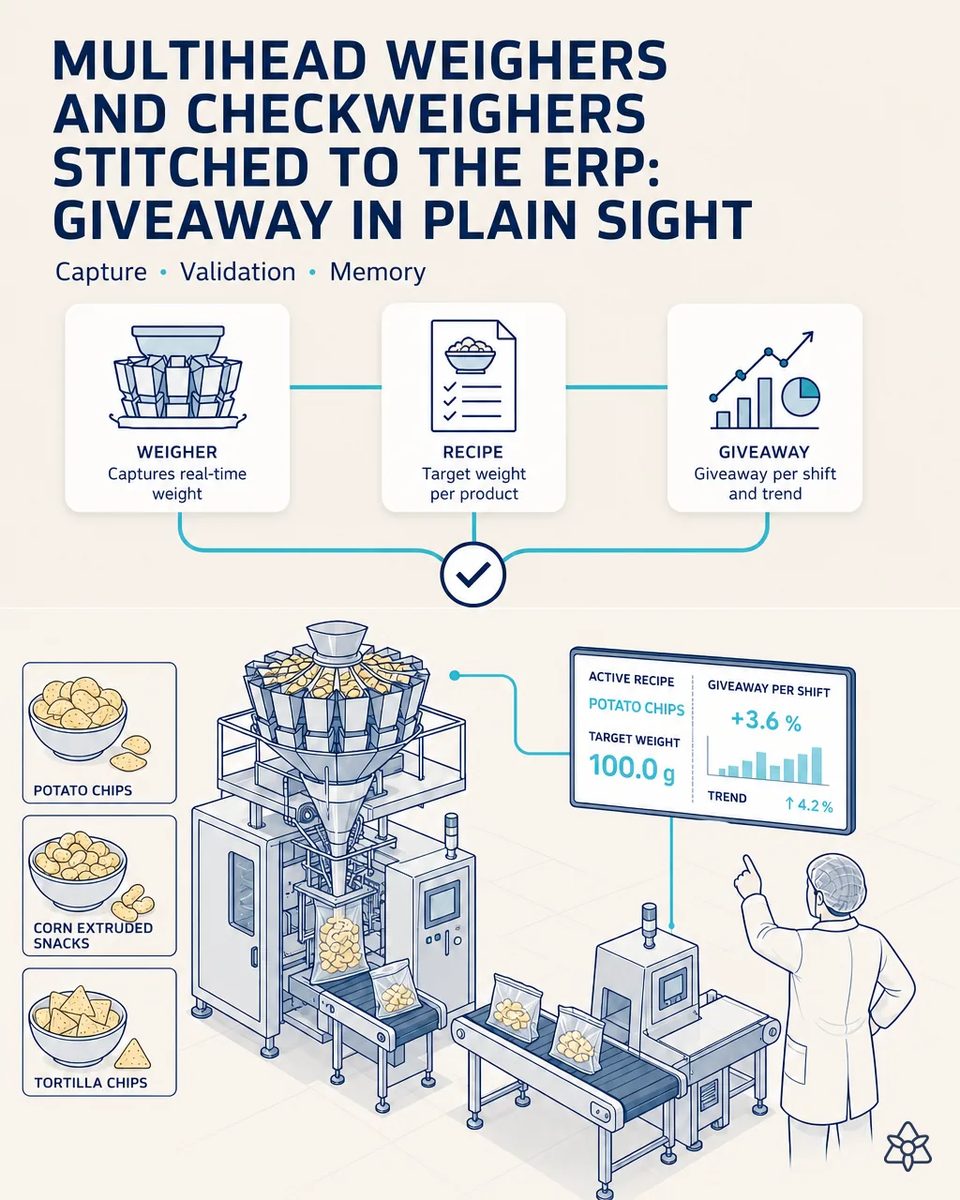
The multihead weighers and checkweighers on the packing line are only a few years old and already have a data interface. But they are isolated: the target weight for each pack size is typed by hand at every changeover. iLEAN Connect links ERP, weighers and checkweighers through APIs. When the order starts, the recipe publishes target weight and tolerances to the machines; the checkweigher sends back actual weights and rejects.
Modern weighers, typed by hand at every changeover.
The multihead weighers and checkweighers on the packing line are only a few years old and already have a data interface. But they are isolated: the target weight for each pack size is typed by hand at every changeover. A wrong digit leaves bags underweight or, more often, gives product away: a few extra grams per bag, at hundreds of bags per minute, add up to a lot of money a year.
- The multihead weighers and checkweighers on the packing line are only a few years old and already have a data interface nobody uses. The investment is already made; it just is not connected.
- But they work isolated: the target weight and tolerances for each pack size are typed by hand at every changeover, from memory or from a printed list taped to the machine. Every pack size and flavor change is a new chance for a wrong digit.
- A wrong digit leaves bags underweight or, more often, gives product away. A few extra grams per bag at hundreds of bags per minute add up to a lot of money a year.
- And the checkweigher's actual weights and rejects stay on its screen, so nobody sees giveaway per shift until the month's yield is closed and the money is already gone.
Connect stitching ERP, weighers and checkweighers through their APIs.
iLEAN Connect links ERP, weighers and checkweighers through APIs. When the order starts, the recipe publishes target weight and tolerances to the machines; the checkweigher sends back actual weights and rejects. The packing lead sees giveaway per line, pack size and shift in real time, and decides the adjustment. Nothing changes on the machine without that confirmation.
None of the machines is replaced. The order publishes the recipe, the weighers receive it and the checkweigher sends back what really went into each nitrogen-flushed bag. The packing lead decides the adjustment; nothing changes on the machine without that confirmation.
Isolated weighers versus weighers stitched to the order
| Aspect | Today | With iLEAN Connect |
|---|---|---|
| Target weight at a pack size change | Typed on the weigher panel | Published by the order |
| Tolerances per pack size | Remembered or looked up | Sent with the recipe |
| Checkweigher actual weights | Stay on its screen | Back in the system per bag |
| Giveaway per line and shift | Known at month end | Visible in real time |
| Underweight bags | Found by the checkweigher, unexplained | Linked to the recipe and the setting |
| Changes on the machine | Whoever is at the panel | Only after the packing lead confirms |
Zero typing errors at changeovers and less product giveaway. Estimated payback of three to six months depending on volume; estimate to be validated.
Impact estimate — to be validated with your numbers.
The block below is an estimate to be validated against your plant's actual data. We put it forward so the committee has an order of magnitude; we refine it during the assessment.
- Estimated payback 3-6 months, depending on volume.
- Less product giveaway from overweight bags, which is usually the largest silent loss on the packing floor of a snack plant.
- Zero typing errors at pack size and flavor changeovers, which is when most wrong target weights are entered, usually under time pressure.
- Giveaway per line, pack size and shift on screen, so the adjustment is made the same day instead of at month end. The packing lead sees which line and pack size are drifting, not just a monthly total.
Payback 3-6 months · less product giveaway from overweight (estimate to be validated)
And the fair question from the production manager
“And if the ERP sends a wrong target weight to the weigher?” — the recipe comes from the order the plant already trusts, and the value is checked against the tolerances defined for that pack size before it is published. Matching order, pack size and recipe is an anchored task, where the best models drop below 1.5% error [1], and the packing lead confirms the change before the weigher applies it. A mismatch stops the publish, not the line, and the lead sees exactly which value disagrees.
[1] OpenAI paper "Why Language Models Hallucinate", 2025 — on the reliability of AI in anchored tasks.
What people ask about connecting multihead weighers to the ERP
Do we have to replace the weighers or the checkweighers?
No. The case works with the data interface they already have. If one older model has no interface, it is read through its panel with a camera, as in the fryer case of this same series. No weigher is opened or reprogrammed.
How is giveaway calculated per shift?
From the checkweigher's actual weights against the target weight of the active recipe, grouped by line, pack size and shift. It is the same figure you compute at month end, only every minute, while there is still time to act on it.
Does it account for nitrogen-flushed bags and settling?
The target weight and tolerances are the ones your recipe defines, nitrogen flushing included. iLEAN publishes and measures against them; it does not change the spec your quality team set. If the spec changes, it changes in the recipe, once.
Can it change the weigher settings on its own when giveaway rises?
No. It shows the trend and proposes the adjustment; the packing lead decides and confirms. Nothing changes on the machine without that confirmation, and every change is logged with who approved it and why, so a later giveaway spike can be traced to the change that caused it.
Does it help with underweight complaints?
Yes, because each lot keeps its actual weights from the checkweigher. Answering a retailer about a short-weight claim becomes a query instead of an argument over a sample. The actual weights of that lot are already on record.
More cases from this series
- Food safety audit, always readyiLEAN Agents assembles the food safety dossier per lot: cleanings, metal detector, weights and…
- Camera-validated flavor changeoverEdge cameras on drum, hopper and belts: the snack line does not start the new flavor until cleaning is…
- The continuous fryer panel, read by a cameraA camera reads the fryer panel without touching the PLC and stores the oil curve per lot to link it with…
- The lab spreadsheet flows into the ERP on its owniLEAN reads the quality spreadsheet (moisture, oil, salt, color) and, after validation, pushes it to the…
- Line tablet: validated in two tapsEverything iLEAN captures goes through a line tablet: the operator confirms in two taps before data…
- Potato lot alert: re-plan before the fryeriLEAN reads the potato supplier alert, cross-checks it with active orders and proposes re-planning…
Tell us how many grams per bag you think you are giving away today.
We work on your plant's real data, not ours. Assessment with no commitment.
Request estimated ROI within 48h ‹ See all cases of savory snacks See food industry