Paperless shift start-up in a savory snack factory
In a savory snack plant every shift starts with a printed production order and the fryer control sheet: oil temperature, belt speed, scheduled flavor, first readings. That paper defines the lot, yet it sits in a folder until someone retypes it. With iLEAN Connect the supervisor takes one photo of the order and one of the fryer sheet. The system recognizes the layout, extracts lot, flavor, line and settings, and stores them in central memory. Zero change of habit: the paper still exists, it just stops getting lost.
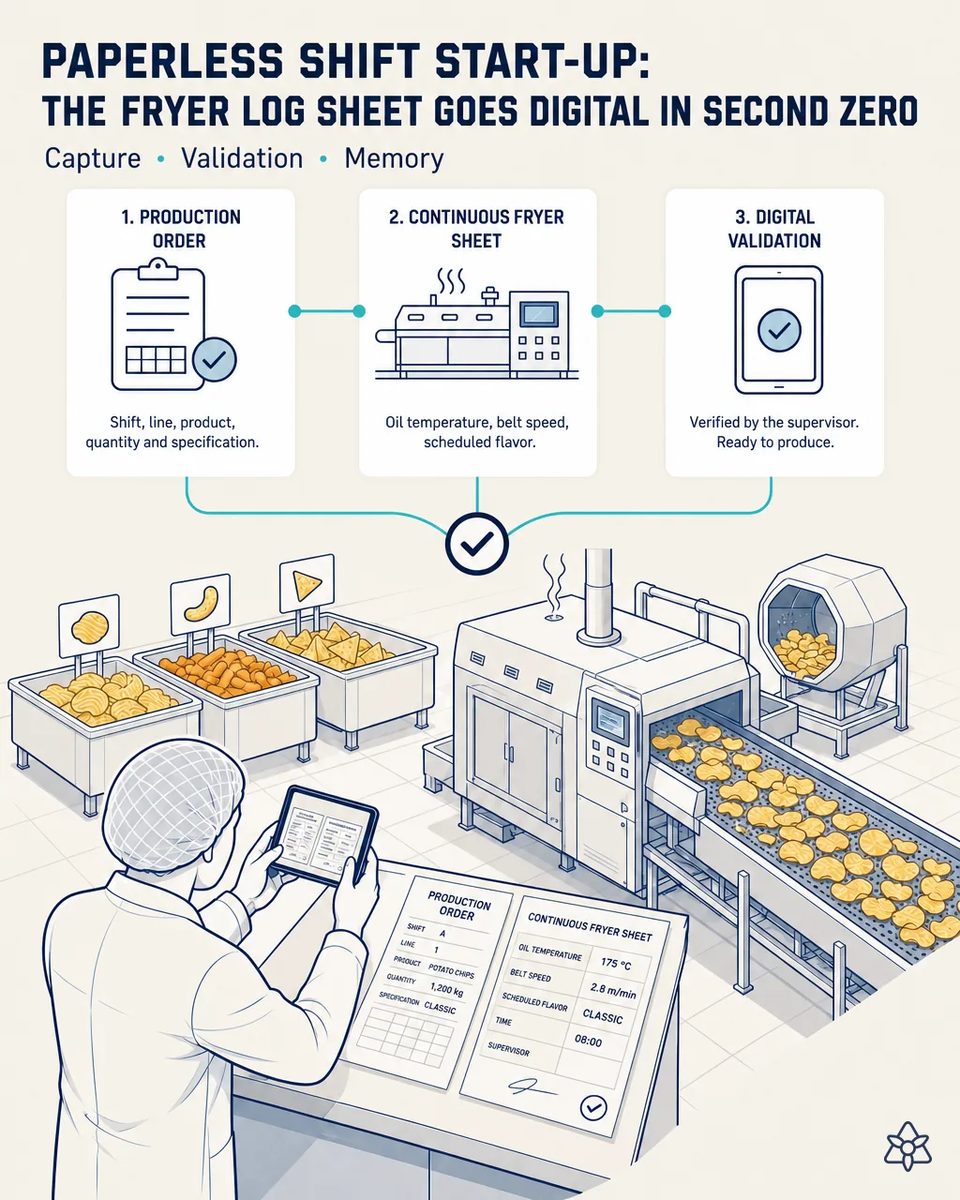
The two sheets that define the lot spend half a shift in a folder.
In a savory snack plant every shift starts with a printed production order and the fryer control sheet: oil temperature, belt speed, scheduled flavor, first readings. That paper defines the lot, yet it sits in a folder until someone retypes it. Between the supervisor writing it down and someone keying it in, four to eight hours go by. If a dark chip or an under-seasoned bag shows up mid-morning, nobody can check on the spot what the fryer was set to at start-up.
- The production order says line, product, quantity and flavor. The fryer sheet says what really happened at start-up: frying oil temperature per zone, belt speed, slicer thickness and first readings.
- Both are filled in by hand at the fryer and both end up in the same folder until someone in the office has time to key them in, usually between two other urgent tasks.
- Between the supervisor's signature and the keyboard, four to eight hours go by. On a night shift, the lot simply waits until the office opens the next morning.
- When a dark chip or an under-seasoned bag turns up mid-morning, the first question is what the fryer was set to at start-up, and the answer is in a folder nobody can reach from the line.
Connect in photo mode — the supervisor keeps the sheets, the system gets the data.
With iLEAN Connect the supervisor takes one photo of the order and one of the fryer sheet. The system recognizes the layout, extracts lot, flavor, line and settings, and stores them in central memory. Zero change of habit: the paper still exists, it just stops getting lost. The extracted data shows up on the line tablet and the supervisor confirms it with two taps. Humans in command: nothing enters the central system until a person has seen it.
Nobody on the fryer floor learns anything new: the sheet is still filled in by hand and photographed in the same minute. That is why this is usually the first case a snack plant approves, and the one the rest are built on. Every later case, from the lab spreadsheet to the evidence pack, hangs its data on the lot that is born here.
The fryer start-up on paper versus the fryer start-up captured
| Aspect | Today, on paper | With iLEAN Connect |
|---|---|---|
| When the snack lot exists in the system | 4-8 h after start-up | Seconds after the photo |
| Frying oil temperature at start-up | Handwritten, filed | Stored per zone and per lot |
| Slicer thickness and belt speed | Only if someone types them | Extracted with the rest of the sheet |
| Night shift lots | Wait for the office to open | Same treatment as the day shift |
| A dark-chip complaint at 11:00 | Search the folder | One query by lot |
| Supervisor's routine at the fryer | — | Two photos and two taps |
The lot exists in the system in second zero, retyping disappears and any deviation investigation starts with the start-up data. Estimated payback of four to nine months depending on lines and shifts; estimate to be validated.
Impact estimate — to be validated with your numbers.
The block below is an estimate to be validated against your plant's actual data. We put it forward so the committee has an order of magnitude; we refine it during the assessment.
- Estimated payback 4-9 months, depending on the number of lines and shifts.
- From a 4-8 hour data lag to seconds: the lot exists in the system while it is still being fried, not the next morning.
- Retyping disappears, and with it the transcription errors that only surface when a lot is investigated and the figures do not add up.
- Every deviation investigation starts from the start-up data instead of from someone's memory of what the fryer looked like that morning.
Payback 4-9 months · from 4-8 h data lag to seconds (estimate to be validated)
And the fair question from the production manager
“What if it reads 175 as 178 on the fryer sheet?” — reading fields from a sheet whose layout is always the same is an anchored task, where the best models drop below 1.5% error [1]. The value also has to fall inside the physical range for frying oil, or it is flagged instead of stored. On top of that, the summary goes to the line tablet and the supervisor confirms or corrects it before anything crosses into the system.
[1] OpenAI paper "Why Language Models Hallucinate", 2025 — on the reliability of AI in anchored tasks.
What people ask about digitizing the fryer start-up sheet
Do we have to redesign the fryer control sheet?
No. The model learns the layout of the sheet you already use, including the boxes people fill in by hand. If each line has its own version, each one is read as it is, and nobody has to agree on a new form. The supervisor keeps writing where they always wrote.
Does it capture the handwritten corrections the supervisor adds at start-up?
Yes, and they are often the most useful part: a zone raised two degrees or a slicer thickness changed after the first readings. A low-confidence value is flagged for the supervisor to confirm instead of being guessed.
Does it tell potato chips, extruded snacks and tortilla chips apart?
It reads the product and flavor written on the order, so each lot is filed under the right family. The fryer settings stay attached to that lot whatever the product is, which is what makes later comparisons possible: the same fryer, the same flavor, two different shifts.
What happens on a night shift with nobody in the office?
Nothing different: the photo is taken at the fryer, the supervisor confirms on the tablet and the lot exists in the system at three in the morning just as it would at ten. The office finds it already there.
Do we need the ERP connected before starting this snack line case?
No. It runs from the first shift against iLEAN's central memory, and the push to the ERP is added later, once the value has been shown on the floor and IT has seen the data is clean.
More cases from this series
- Food safety audit, always readyiLEAN Agents assembles the food safety dossier per lot: cleanings, metal detector, weights and…
- Camera-validated flavor changeoverEdge cameras on drum, hopper and belts: the snack line does not start the new flavor until cleaning is…
- The continuous fryer panel, read by a cameraA camera reads the fryer panel without touching the PLC and stores the oil curve per lot to link it with…
- The lab spreadsheet flows into the ERP on its owniLEAN reads the quality spreadsheet (moisture, oil, salt, color) and, after validation, pushes it to the…
- Line tablet: validated in two tapsEverything iLEAN captures goes through a line tablet: the operator confirms in two taps before data…
- Potato lot alert: re-plan before the fryeriLEAN reads the potato supplier alert, cross-checks it with active orders and proposes re-planning…
Tell us how many hours a fryer start-up takes to reach your system today.
We work on your plant's real data, not ours. Assessment with no commitment.
Request estimated ROI within 48h ‹ See all cases of savory snacks See food industry