Seasoning and burnt chips inspected at 100%
Thousands of chips per minute pass the seasoning drum exit. The human eye tires and lets the three classic complaints through: burnt chips, unseasoned chips and seasoning clumped into lumps. iLEAN Edge places a camera over the belt, trained on good and bad examples of the actual product: potato, extruded or tortilla chip. It infers in milliseconds inside the plant, without sending images to the cloud.
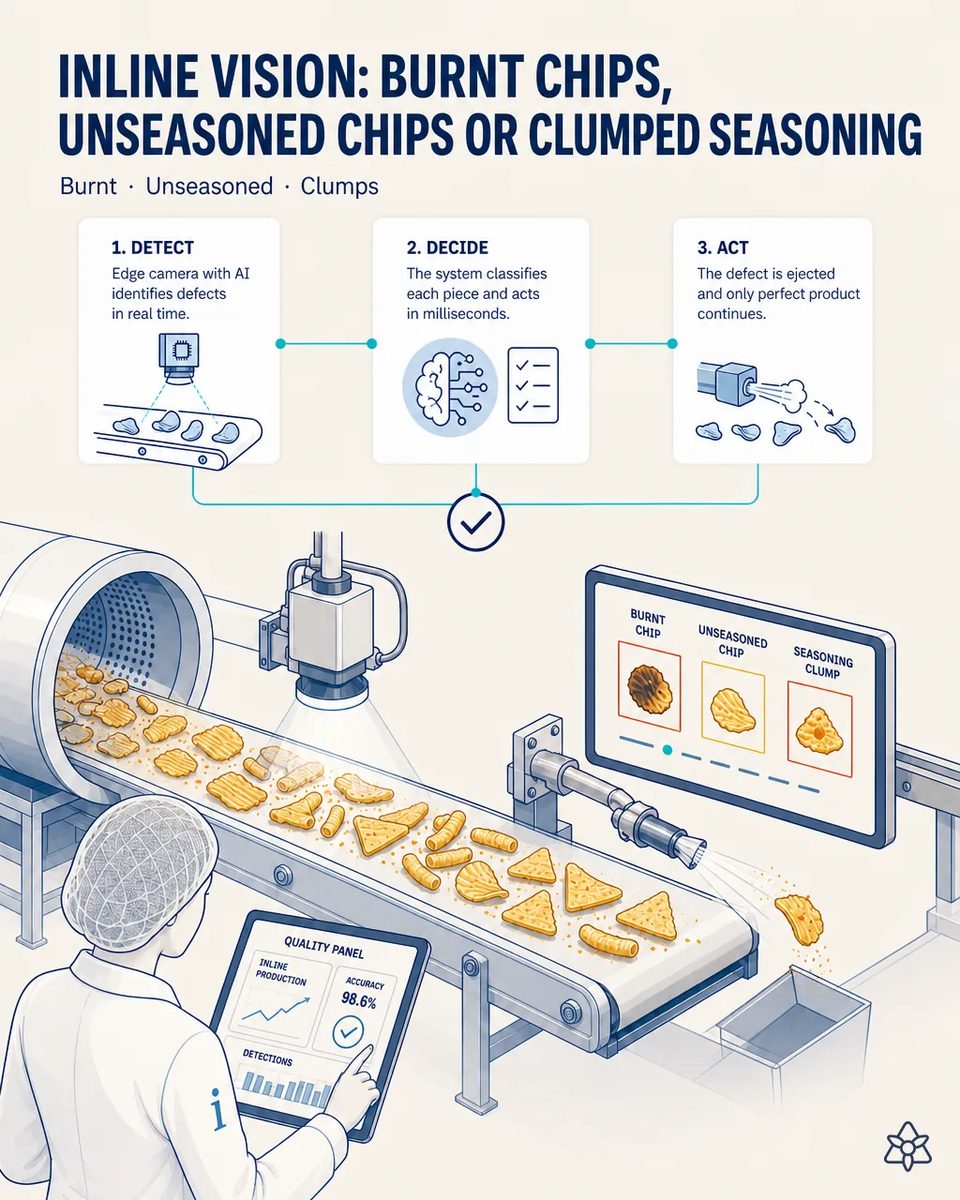
Three complaints repeat, and sampling cannot catch them.
Thousands of chips per minute pass the seasoning drum exit. The human eye tires and lets the three classic complaints through: burnt chips, unseasoned chips and seasoning clumped into lumps. Quality checks a sample every so often. Between samples, a seasoner that starts clumping or a hotter fryer zone can fill hundreds of bags.
- Thousands of chips per minute pass the seasoning drum exit. The human eye tires and lets the three classic complaints through: burnt chips, unseasoned chips and seasoning clumped into lumps.
- Quality checks a sample every so often. Between two samples, a seasoner that starts clumping or a hotter fryer zone can fill hundreds of bags.
- A burnt chip is not only a complaint: dark pieces are also the ones that concentrate acrylamide, which quality has to keep as low as reasonably achievable. Removing them before the weigher helps on both fronts.
- And when the complaint arrives, nobody can say whether it was a one-off piece or half an hour of drifting seasoning on that line. Without data, the answer to the retailer is an apology and a promise.
Edge over the belt — inference in milliseconds, inside the plant.
iLEAN Edge places a camera over the belt, trained on good and bad examples of the actual product: potato, extruded or tortilla chip. It infers in milliseconds inside the plant, without sending images to the cloud. The defective piece is rejected before the weigher and, if the trend rises, the supervisor is told: the seasoner is clumping or the fryer has drifted. The person decides the adjustment.
The camera does two jobs at once. It removes the defective piece before the multihead weigher, and it tells the supervisor when the defect rate rises, which is the earliest signal that the seasoner or the fryer has drifted. The first job saves bags; the second saves shifts.
Sampling at the seasoner versus 100% inspection with Edge
| Aspect | Sampling | With iLEAN Edge |
|---|---|---|
| Burnt chips | Found in the bag by the consumer | Rejected before the weigher |
| Unseasoned or bare chips | Seen if they fall in the sample | Classified piece by piece |
| Seasoning lumps | Reported weeks later | Detected as they leave the drum |
| A seasoner starting to clump | Discovered at the next sample | Flagged by the rising trend |
| Images sent to the cloud | — | None: inference stays in the plant |
| Product families | One inspector, all products | A model per potato, extruded or tortilla |
From sampling to 100% inspection, fewer complaints and a root cause visible on the spot. Estimated payback of five to twelve months depending on current scrap; estimate to be validated.
Impact estimate — to be validated with your numbers.
The block below is an estimate to be validated against your plant's actual data. We put it forward so the committee has an order of magnitude; we refine it during the assessment.
- Estimated payback 5-12 months, depending on current scrap and complaint levels.
- From sampling to 100% inspection at the seasoning drum exit, on every shift and every flavor, including the night shift when attention is lowest.
- Fewer consumer complaints for burnt chips, bare chips and seasoning lumps, which are the ones that reach retailers and social media first.
- A root cause visible on the spot: clumping seasoner or drifting fryer, with the time it started and the lots it touched. That turns a complaint reply into a precise answer with a time window and the number of pieces rejected.
Payback 5-12 months · 100% inspection vs sampling (estimate to be validated)
And the fair question from the production manager
“Kettle chips are supposed to have darker edges — will it reject good product?” — that is why the model is trained on good and bad examples of your own products under that belt's lighting, not on a generic catalog. Classifying a chip against those examples is an anchored task, where the best models drop below 1.5% error [1]; borderline pieces are counted and shown to quality, who sets where the line is drawn for each product. Nothing is rejected on a rule nobody in the plant agreed to.
[1] OpenAI paper "Why Language Models Hallucinate", 2025 — on the reliability of AI in anchored tasks.
What people ask about vision at the seasoning drum exit
Can one camera handle potato chips, puffs and tortilla chips?
Yes, by switching the model with the active product. Each family is trained on its own good and bad examples, because a dark tortilla chip and a dark potato chip are not judged the same way.
How is the defective piece removed?
Usually with an air jet synchronized with the belt, placed before the multihead weigher. If the line already has a reject system, iLEAN drives it instead of adding another piece of hardware to an already crowded belt. The reject point is placed where the line layout allows.
Does it keep up with snack line speed?
Inference runs on a local Edge device and resolves in milliseconds per piece. It does not depend on the plant network or the cloud, so a network outage does not stop inspection. Images stay inside the plant, which also settles the data question with IT.
Can it tell a seasoning lump from a naturally folded chip?
That is one of the classes trained explicitly, with real examples from your line. Doubtful cases are logged so quality can review them and refine the model over the first weeks, until the doubtful pile is small and stable.
What does the supervisor receive when the trend rises?
A short alert: which defect is rising, since when and what it usually points to, seasoner clumping or a fryer zone running hot. The supervisor decides the adjustment on the line, and the alert closes when the rate goes back to normal.
More cases from this series
- Food safety audit, always readyiLEAN Agents assembles the food safety dossier per lot: cleanings, metal detector, weights and…
- Camera-validated flavor changeoverEdge cameras on drum, hopper and belts: the snack line does not start the new flavor until cleaning is…
- The continuous fryer panel, read by a cameraA camera reads the fryer panel without touching the PLC and stores the oil curve per lot to link it with…
- The lab spreadsheet flows into the ERP on its owniLEAN reads the quality spreadsheet (moisture, oil, salt, color) and, after validation, pushes it to the…
- Line tablet: validated in two tapsEverything iLEAN captures goes through a line tablet: the operator confirms in two taps before data…
- Potato lot alert: re-plan before the fryeriLEAN reads the potato supplier alert, cross-checks it with active orders and proposes re-planning…
Tell us which of the three complaints reaches you most often.
We work on your plant's real data, not ours. Assessment with no commitment.
Request estimated ROI within 48h ‹ See all cases of savory snacks See food industry