In-line vision AI: coating, stick and cone checked at 100%
At hundreds of units per minute, the human eye cannot check every coated stick, every cone or every sandwich. iLEAN Edge mounts a camera over the line before wrapping and sees every unit in milliseconds.
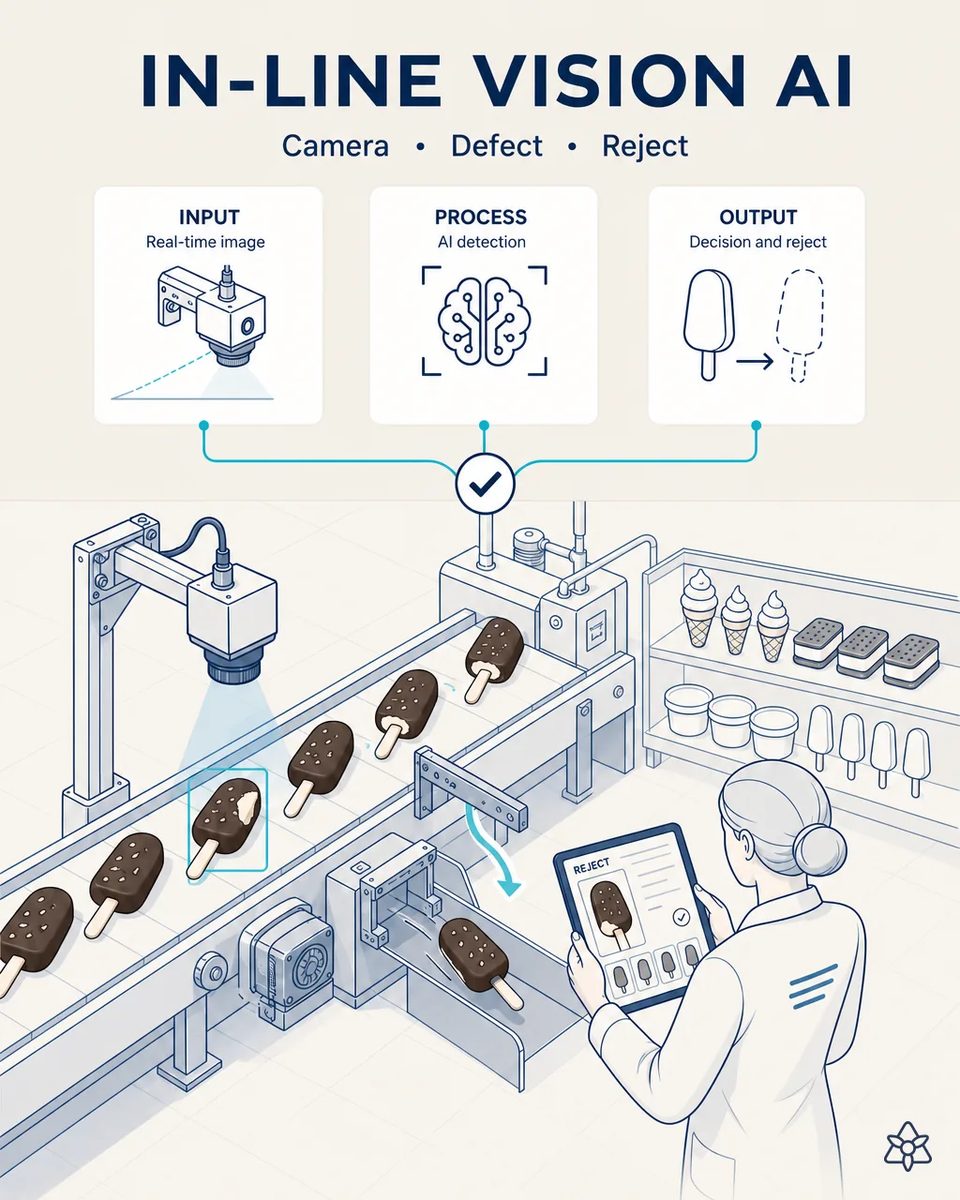
At hundreds of units per minute, sampling misses the coating gap that becomes a complaint.
Incomplete coating, bent stick, broken cone or misplaced biscuit. Today inspection is by sampling, in the cold and at high speed, and whatever slips through comes back as a complaint, sometimes from a demanding licensed brand.
- An ice cream line runs hundreds of units per minute: enrobed stick bars, cones and sandwiches, all moving toward the wrapper in seconds. Once wrapped and cased, a defect is invisible until the consumer opens the pack.
- The defects are visual and well known: incomplete coating, a bent or off-center stick, a broken cone, a misplaced biscuit on a sandwich. None of them is a food safety issue, and all of them are a brand issue.
- Inspection today is by sampling, one or two percent, done in the cold and at speed, and fatigue decides what gets through. A sample that happens to miss a bad minute misses the whole problem.
- Whatever slips through comes back as a consumer complaint, sometimes through a demanding licensed brand partner whose specification is stricter than your own. Each complaint costs credit notes, investigation time and sometimes the next tender.
Edge — a local vision model decides on every ice cream unit in milliseconds, before the wrapper.
A local vision model, trained on good and defective units of each format, decides in milliseconds and diverts the defective one without stopping the line. No images sent to the cloud. The quality technician sets the criteria and tunes the thresholds; every reject is logged with photo and batch for root cause analysis.
The model runs at the line, not in the cloud: no images leave the plant and the decision takes milliseconds. Defective units are diverted without stopping the line, and every reject is logged with photo, batch and shift, which turns complaints into root cause data. The technician sees, by shift, which defect is growing.
Visual inspection of coated ice cream today versus with iLEAN Edge
| Aspect | Visual sampling | With iLEAN Edge |
|---|---|---|
| Coated stick bars inspected | 1-2% sampling | 100% of units |
| Incomplete coating or bent stick | Caught if the sample happens to hold it | Diverted before the wrapper |
| Broken cone or misplaced sandwich biscuit | Found by the consumer | Rejected at the line |
| Enrobing line speed | Limits what the eye can see | Unaffected |
| Coating defect history | A tally on the shift sheet | Photo, batch and shift per reject |
| Images of your formats | — | Stay in the plant, no cloud |
From one or two percent sampling to inspecting one hundred percent of units, fewer complaints and defect data by batch and shift. Estimated payback of five to twelve months; estimate to be validated.
Impact estimate — to be validated with your numbers.
The block below is an estimate to be validated against your plant's actual data. We put it forward so the committee has an order of magnitude; we refine it during the assessment.
- Estimated payback 5-12 months.
- From 1-2% sampling to 100% of units inspected before wrapping. Every unit checked, at line speed, on every shift.
- Fewer consumer and licensed brand complaints, and less product pulled back from the cold store or from the customer. A product rejected at the line costs the mix; a product rejected by the customer costs much more.
- Defect data by format, batch and shift, so a coating problem can be traced to chocolate temperature, a chocolate batch or an enrober setting. That is how the enrober team learns which adjustment really works.
Payback 5-12 months · from 1-2% sampling to 100% inspected (estimate to be validated).
And the fair question from the production manager
“What if it starts rejecting good bars?” — the false positive is the real risk of any vision system, which is why the model is trained on good and defective units of your own formats under that line's lighting. Classifying a known defect on a known product is an anchored task, where the best models stay below 1.5% error [1]. The quality technician sets the criteria and tunes the thresholds, and borderline units are reviewed on the tablet, feeding the training back.
[1] OpenAI paper "Why Language Models Hallucinate", 2025 — on the reliability of AI in anchored tasks.
What people ask about vision inspection of coated stick bars and cones
Can it keep up with the speed of a stick bar line?
Yes. Inference runs on a local device next to the line and resolves each unit in milliseconds, without depending on the plant network or the cloud. The line keeps its speed; the reject gate simply acts on the units the model flags.
Which ice cream defects does the camera check?
Incomplete or uneven coating, bent or missing sticks, broken or cracked cones and misplaced biscuits on sandwiches. The catalog is set per format with the quality team. New formats for the season are added by training on a few hundred real units.
How many defective bars or cones are needed to train it?
Fewer than expected, because each format's defect catalog is short and repetitive. What matters is that they are real units from your line under your lighting. Borderline units reviewed by the technician keep improving the model over the season.
Does frost or condensation on the product confuse the camera?
It is taken into account from the start: the lighting and the training images include the normal frost on product leaving the tunnel and the enrober, so it is not read as a defect. Lighting is enclosed so that the camera sees the same scene on every shift.
Does the camera take the quality technician's place at the wrapper?
No. The technician defines what counts as a defect, sets the thresholds and reviews borderline cases. The camera takes the repetitive part, unit after unit. The technician gains time to look at the causes behind the rejects.
More cases from this series
- Audit evidence pack always ready: IFS, BRCGS and FSSCiLEAN Agents organizes CCPs, cleanings and lab results by standard: the ice cream plant always has its…
- Right-first-time batch release: every ring lines upILEAN coordinates goods-in, CCPs, allergens, coding and lab so every ice cream batch is released right…
- Coder stitched to the ERP: batch and date without typingBatch, date and target weight travel from the ERP to the coder and checkweigher on the ice cream line:…
- Raw material intake by photo: delivery note and certificate into the ERPPhoto of the delivery note, certificate of analysis and labels: iLEAN checks them against spec and posts…
- Line incidents dictated without putting the samples downWith an earpiece, quality dictates what it sees on the ice cream line and iLEAN turns it into an…
- Lab Excel to ERP without retyping: 5 licenses down to 1iLEAN reads the lab Excel of an ice cream plant and posts it to the ERP after validation: batches…
Tell us what share of your complaints come from coating, stick or cone defects.
We work on your plant's real data, not ours. Assessment with no commitment.
Request estimated ROI within 48h ‹ See all cases of ice cream See food industry