Line incidents dictated without putting the samples down
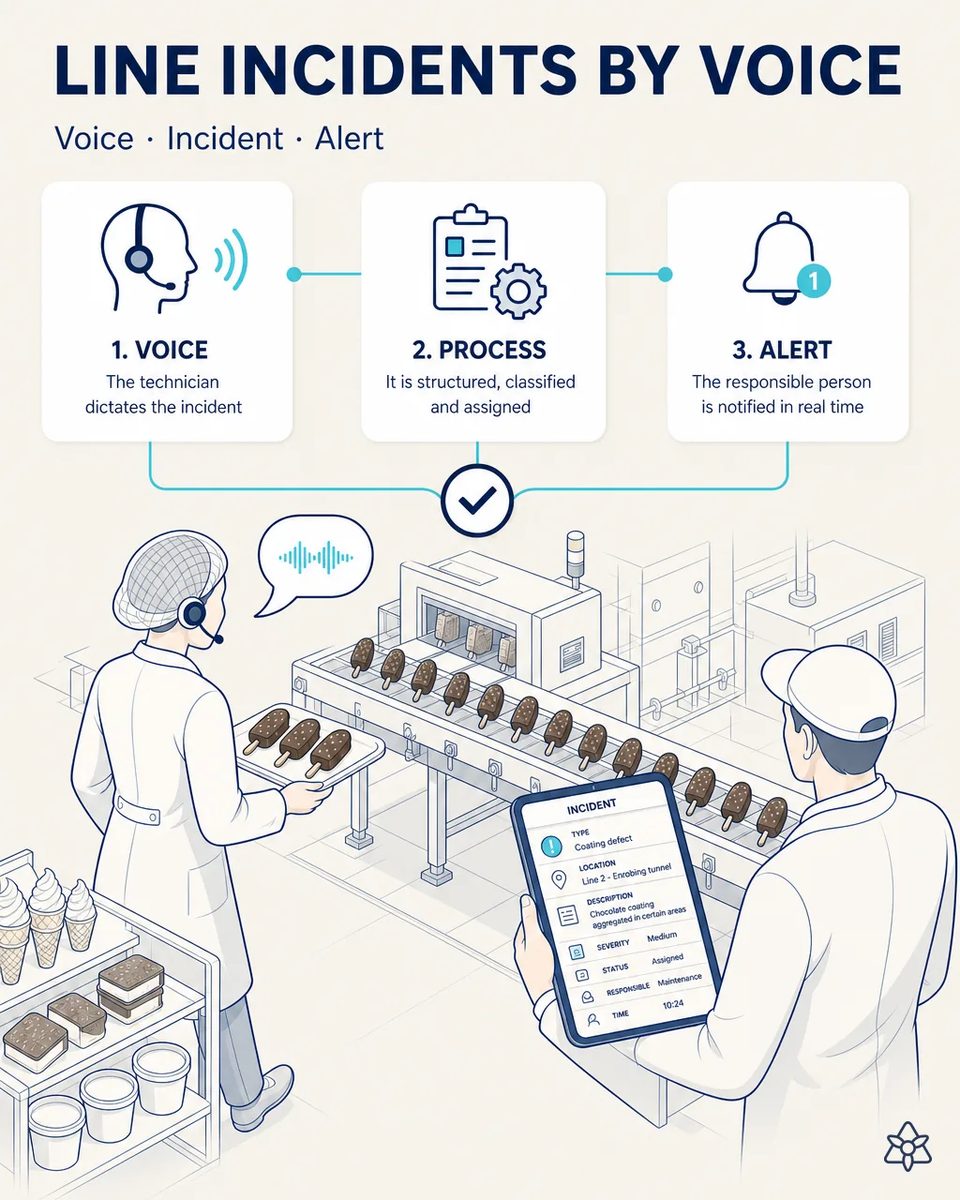
The quality technician and the shift lead walk freezers, coating, hardening tunnel and wrapping with gloves on and hands full. With an earpiece they say what they see: note that the coating on line four is coming out thin since the chocolate batch change.
On an ice cream line, a late incident report arrives after the product has hardened.
Overrun drifting down, dripping coating, a biscuit arriving soft: today it goes by radio, by word of mouth or into a notebook typed up at the end of the shift. By the time it reaches whoever must act, the product is already hardened.
- The quality technician and the shift lead walk the freezers, the enrober, the hardening tunnel and the wrapper with gloves on and samples in hand. Stopping to write means putting samples down in a cold, wet area.
- Overrun drifting down, dripping coating, a soft biscuit on the sandwich line, a stick going in crooked: today it travels by radio, by word of mouth or into a notebook typed up at the end of the shift.
- By the time it reaches maintenance or the line lead, the product is already through the hardening tunnel and the only options left are hold or rework. At peak season, that can be a full pallet of stick bars.
- And because nobody writes it down properly, the same coating drift after a chocolate batch change is solved again next month, from scratch, by someone else. The knowledge of what fixed it last time leaves with the shift.
Connect in voice mode — quality speaks while walking the line; iLEAN structures and routes.
iLEAN listens, structures the incident with line, product, active batch and type of deviation, crosses it with what it already knows and alerts whoever acts. In seconds it replies: maintenance is coming in ten minutes, shall I open a hold on the last twenty? The AI proposes; the quality technician decides whether to hold, adjust or carry on. Everything is recorded, their voice turned into data.
The incident is no longer lost between the enrober and the office. iLEAN structures it with line, product, active batch and type of deviation, and answers in seconds with what it already knows. The technician decides whether to hold, adjust or carry on, and that decision is recorded too.
Ice cream line incidents today versus ice cream line incidents with iLEAN
| Aspect | Today | With iLEAN Connect |
|---|---|---|
| Thin or dripping coating | Said on the radio, maybe noted | Incident with line, product and chocolate batch |
| Who hears about the coating issue | Whoever is nearby | The role that must act, in seconds |
| Ice cream already produced | Through the hardening tunnel | Hold proposed on the last units |
| Drift after a chocolate or biscuit batch change | Solved again each time | Detected as recurring |
| The technician's hands | Busy with samples | Still busy — only the voice is used |
| Ordinary talk by the enrober | — | Not recorded |
Immediate action on line incidents no longer depends on bumping into someone in the corridor. Less rework and waste from late reaction, and real data for root cause; estimate to be validated.
Impact estimate — to be validated with your numbers.
The block below is an estimate to be validated against your plant's actual data. We put it forward so the committee has an order of magnitude; we refine it during the assessment.
- No standalone payback: this is an enabling piece, and we do not put a range on it because its value shows up in the cases that use its data.
- Less rework and waste from late reaction, because maintenance or the line lead acts while the product is still at the freezer or the enrober.
- Real data for root cause: incidents by line, format, chocolate or biscuit batch and shift, instead of memories from the corridor. That history is what a root cause analysis on coating or overrun needs.
- Faster onboarding of new shift leads, who inherit the incident history of each line instead of starting blind in peak season.
Enabling value · less rework and waste from late reaction (estimate to be validated).
And the fair question from the production manager
“With the noise of the compressors and the tunnel fans, will it understand what I say?” — recognition is prepared for industrial noise and for line vocabulary, and turning a dictated sentence into line, product, batch and deviation type is an anchored task, where the best models stay below 1.5% error [1]. It reads back what it understood and the quality technician confirms. It listens only when the technician chooses to dictate, never continuously.
[1] OpenAI paper "Why Language Models Hallucinate", 2025 — on the reliability of AI in anchored tasks.
What people ask about dictating ice cream line incidents by earpiece
Does it work with gloves, hairnet and hearing protection on?
Yes. The earpiece is compatible with hearing protection and needs no hands. It is designed for people who are holding coated stick bars or cone samples at the very moment they report. Recognition is tuned to the vocabulary of the line: overrun, enrober, extrusion, hardening tunnel.
Does the technician need to say the ice cream batch number?
No. Saying the line and what they see is enough: iLEAN knows which product and which batch are running on that line at that moment and attaches them to the incident. If the technician names another line or product, that correction is what gets recorded.
What does iLEAN answer back on the line?
What it knows that can help decide: whether maintenance is on its way, whether the same drift happened after the last chocolate batch change, or whether it suggests a hold on the last units. The reply comes back through the same earpiece, so nobody has to look for a screen.
Is the earpiece a way to monitor the line operators?
No. It only records what the technician or the shift lead chooses to dictate. There is no continuous listening and no tracking of where anyone is on the floor. That boundary is set in writing before the case starts, and the works council can see it.
Why is there no payback figure for hands-free incident reporting?
Because its value appears through other cases: less rework, better root cause, data for batch release. We prefer to say so plainly rather than invent a number. It is usually deployed with the freezer tablet, because both feed the same incident history.
More cases from this series
- Audit evidence pack always ready: IFS, BRCGS and FSSCiLEAN Agents organizes CCPs, cleanings and lab results by standard: the ice cream plant always has its…
- Right-first-time batch release: every ring lines upILEAN coordinates goods-in, CCPs, allergens, coding and lab so every ice cream batch is released right…
- Coder stitched to the ERP: batch and date without typingBatch, date and target weight travel from the ERP to the coder and checkweigher on the ice cream line:…
- Raw material intake by photo: delivery note and certificate into the ERPPhoto of the delivery note, certificate of analysis and labels: iLEAN checks them against spec and posts…
- Lab Excel to ERP without retyping: 5 licenses down to 1iLEAN reads the lab Excel of an ice cream plant and posts it to the ERP after validation: batches…
- Overrun and weight validated at the freezer in two tapsOverrun, weight and temperature captured by iLEAN are validated in two taps at the freezer: deviations…
Tell us how a coating or overrun incident reaches maintenance today.
We work on your plant's real data, not ours. Assessment with no commitment.
Request estimated ROI within 48h ‹ See all cases of ice cream See food industry