Raw material intake by photo: delivery note and certificate into the ERP
Milk and cream tankers and trucks of sugar, cocoa, biscuit, wafer and nuts arrive at the plant. The goods-in lead photographs the delivery note, the certificate of analysis and the batch labels, and iLEAN does the rest.
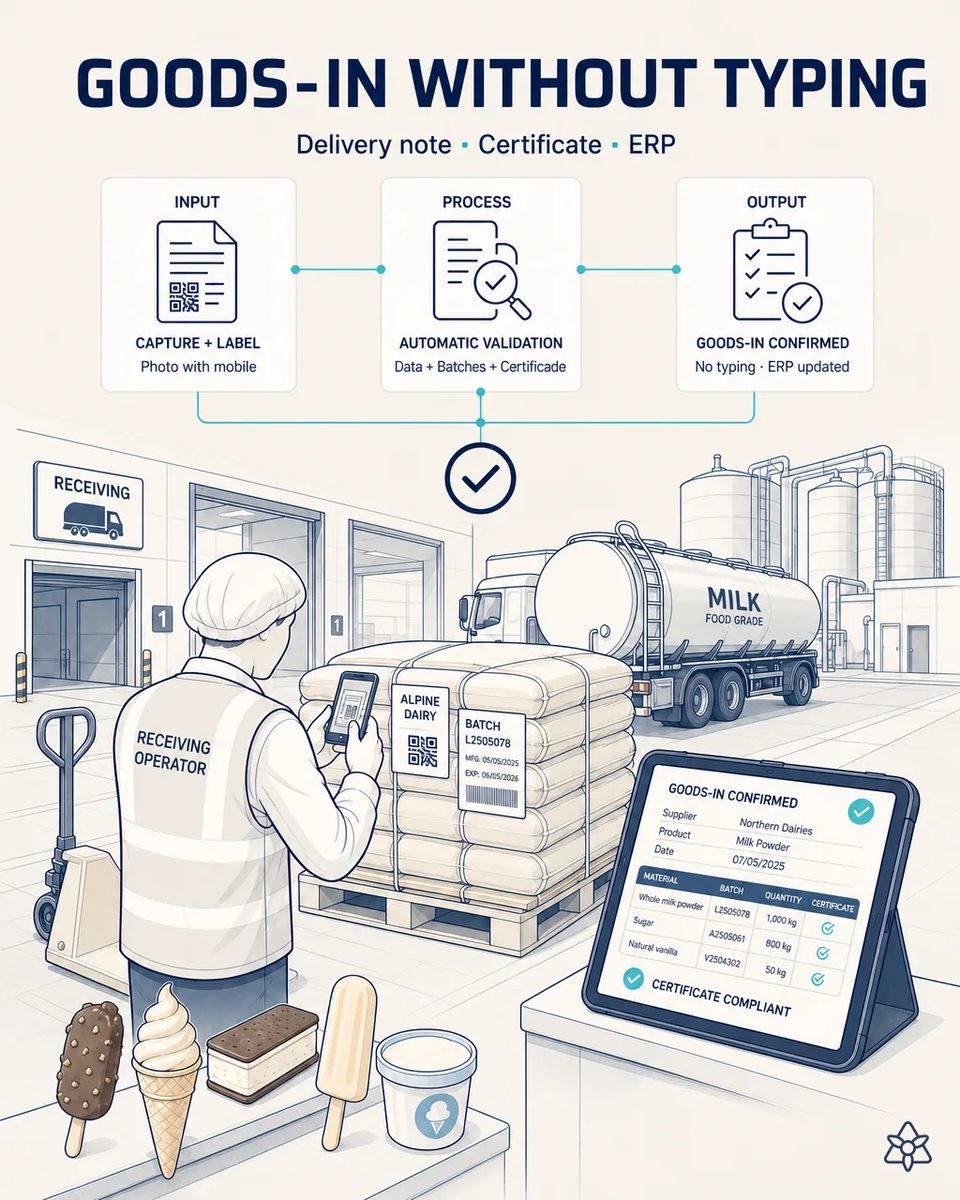
The traceability of every ice cream starts at the dock, typed line by line.
Today each delivery is checked and typed into the ERP line by line. The truck waits, and one mistyped batch breaks the traceability needed later for an alert or an allergen.
- Milk and cream tankers, and trucks of sugar, milk powder, cocoa, biscuit, wafer cones and nuts arrive at the dock, each supplier with its own delivery note format. Some come typed, some handwritten, some as a printout from the supplier's own system.
- Each delivery is checked and typed into the ERP line by line, and its certificate of analysis is filed rather than compared with the raw material specification. A milk powder batch out of spec can reach the mix room before anyone reads its certificate.
- The truck waits thirty to forty-five minutes at the dock, and the carrier charges for that waiting time. In peak season, with trucks queued, the dock becomes the plant's first bottleneck.
- One mistyped batch on a nut or cocoa delivery breaks the traceability needed later for a supplier alert or an allergen investigation. Finding it means going back through the paper delivery notes of that week.
Connect in photo mode at goods-in — delivery note, certificate and labels, with no supplier changes.
Vision AI recognizes each supplier's format without asking them to change it, extracts batches, quantities and best-before dates, reads the certificate values and checks them against spec. One validation tap and everything goes into the ERP. The goods-in module usually needs two or three licenses per shift. With Connect only the lead validates, without logging into the ERP: a typical fifty to seventy percent reduction, plus no more carrier waiting charges.
The supplier sends what it always sends. The goods-in lead takes the photos, checks one summary and taps once. Batches, quantities, best-before dates and certificate values are already in the ERP when the truck pulls away from the dock.
Ice cream raw material intake today versus raw material intake with iLEAN
| Aspect | Today | With iLEAN Connect |
|---|---|---|
| Milk powder or cocoa truck at the dock | 30-45 minutes | 5-10 minutes |
| Certificate of analysis for milk and cream | Filed, rarely compared | Checked against spec on the spot |
| Batch and best-before of nuts or wafer cones | Typed by hand | Read from the label photo |
| Each supplier's delivery note layout | Learned by a person | Recognized without templates |
| Carrier waiting charges | Paid | Avoided |
| Goods-in module licenses | 2-3 per shift | The lead validates without logging in |
From thirty or forty-five minutes per truck to five or ten, certificates checked on the spot and full traceability by photo. Estimated payback of three to eight months; estimate to be validated.
Impact estimate — to be validated with your numbers.
The block below is an estimate to be validated against your plant's actual data. We put it forward so the committee has an order of magnitude; we refine it during the assessment.
- Estimated payback 3-8 months.
- From thirty or forty-five minutes per truck to five or ten, and no more carrier waiting charges. The dock clears faster on the mornings when several tankers arrive at once.
- A typical 50-70% reduction in goods-in module licenses, because only the lead validates.
- Certificates checked at reception and full traceability by photo, which is the first ring of any allergen or supplier alert trace. Without it, the supplier alert case can only be as good as the typing at the dock.
Payback 3-8 months · -50 to -70% goods-in module licenses (estimate to be validated).
And the fair question from the production manager
“Every supplier sends a different delivery note — will it read them all?” — yes, without asking any supplier to change: the model extracts the table and fields without a template per supplier. Reading batch, quantity and best-before from a delivery note or label is an anchored task, where the best models stay below 1.5% error [1]. And the goods-in lead sees the summary before posting, with any mismatch against the purchase order highlighted for a decision. Nothing reaches the ERP without that tap, and the photos stay attached to the batch.
[1] OpenAI paper "Why Language Models Hallucinate", 2025 — on the reliability of AI in anchored tasks.
What people ask about ice cream raw material intake by photo
Does it read certificates of analysis for milk, cream and milk powder?
Yes. It extracts the values on the certificate — fat, protein, microbiology, temperature on arrival — and compares them with your raw material specification before the delivery is accepted. A value out of specification is flagged before the milk or cream reaches the silo.
What happens when a cocoa label does not match its delivery note?
The mismatch is highlighted for the goods-in lead, who decides whether to accept, correct or reject before anything is posted. It is never resolved silently. The supplier can be informed with the photo attached, which shortens the discussion.
Does it work for milk tankers and palletized dry goods alike?
Yes. A tanker comes with its delivery note and sample record; a pallet of cones or nuts comes with labels. Both are photographed and read the same way. A new supplier's format is recognized on its first delivery, with no setup per supplier or per product.
Do we need barcode scanners at the ice cream plant dock?
No. A phone or tablet photo is enough. Where a label carries a barcode, it is read from the image as well. Labels that are torn or frosted are flagged for the lead to type or photograph again.
Can we start with the goods-in dock before the mix room?
Yes, and it is a common starting point, because every later trace in an ice cream plant depends on the batch recorded at the dock being correct. It is also where the license saving shows first, because goods-in works every shift.
More cases from this series
- Audit evidence pack always ready: IFS, BRCGS and FSSCiLEAN Agents organizes CCPs, cleanings and lab results by standard: the ice cream plant always has its…
- Right-first-time batch release: every ring lines upILEAN coordinates goods-in, CCPs, allergens, coding and lab so every ice cream batch is released right…
- Coder stitched to the ERP: batch and date without typingBatch, date and target weight travel from the ERP to the coder and checkweigher on the ice cream line:…
- Line incidents dictated without putting the samples downWith an earpiece, quality dictates what it sees on the ice cream line and iLEAN turns it into an…
- Lab Excel to ERP without retyping: 5 licenses down to 1iLEAN reads the lab Excel of an ice cream plant and posts it to the ERP after validation: batches…
- Overrun and weight validated at the freezer in two tapsOverrun, weight and temperature captured by iLEAN are validated in two taps at the freezer: deviations…
Tell us how long a cocoa or milk powder truck waits at your dock today.
We work on your plant's real data, not ours. Assessment with no commitment.
Request estimated ROI within 48h ‹ See all cases of ice cream See food industry