Mix weighing sheet, digital at second zero
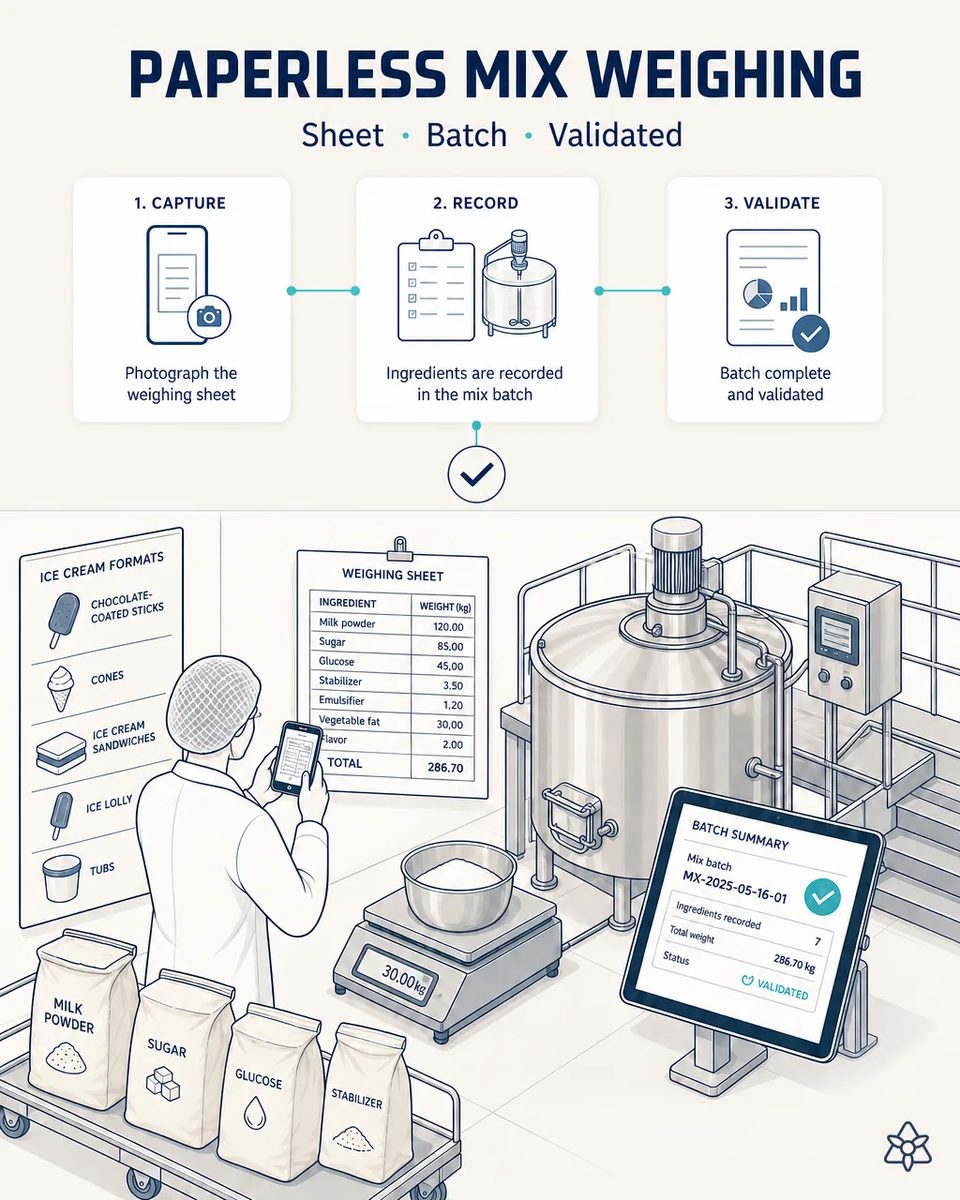
In an ice cream plant everything starts in the mix room. The operator loads the tank following the work order and writes down by hand which batch of each ingredient went in and how much was weighed. With iLEAN, one photo of that sheet when the load is closed is enough.
The mix batch exists in the tank hours before it exists in any system.
A mix carries eight to fifteen ingredients, each with its own supplier batch. The sheet is filled in with gloves on and in a hurry, then retyped hours later. When quality needs to know which stabilizer batch went into a mix, someone has to go and find the paper.
- A single ice cream mix carries eight to fifteen ingredients — skim milk powder, cream, sugar, glucose syrup, stabilizer, emulsifier, vegetable fat, cocoa, flavorings — each with its own supplier batch. Some recipes add inclusions and variegates later, with batches of their own.
- The operator writes each batch and the weighed kilos by hand, with gloves on and the next tank waiting, and the sheet is retyped four to twelve hours later, often by someone who never saw the load. Handwriting, abbreviations and crossed-out figures travel with it.
- A weighing error on the stabilizer or the fat goes unnoticed until the lab measures total solids, or until overrun and texture start drifting at the continuous freezer. By then the mix is frozen and the cause is a guess.
- When quality needs to know which stabilizer batch went into which mix — for a complaint or a supplier alert — someone has to walk to the mix room archive and find the paper.
Connect in photo mode — the mix room keeps its weighing sheet and adds one photo.
iLEAN Connect extracts order, mix, ingredient, batch, target and actual weight, flags out-of-tolerance weights and stores it all in central memory linked to the work order. The operator's routine does not change. Before the data enters the system, the operator sees the summary on the tablet and confirms with two taps. The AI reads; the person decides.
Nothing changes in the mix room routine: the operator closes the load, takes one photo and confirms with two taps. What changes is that the mix batch, with every ingredient batch inside it, exists in central memory before the mix leaves the tank for the pasteurizer. That is the first link of every later trace.
The mix weighing sheet today versus the mix weighing sheet with iLEAN
| Aspect | Today, on paper | With iLEAN Connect |
|---|---|---|
| Ingredient batch per mix | Handwritten, retyped 4-12 h later | In the system at second zero |
| Out-of-tolerance stabilizer or fat weight | Seen when solids or overrun drift | Flagged before pasteurization |
| Link to the work order | Matched by hand afterwards | Tied automatically on capture |
| Which mixes used a given stabilizer batch | A hunt through the mix room archive | One query |
| Night and weekend mixes | Wait for Monday's typing | Same latency as a weekday |
| Mix room operator's routine | — | Unchanged: one photo, two taps |
We go from four to twelve hours of latency to having the mix batch in the system at second zero, with weighing deviations caught before pasteurization. Estimated payback of four to nine months; estimate to be validated.
Impact estimate — to be validated with your numbers.
The block below is an estimate to be validated against your plant's actual data. We put it forward so the committee has an order of magnitude; we refine it during the assessment.
- Estimated payback 4-9 months, depending on the number of mixes prepared per day and on the height of the season peak.
- Mix batch latency from 4-12 hours down to second zero, with every ingredient batch linked to its work order. Night-shift mixes stop waiting for the morning office.
- Weighing deviations caught before pasteurization, when the mix can still be corrected instead of reworked or downgraded.
- Retyping hours recovered in the mix room and in quality, which in peak season is exactly where they hurt most. A tank waiting for someone to find a sheet is a tank not being refilled.
Payback 4-9 months · from 4-12 h latency to second zero (estimate to be validated).
And the fair question from the production manager
“What if it misreads a batch number on a sheet written with gloves on?” — reading fields from a weighing sheet whose structure is known is an anchored task, and in anchored tasks the best models stay below 1.5% error [1]. There is a second net as well: the operator sees the summary on the mix room tablet, next to the recipe targets, and confirms or corrects it before anything enters the system. Any value the model is unsure of is highlighted for the person to check.
[1] OpenAI paper "Why Language Models Hallucinate", 2025 — on the reliability of AI in anchored tasks.
What people ask about digitizing the ice cream mix weighing sheet
Do we have to redesign our mix room weighing sheet?
No. The sheet stays exactly as your recipes and your HACCP plan defined it. The model reads its structure as it is, including the printed targets and the handwritten actual weights and supplier batches next to them. Crossed-out values and margin notes are read too, because that is where the real load is written.
Does it catch a stabilizer or emulsifier weighed out of tolerance?
Yes. Each actual weight is compared with the recipe target and its tolerance, and a deviation is flagged on the tablet before the mix goes to the pasteurizer, which is the last moment it can be corrected cheaply. After pasteurization and aging, the same error costs a whole mix.
How does the mix batch connect to the finished ice cream batch?
Through the work order. The mix batch is stored against it, so when the freezer and packing batches are recorded later, the chain from ingredient batch to finished goods pallet is already complete.
What about rework mix added to a new tank?
It is captured like any other ingredient line, with its own origin batch, so a rework addition stops being an invisible gap in the traceability of the new mix. The same applies to inclusions or a second flavor base pumped from another tank.
Do we need the ERP connected before the first mix is captured?
No. The case works from the first mix against iLEAN's central memory. Posting to the ERP is connected later, once the mix room team has seen the value in their own routine.
More cases from this series
- Audit evidence pack always ready: IFS, BRCGS and FSSCiLEAN Agents organizes CCPs, cleanings and lab results by standard: the ice cream plant always has its…
- Right-first-time batch release: every ring lines upILEAN coordinates goods-in, CCPs, allergens, coding and lab so every ice cream batch is released right…
- Coder stitched to the ERP: batch and date without typingBatch, date and target weight travel from the ERP to the coder and checkweigher on the ice cream line:…
- Raw material intake by photo: delivery note and certificate into the ERPPhoto of the delivery note, certificate of analysis and labels: iLEAN checks them against spec and posts…
- Line incidents dictated without putting the samples downWith an earpiece, quality dictates what it sees on the ice cream line and iLEAN turns it into an…
- Lab Excel to ERP without retyping: 5 licenses down to 1iLEAN reads the lab Excel of an ice cream plant and posts it to the ERP after validation: batches…
Tell us how long a mix batch takes to exist in your system today.
We work on your plant's real data, not ours. Assessment with no commitment.
Request estimated ROI within 48h ‹ See all cases of ice cream See food industry