Packaging Defect on the Fly
At line speed, the human eye lets through bags or drums that are poorly sealed, mislabeled or irregularly filled; the error here isn't just cosmetic, it can be a mislabeled allergen. Edge: a camera over the line with a CNN trained on good/bad examples of the specific format infers in milliseconds and diverts the defective unit before palletizing.
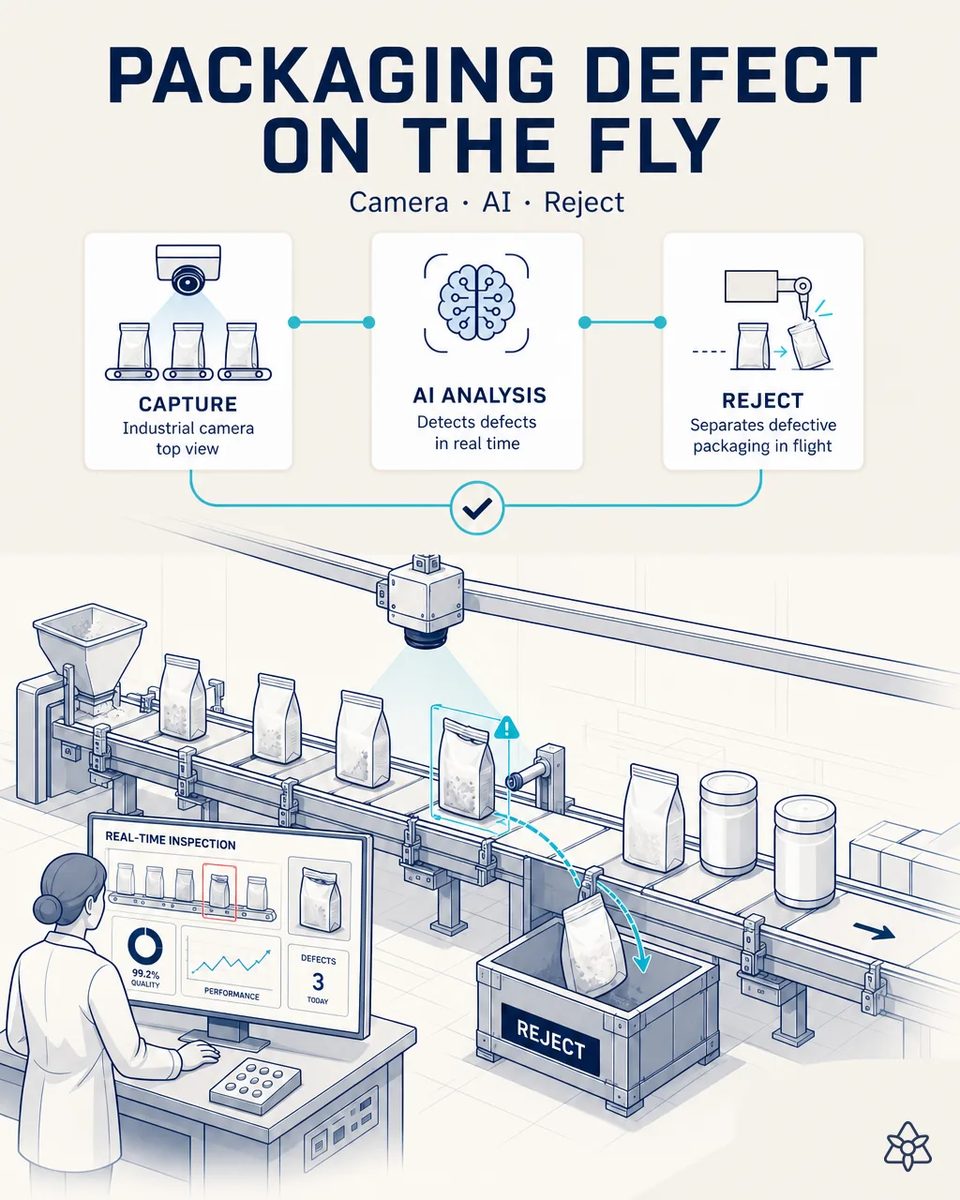
At line speed, a wrong label looks just like a right one.
At line speed, the human eye lets through bags or drums that are poorly sealed, mislabeled or irregularly filled; the error here isn't just cosmetic, it can be a mislabeled allergen.
- The packing line fills bags, pouches and drums of premixes and functional blends at a speed the human eye cannot follow unit by unit, shift after shift.
- Quality samples 1-2% of units, so a poorly sealed bag, an irregular fill or a crooked label goes out on most of the pallet before anyone sees it.
- Here a label error is not cosmetic: the wrong label on the wrong blend can be an undeclared allergen on your customer's production line.
- Complaints about seals and labels arrive weeks later, after the bags have been opened and their content already used in someone else's product, which is the worst moment to find out.
Edge on the packing line — every unit inspected, the defective one diverted.
Edge: a camera over the line with a CNN trained on good/bad examples of the specific format infers in milliseconds and diverts the defective unit before palletizing.
A camera over the line and a model trained on good and bad examples of your own formats decide in milliseconds, locally, without waiting for the network. The defective unit leaves the line before the palletizer, not after the customer opens it. And the label check turns the packing line into the last allergen gate before the dock. Every rejected unit is stored with its image, so quality knows why it was pulled and the pattern of defects per format and shift becomes visible.
Packing control today versus Edge on every unit
| Aspect | Today | With iLEAN Edge |
|---|---|---|
| Packed units actually inspected | 1-2% by sampling | 100% |
| Seal integrity on bags and pouches | Checked by hand on samples | Checked on every unit |
| Label matches the blend being packed | Assumed after the changeover check | Verified unit by unit |
| Irregular or short fill in the bag | Found later, if at all | Seen in the image |
| Defective bag or drum | Palletized and shipped | Diverted before palletizing |
| Sealing and labeling complaints | Arrive weeks later | Drastically reduced |
1-2% sampling → 100% unit control. Sealing/labeling complaints → drastic reduction.
Impact estimate — to be validated with your numbers.
The block below is an estimate to be validated against your plant's actual data. We put it forward so the committee has an order of magnitude; we refine it during the assessment.
- Estimated payback 5-12 months, depending on line speed, formats and the cost of each complaint.
- From 1-2% sampling to 100% unit control on seal, label and fill.
- Sealing and labeling complaints drop drastically, because the defect is caught on the line and not in the customer's warehouse.
- And a wrong-label allergen risk is intercepted before it leaves the plant, which is worth more than any scrap figure on this page.
Payback 5-12 months · 100% unit control vs. 1-2% sampling — estimate to validate
And the fair question from the production manager
"What if it rejects good bags and slows the packer?" — the false positive is the real risk of any vision system, which is why the model is trained on good and bad examples of your specific formats with that line's lighting, not on a generic model. Reading the printed label text is an anchored task, where the best models drop below 1.5% error [1], and borderline units go to a reject lane for a person to decide, feeding back into training.
[1] OpenAI paper "Why Language Models Hallucinate", 2025 — on the reliability of AI in anchored tasks.
What people ask about camera inspection on the ingredient packing line
Can it tell whether the label belongs to the blend being packed right now?
Yes. The expected label is taken from the formula currently running, and each unit's printed product name, lot code and allergen statement is compared with it before the unit moves on. A leftover roll of labels from the previous blend is caught on the first bag.
Does it work with multi-wall paper bags as well as pouches and drums?
Yes, with one model per format. Each format is trained on its own good and bad examples, because seals and fills fail differently on a paper sack, a stand-up pouch and a fiber drum. The right model is selected automatically from the formula and format running, with no operator action at changeover.
How fast is the reject decision on the packing conveyor?
Inference runs locally on the line in milliseconds per unit, so it keeps pace with the packer and does not depend on the plant network or the cloud. The reject actuator fires before the unit reaches the palletizer.
Does camera inspection replace the checkweigher and the metal detector?
No. Those stay where they are; the camera covers what they cannot see, such as the seal, the label and the visual fill level of each unit. Their results can be joined to the same unit record if you want one view of each bag: weight, metal check, seal, label and fill, all in one place.
How many packed units does the model need to start?
Fewer than expected, because packaging defects repeat. What matters is that they are real units from your formats and your line, including the bad ones you already set aside. The model keeps improving with every borderline unit a person decides.
More cases from this series
- Audit Evidence Pack ReadyEvery changeover between formulas automatically generates an auditable dossier organized by IFS, kosher…
- Zero Undeclared Allergens4 coordinated verification rings (ERP, dosing scale, Edge, dossier) stop the line on any allergen…
- Paperless Formula WeighingThe paper weighing sheet is photographed and enters central memory instantly, with zero change to the…
- Raw Material Delivery NotePhotograph the delivery note and batch labels for spices; one-tap validation and direct ERP sync, no…
- Dosing Scale Tied to ERPThe modern dosing scale receives the active formula directly from the ERP via API, with no manual…
- Voice on the Weighing FloorThe production supervisor dictates notes while walking the floor with a headset; iLEAN structures them…
Tell us what share of your packed units quality actually gets to see today.
We work on your plant's real data, not ours. Assessment with no commitment.
Request estimated ROI within 48h ‹ See all cases of functional ingredients See food