Paperless Formula Weighing
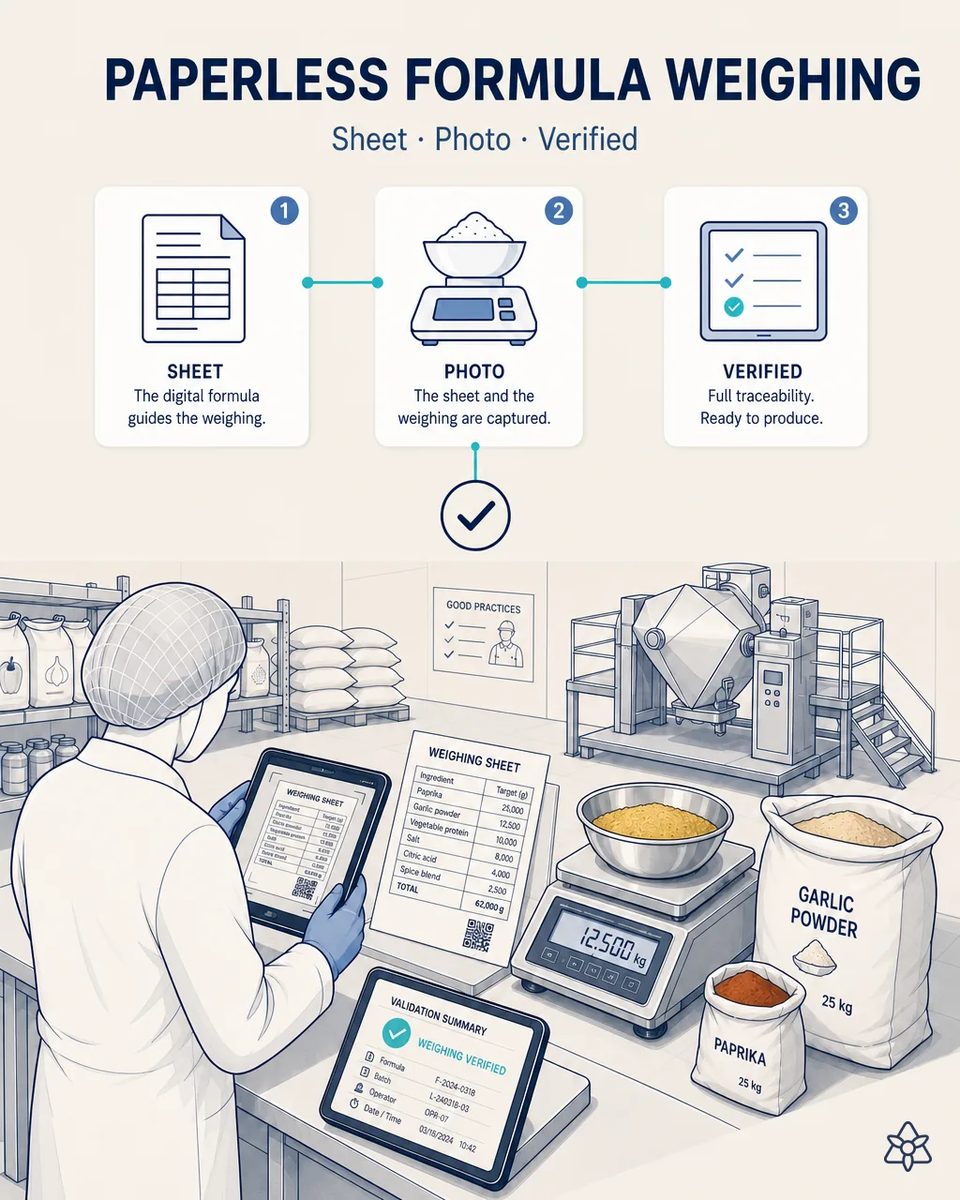
Every formula starts with a paper weighing sheet listing 15 to 30 raw materials, each with its exact quantity and tolerance. It's the document that proves the formula was made correctly, and it can sit untranscribed for hours or get lost in a physical folder. Connect photo mode: the operator photographs the sheet when weighing is done. A grounded language model extracts every ingredient, the actual quantity against target, and the sign-off, with zero change to the routine.
The document that proves the formula sits in a folder.
Every formula starts with a paper weighing sheet listing 15 to 30 raw materials, each with its exact quantity and tolerance. It's the document that proves the formula was made correctly, and it can sit untranscribed for hours or get lost in a physical folder.
- A vitamin premix or a fiber-and-protein blend is built from 15 to 30 raw materials, each with a target quantity and a tolerance window. The weighing sheet is where the operator writes the actual weight, the raw material lot and their initials, line by line.
- That sheet is the only proof that the batch was made to formula. Until someone transcribes it, the actual-versus-target deviation of each ingredient exists only in handwriting, on a page that has been next to a scale and a dust extraction hood all shift.
- Transcription happens hours later, when it happens at all: the sheet can sit in a tray until the end of the shift or end up in a weekly binder that nobody ever types up.
- When a customer asks for the composition of a lot shipped three weeks ago, or a carrier lot of maltodextrin is put on hold, the answer means flipping through paper by date and hoping the right sheet is there and legible.
Connect in photo mode — the operator keeps the same sheet and adds one photo.
Connect photo mode: the operator photographs the sheet when weighing is done. A grounded language model extracts every ingredient, the actual quantity against target, and the sign-off, with zero change to the routine.
The weighing booth is where the formula becomes real, and it is also where the record is weakest. One photo when weighing closes moves that record from a folder into the central memory, with every ingredient, every actual quantity and every sign-off, and the operator does not have to learn a new screen.
The weighing sheet on paper versus the weighing sheet captured
| Aspect | Today, on paper | With iLEAN Connect |
|---|---|---|
| Time until the sheet is digital | Hours, or never | Zero seconds after the photo |
| Actual weight against target per ingredient | Handwritten, unreadable at scale | Extracted line by line with its tolerance |
| Raw material lot on each weighing line | Written if there is room | Tied to the batch and the formula |
| Finding the sheet of a past batch | Flip through weekly binders | Instant web search by batch or formula |
| Weighing operator sign-off | Initials on paper | Captured and timestamped |
| Routine in the weighing booth | — | Unchanged: one photo at the end |
Hours of latency until transcription (if it ever happens) → zero seconds. Untraceable sheet → instant web lookup by batch and formula.
Impact estimate — to be validated with your numbers.
The block below is an estimate to be validated against your plant's actual data. We put it forward so the committee has an order of magnitude; we refine it during the assessment.
- Estimated payback 4-9 months, depending on how many formulas you weigh per shift and how many weighing booths you run.
- From hours of latency — when the sheet is transcribed at all — down to capture in zero seconds.
- Every weighing sheet becomes searchable by batch and by formula, so a customer composition request is answered with a query instead of an afternoon in the archive.
- Out-of-tolerance lines stop being discovered at the blender or at the lab: the deviation is visible the moment the sheet is photographed, while the batch can still be corrected.
Payback 4-9 months · from hours of latency (if ever transcribed) to zero-second capture — estimate to validate
And the fair question from the production manager
"What if it reads 1.25 kg where the operator wrote 12.5?" — reading fields from a weighing sheet with a fixed layout is an anchored task, where the best models drop below 1.5% error [1]. And there are two more nets: every extracted quantity is checked against that ingredient's target and tolerance, so a misplaced decimal shows up as an impossible deviation, and the summary goes to the booth tablet for the operator to confirm before it is stored.
[1] OpenAI paper "Why Language Models Hallucinate", 2025 — on the reliability of AI in anchored tasks.
What people ask about photographing the formula weighing sheet
Do we need to redesign our formula weighing sheet for this to work?
No. The model learns the layout you already print from the ERP or the formulation spreadsheet, including the columns for target, tolerance, actual weight and raw material lot. A cleaner layout helps later, but it is not a precondition.
Can it read handwritten actual weights and crossed-out corrections?
Yes, and they are the part that matters, because the printed target is already known. A crossed-out figure or a value read with low confidence is flagged on the tablet for the operator to confirm instead of being guessed.
How does it handle a premix with 30 lines and micro-ingredients in grams?
Each line is extracted with its unit and compared with its own tolerance, so a vitamin weighed in grams and a fiber carrier weighed in kilos are judged on their own scale. Long sheets are the usual case in this sub-sector, not the exception.
Is the photo of the weighing sheet kept as evidence for a customer or an IFS audit?
Yes. The original image is stored next to the extracted data, so anyone checking a batch sees both the structured record and the sheet exactly as the operator signed it.
Do we need ERP integration before photographing the first sheet?
No. The case works from the first weighing against iLEAN's central memory, and the push to the ERP is connected once the plant has seen the value. That is usually why it is the first case approved.
More cases from this series
- Audit Evidence Pack ReadyEvery changeover between formulas automatically generates an auditable dossier organized by IFS, kosher…
- Zero Undeclared Allergens4 coordinated verification rings (ERP, dosing scale, Edge, dossier) stop the line on any allergen…
- Raw Material Delivery NotePhotograph the delivery note and batch labels for spices; one-tap validation and direct ERP sync, no…
- Dosing Scale Tied to ERPThe modern dosing scale receives the active formula directly from the ERP via API, with no manual…
- Voice on the Weighing FloorThe production supervisor dictates notes while walking the floor with a headset; iLEAN structures them…
- Lab Spreadsheet Into ERPILEAN reads the lab's quality-control spreadsheet in real time and syncs it to the ERP, cutting ERP…
Tell us how long a signed weighing sheet takes to become searchable in your plant.
We work on your plant's real data, not ours. Assessment with no commitment.
Request estimated ROI within 48h ‹ See all cases of functional ingredients See food