Zero Undeclared Allergens
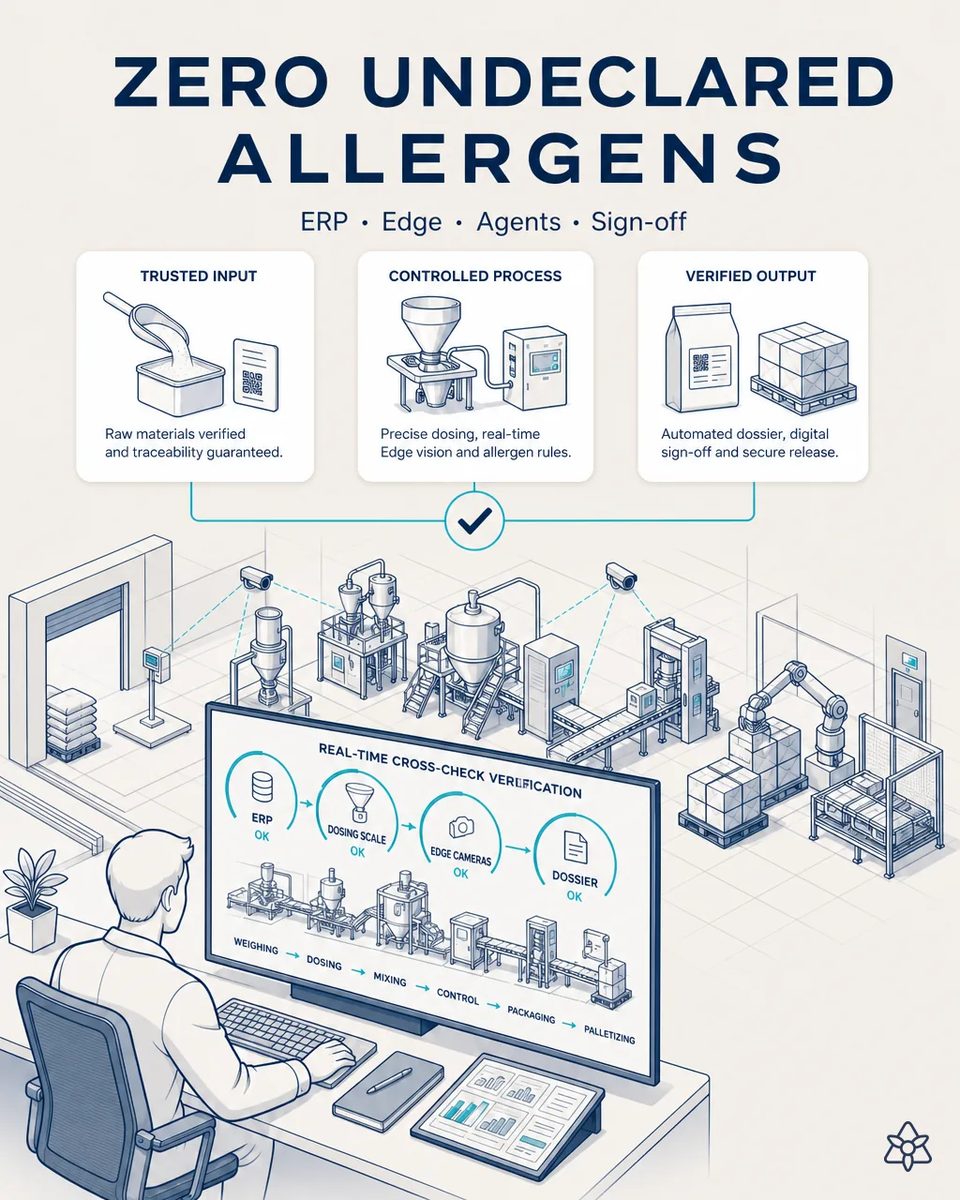
An undeclared-allergen incident or cross-contamination in a formula sold as raw material propagates into the client's finished product and certification. Connect + Edge + Agents coordinated in 4 rings: the ERP's formula, the actual captured weighing, Edge-validated cleaning, and the batch's evidence-pack dossier; if they don't match, JIDOKA AI stops the line. SMED AI speeds up formula changeovers.
Your allergen incident ends up in someone else's product.
An undeclared-allergen incident or cross-contamination in a formula sold as raw material propagates into the client's finished product and certification.
- A functional ingredient is sold as raw material. An undeclared allergen or a cross-contamination does not stay in your plant: it travels into your customer's finished product and into their certification.
- The causes rarely come alone: a formula version that changed, a minor ingredient weighed from the wrong container, a changeover cleaned in a hurry, a label left over from the previous run.
- Each control on its own may pass. What fails is that nobody checks that the formula, the actual weighing, the cleaning and the dossier tell the same story about the same batch.
- One incident means a customer claim, a recall in somebody else's market and a multi-year supply contract under review, long before anyone has found the root cause.
Connect, Edge and Agents in four rings — if they disagree, JIDOKA AI stops the line.
Connect + Edge + Agents coordinated in 4 rings: the ERP's formula, the actual captured weighing, Edge-validated cleaning, and the batch's evidence-pack dossier; if they don't match, JIDOKA AI stops the line. SMED AI speeds up formula changeovers.
No single ring solves the problem, because each one already exists today in some form and incidents still happen. What changes is the cross-check: four independent sources that must agree, and a line that stops the moment they do not. SMED AI makes sure that extra rigor does not cost changeover time.
The four rings and what each one closes
| Ring | Cases it draws on | What it closes |
|---|---|---|
| 1 · Released formula | Dosing scale tied to ERP (8) + lab sync (6) | The released formula and its declared allergens |
| 2 · Actual weighing | Weighing sheet (1) + minor scale (2) + receiving (7) | What really went into the batch, lot by lot |
| 3 · Cleaning and packing | Allergen changeover (10) + packing inspection (9) | No residue on the blender, no wrong label on the bag |
| 4 · Batch dossier | Two-tap validation (5) + evidence pack (11) | A signed, auditable record per batch |
| JIDOKA AI stop | Cross-check of rings 1 to 4 | Batch held on any allergen discrepancy |
| SMED AI on formula changes | Changeover preparation and sequencing | Faster formula changes without skipping a ring |
Yearly incidents risking client claims or certification loss → zero. Discrepancies caught on the line, not at the client's plant.
Impact estimate — to be validated with your numbers.
The block below is an estimate to be validated against your plant's actual data. We put it forward so the committee has an order of magnitude; we refine it during the assessment.
- Estimated payback 6-12 months, measured against the first incident avoided.
- Yearly incidents that put customer claims or certification at risk go toward zero, with discrepancies caught on the line instead of at the customer's plant.
- It protects the multi-year supply contracts that depend on your allergen record, which is often the real asset of a functional ingredients business and the first thing a customer reconsiders after an incident.
- And SMED AI shortens formula changeovers, so adding verification does not cost capacity on the blenders.
Payback 6-12 months against the first incident avoided · protects multi-year contracts — estimate to validate
And the fair question from the production manager
"Do we need all twelve cases before this works?" — no, and framing it that way would mean never starting. The rings are built in layers and each case pays on its own. Where the system reads documents, panels or labels it works on anchored tasks, where the best models drop below 1.5% error [1], and JIDOKA AI stops only on a verifiable discrepancy between sources, never on model uncertainty.
[1] OpenAI paper "Why Language Models Hallucinate", 2025 — on the reliability of AI in anchored tasks.
What people ask about the zero undeclared allergens system
Where should a functional ingredients plant start with the four rings?
With the weighing sheet or the dosing scale integration, which build ring 2 or ring 1 with the fewest dependencies. Each layer has its own return before the next one is added, and the cross-check switches on as soon as two rings exist.
What does the cross-check catch that our HACCP plan does not?
The combination. A correct formula, an acceptable weighing and a signed cleaning can each pass their own control while the batch still carries an allergen it should not. Each control sees its own slice; the rings compare the slices with each other, batch by batch.
What happens on the line when two rings disagree about a batch?
JIDOKA AI holds the line or the batch and shows which sources disagree and why. A person decides the release, with the evidence in front of them. Every hold and every release is written to the batch dossier, with the evidence that justified it and the name of the person who decided.
How does SMED AI fit with stricter allergen control on formula changes?
It prepares the next formula, its raw materials and the cleaning sequence while the current batch runs, so the verification adds checks without adding downtime. It also proposes sequences that reduce the number of full allergen cleans per week.
Can the return of the allergen flagship be estimated before committing?
Yes. With your incident and claim history, the share of allergen-sensitive volume and your changeovers per week, the return per layer is estimated before deciding the order. The figures stay an estimate until they are validated with your own data.
More cases from this series
- Audit Evidence Pack ReadyEvery changeover between formulas automatically generates an auditable dossier organized by IFS, kosher…
- Paperless Formula WeighingThe paper weighing sheet is photographed and enters central memory instantly, with zero change to the…
- Raw Material Delivery NotePhotograph the delivery note and batch labels for spices; one-tap validation and direct ERP sync, no…
- Dosing Scale Tied to ERPThe modern dosing scale receives the active formula directly from the ERP via API, with no manual…
- Voice on the Weighing FloorThe production supervisor dictates notes while walking the floor with a headset; iLEAN structures them…
- Lab Spreadsheet Into ERPILEAN reads the lab's quality-control spreadsheet in real time and syncs it to the ERP, cutting ERP…
Tell us what an undeclared allergen claim from a customer would cost your plant.
We work on your plant's real data, not ours. Assessment with no commitment.
Request estimated ROI within 48h ‹ See all cases of functional ingredients See food