Legacy Scale Panel Reading
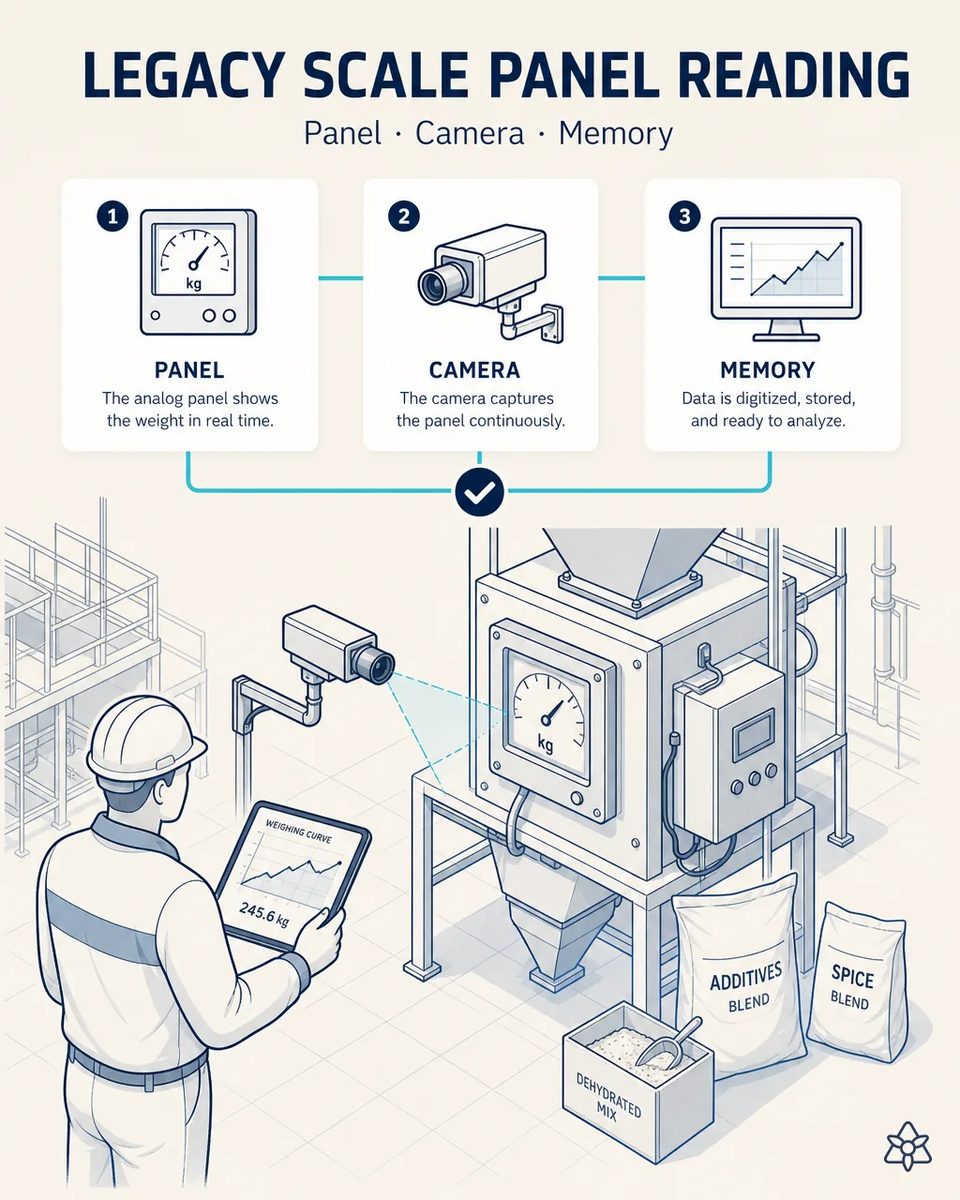
The scale that weighs minor components (additives, colorants, flavors in grams) has been on the floor for over a decade with a proprietary display that talks to nothing, and carries the highest risk of formula deviation. Connect photo mode on the panel: an external camera reads every weighing with OCR and a grounded model, matching it against the active formula sheet, without touching the original panel.
The scale with the smallest quantities carries the biggest risk.
The scale that weighs minor components (additives, colorants, flavors in grams) has been on the floor for over a decade with a proprietary display that talks to nothing, and carries the highest risk of formula deviation.
- Colorants, flavors, vitamins, enzymes and processing aids are weighed in grams on a scale that has been on the floor for over a decade. Its display is proprietary and it has no port, network or export the plant can use.
- These are the ingredients where one extra gram is a formula deviation: an overdosed colorant, a vitamin claim the batch no longer meets, an additive above its legal limit in the customer's finished product.
- The operator reads the display and writes the figure on paper. If the reading is rounded, swapped with the next ingredient or skipped, nothing records it and nobody finds out until the lab assay, if it is assayed at all.
- Replacing the scale means capex, revalidation and recalibration downtime on a line that works, so the decision keeps getting postponed while the risk stays exactly where it is.
Connect in photo mode on the panel — read from outside, the scale untouched.
Connect photo mode on the panel: an external camera reads every weighing with OCR and a grounded model, matching it against the active formula sheet, without touching the original panel.
The scale is not opened, rewired or recalibrated. A camera on a bracket reads what the operator already reads, and the difference is that every reading is kept, compared with the active formula and attached to the batch. The replacement decision stops being urgent. And because the reading is matched with the formula as it happens, a wrong addition is caught while the batch is still in the weighing booth, not when the lab assay comes back out of range.
The minor-ingredient scale today versus the scale being read
| Aspect | Today | With iLEAN Connect |
|---|---|---|
| Gram-level record of each addition | Handwritten, if written | Every stable reading captured |
| Match against the active formula sheet | Done by eye | Automatic, ingredient by ingredient |
| Overdosed colorant or vitamin | Found at the lab or by the customer | Flagged at the scale |
| Scale calibration and validation | — | Untouched: nothing installed on it |
| Minor-ingredient scale replacement capex | Pending in the plan | Deferrable indefinitely |
| Traceability of additives and flavors | Gaps by the gram | Complete, gram by gram |
Minor-component weighing with no digital record → full gram-by-gram batch traceability. Scale replacement indefinitely deferrable.
Impact estimate — to be validated with your numbers.
The block below is an estimate to be validated against your plant's actual data. We put it forward so the committee has an order of magnitude; we refine it during the assessment.
- Estimated payback 5-10 months, mostly from avoided recalibration and replacement capex on the minor-ingredient scale.
- Fewer minor-component deviations, which are the ones that turn a compliant premix into a non-conforming one with a single misread gram.
- Full gram-by-gram batch traceability for the additives, colorants and flavors that today leave no digital trace at all.
- And the scale replacement moves from the urgent column to whenever it actually makes sense for the plant.
Payback 5-10 months · avoids recalibration CAPEX and cuts minor-component deviations — estimate to validate
And the fair question from the production manager
"Can a camera really read a gram-level weight off an old display?" — it is an anchored task: a fixed display, digits or a needle in a known position and a value that must fall inside the tolerance of the ingredient being weighed, where the best models drop below 1.5% error [1]. A frame that is blurred, glared or outside the possible range is discarded and read again rather than accepted, and a persistent doubt is sent to the operator.
[1] OpenAI paper "Why Language Models Hallucinate", 2025 — on the reliability of AI in anchored tasks.
What people ask about reading the minor-ingredient scale panel
Does the minor-ingredient scale need recalibrating after the camera goes in?
No. Nothing is connected to the scale and nothing is installed inside it, so its calibration and any validation stay exactly as they are. The camera sits on its own bracket and can be removed without leaving a trace on the machine.
How does it know which additive is being weighed at each moment?
It follows the active formula sheet and the order of additions. Each stable reading is matched with the next expected ingredient, and an unexpected weight is flagged instead of being assigned blindly. If the operator changes the order, the tablet asks which ingredient was added.
What about glare from hygienic lighting or powder on the display?
Camera position and lighting are set at commissioning for that specific panel. A frame that cannot be read with confidence is discarded, and if the problem persists the operator is asked to confirm the value.
Is the reading precise enough for vitamins and colorants dosed in grams?
The camera reads what the display shows, so the resolution is the scale's own. What it adds is that every reading is kept and checked against the tolerance, which is exactly where today's deviations slip through.
Can the same camera approach cover other closed panels in a blending plant?
Yes: the blender timer, the sifter or the metal detector. You start with the minor-ingredient scale because it is where a small error costs the most, and the same bracket and model pattern is then reused panel by panel, at a fraction of the first one's effort.
More cases from this series
- Audit Evidence Pack ReadyEvery changeover between formulas automatically generates an auditable dossier organized by IFS, kosher…
- Zero Undeclared Allergens4 coordinated verification rings (ERP, dosing scale, Edge, dossier) stop the line on any allergen…
- Paperless Formula WeighingThe paper weighing sheet is photographed and enters central memory instantly, with zero change to the…
- Raw Material Delivery NotePhotograph the delivery note and batch labels for spices; one-tap validation and direct ERP sync, no…
- Dosing Scale Tied to ERPThe modern dosing scale receives the active formula directly from the ERP via API, with no manual…
- Voice on the Weighing FloorThe production supervisor dictates notes while walking the floor with a headset; iLEAN structures them…
Tell us how old your minor-ingredient scale is and how its weighings get recorded.
We work on your plant's real data, not ours. Assessment with no commitment.
Request estimated ROI within 48h ‹ See all cases of functional ingredients See food