Planning the tunnel oven as what it is: a work center that runs better if you never stop it.
In a bread, breadstick or crispbread plant, every tunnel oven start-up costs: 1-3 hours ramping the temperature back up while burning gas without producing, first trays out of specification and, in hearth ovens, thermal cycles that wear down the refractory. The iLEAN Planning Agent models the oven as a continuous or semi-continuous work center and builds the monthly plan with long campaigns and the fewest possible start-ups — from the spreadsheets you already have.
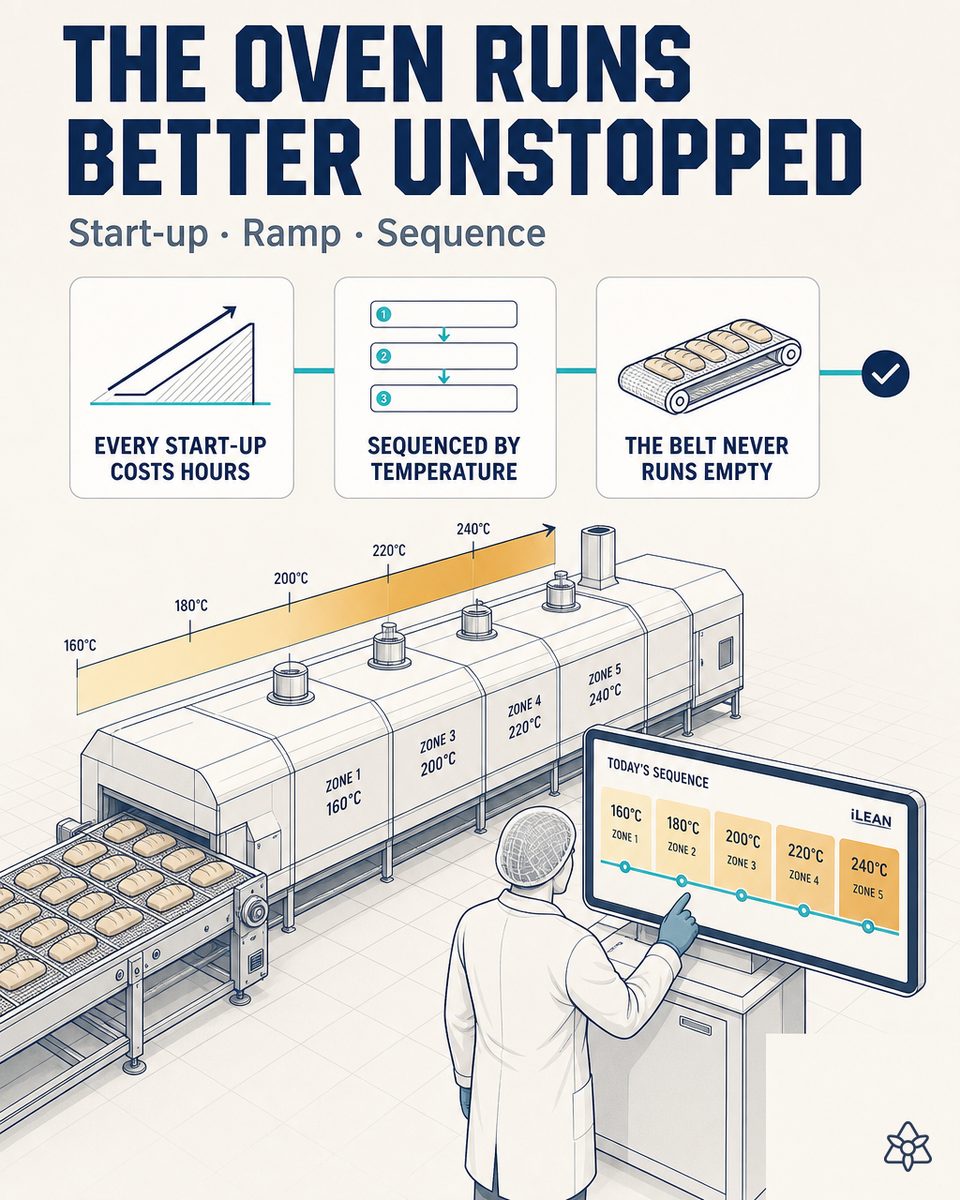
The plan is built in a spreadsheet looking at demand — and the oven picks up the bill.
In a tile plant, stopping the kiln is catastrophic: thermal shock cracks the refractories and the invoice is enormous. A bakery tunnel oven does not go that far — it runs at 180-300 °C and stopping it does not break anything all at once — but every start-up has a real cost that almost no plant adds up in one place:
- Reheating gas. Bringing the oven back up to temperature takes 1 to 3 hours depending on size — burning fuel without a single saleable piece coming out.
- Transient product. Until the temperature profile settles, the first trays come out pale or over-baked. In breadsticks and crispbread, where color is a retailer specification, that is straight scrap.
- The wear you do not see. In hearth ovens, every thermal cycle fatigues the refractory. It is not the tile plant's sudden failure, but it shortens the life of the hearth and brings the long maintenance shutdown forward.
And who decides how many times the oven starts up in a month? The production plan. A plan built in a spreadsheet, looking at demand SKU by SKU, tends to fragment: short campaigns, frequent changeovers, line gaps that end in an oven stop. Not because the planner does not know better — they know perfectly well — but because with a spreadsheet they barely get to one viable plan, and comparing alternatives that group campaigns better would take another three days they do not have.
Connect absorbs your spreadsheets; the Agent builds the plan that respects the oven.
The iLEAN Planning Agent was born planning work centers that genuinely cannot stop — continuous work centers in heavy industry where continuity is a hard constraint. That same machinery, applied to a bakery tunnel oven, is dialed down: strict continuity if the plant decides so, or a heavy penalty per start-up so the engine minimizes them without forbidding them.
The user drops in their spreadsheets. The agent builds the model of the oven, its lines and its SKUs, and returns an editable receipt. The engine solves with the oven's constraints. The human compares three scenarios and approves with a stamp.
The specific iLEAN piece for the oven of a bread, breadstick or crispbread plant:
- Connect — absorbs the chaotic documents the plant already has: the production spreadsheet with its thousand tabs, the sales demand that arrives by email, the rates by SKU and line. No mandatory template and no prior integration project.
- Planning Agent — builds the planner's database by itself (work center, lines, items, constraints, demand), asks only when something blocking cannot be derived from the documents, and solves with a constraint optimization engine. For the oven it applies the constraints that matter: minimum campaign length, no job changes on public holidays and weekends, each product's affinity with its preferred line, and continuity or start-up penalties depending on how it is configured.
- Three scenarios, not one plan — maximum output, tight inventory and stability (long campaigns, minimum changeovers — the natural scenario when the expensive work center is an oven). Side by side, with KPIs and the differences explained one by one.
The approved plan is exported to the spreadsheet with the production program format the plant already uses. The team's routine does not change on day one — what changes is how long it takes to reach a good plan, and how many times the oven starts up for nothing.
Spreadsheet plan vs. plan with the Planning Agent
| Aspect | The planner's spreadsheet | With the Planning Agent |
|---|---|---|
| Time to build the monthly plan | Days | One morning, with the agent building the model |
| Oven start-ups and stops | Whatever comes out of fitting it by hand | Minimized by the engine (constraint or penalty) |
| Campaign length | Fragmented by urgent orders | Long campaigns with a configured minimum |
| Changeovers on holidays / weekends | They slip in and somebody suffers them | Blocked by a soft constraint |
| Strategy alternatives | A single viable plan | 3 scenarios compared with KPIs + what-ifs |
| Replanning after an unforeseen event | Another several days | Minutes: recalculated and compared |
| Planning knowledge | In one person's head | In the model, with plant memory |
| Format of the approved plan | The usual spreadsheet | The very same spreadsheet — simply exported |
Impact estimate for your oven — to be validated with your numbers.
The block below is an estimate to be validated with the specific data of your plant. We put it forward so the committee has an order of magnitude; we refine it during the diagnostic.
- Bread, breadstick or crispbread plant with 1-2 tunnel ovens, multi-SKU, monthly plan built today in a spreadsheet by one person.
- First planning session with the agent on the existing documents — with no prior data project. First comparable plan in one morning.
- Expected reduction of oven start-ups and stops of ≥30% against the manual plan, simply by grouping campaigns the way the engine finds and the spreadsheet does not. (Conservative range — estimate to be validated.) Every start-up avoided is reheating gas and transient trays that do not go in the bin.
- Indicative payback between 4 and 9 months, depending on the oven's consumption, the cost of transient scrap and the planning hours freed up.
The defensible technical anchor comes from the planner's most thoroughly documented real case: a high-demand industrial plant in heavy industry — with a strictly continuous furnace — whose agent built the complete model by itself (one oven with 3 lines, 128 items with their production rates, 5 operational constraints and ~4,600 metric tons of demand) from a 114 MB zip with an 18-tab spreadsheet, and delivered 3 optimized scenarios in under an hour. The same class of continuity constraint, dialed down to what a bread oven needs.[1]
And the operations director's reasonable doubt
“What if the plan the AI proposes is not executable in my plant?” — that is why there is human verification at every gate. The intake receipt shows everything the agent has understood from your documents and is corrected inline before anything is solved; the scenarios are compared with the differences explained; and the plan only goes into production when the responsible person approves it with a stamp. If the demand does not fit in full, the system does not say “infeasible”: it delivers a partial plan with its coverage figure and flags exactly what is left out, so a person can decide. The AI proposes; the plant signs.
[1] Real iLEAN case, high-demand plant in heavy industry — verified pilot figures: 114 MB of documents, 18 tabs, 128 items, ~4,600 t, 3 scenarios in <1 h, 99.5% coverage.
What people ask about planning the oven with an agent
Is a bread plant's oven a “continuous” work center like a tile plant kiln?
Not exactly, and it is worth being honest about the difference. In a tile plant, stopping is catastrophic: thermal shock cracks the refractories and the repair costs a fortune — which is why the iLEAN engine treats those lines with the hard constraint of “never stop”. A bakery tunnel oven runs at 180-300 °C and stopping it does not break anything all at once; but stopping does cost real money: 1-3 hours ramping the temperature back up while burning gas without producing a single piece, the first trays out of specification until the thermal profile settles and, in hearth ovens, thermal cycling that accelerates refractory wear. The planner lets you choose the treatment: a hard continuity constraint or a heavy penalty per start-up — and the plan comes out with the long campaigns the oven appreciates.
What does the agent need to build the oven's plan?
The documents the plant already has: the production spreadsheet, the sales demand (even if it arrives by email), the rates of every SKU on every line and the calendar. There is no mandatory template — real chaos is accepted. The agent reads the documents, builds the work center model (oven, lines, items, constraints, demand) and returns an editable receipt of everything it has understood before solving anything. What is missing from the documents is not hidden: the decision taken is shown, and the human corrects it if it does not work for them.
How does the plan avoid unnecessary start-ups and stops?
With genuine plant constraints configured through data, not code: minimum campaign length (no one-day campaigns that force constant changeovers), no job changes on set days (weekends, public holidays), each product's affinity with its preferred line and, if the plant decides so, oven continuity as a hard constraint. The constraint optimization engine looks for the plan that satisfies all of that — not a spreadsheet that approximates it by eye.
Can I compare a long-campaign strategy against a tight-inventory one?
Yes — that is exactly what the three scenarios are for. The system solves the same month under three strategies: maximum output, tight inventory and stability (long campaigns and minimum job changes — the one that usually wins when the expensive work center is an oven). The three come out side by side with their KPIs and the differences explained one by one: which campaigns change, what you gain and what you give up. The committee chooses with numbers, not with faith.
Who approves the plan: the AI or the plant?
The plant, always. The AI proposes: the intake receipt is editable, the scenarios are compared, and the plan only goes into production when the responsible person approves it with a stamp. And the approved plan is exported to the spreadsheet with the production program format the plant already uses — the team's routine does not change on day one; what changes is how long it takes to reach a good plan.
More cases from this series
- With the spreadsheets you already have, a near-optimal plan in a morning. With the full network, the optimum.With the documents you already have, the iLEAN Planning Agent delivers a near-optimal production plan in…
- Mixing and packing are not the oven: if the output fits into fewer hours, switch them off — and make those hours the cheap ones.Mixing and packing are not the oven: they are discrete work centers. The iLEAN Planning Agent compresses…
Tell us your case and in 48h we'll send you the estimated ROI of this AI project for your oven.
We work on the real data of your plant, not ours. Diagnostic with no commitment.
Request estimated ROI in 48h ‹ All bakery cases See food industry