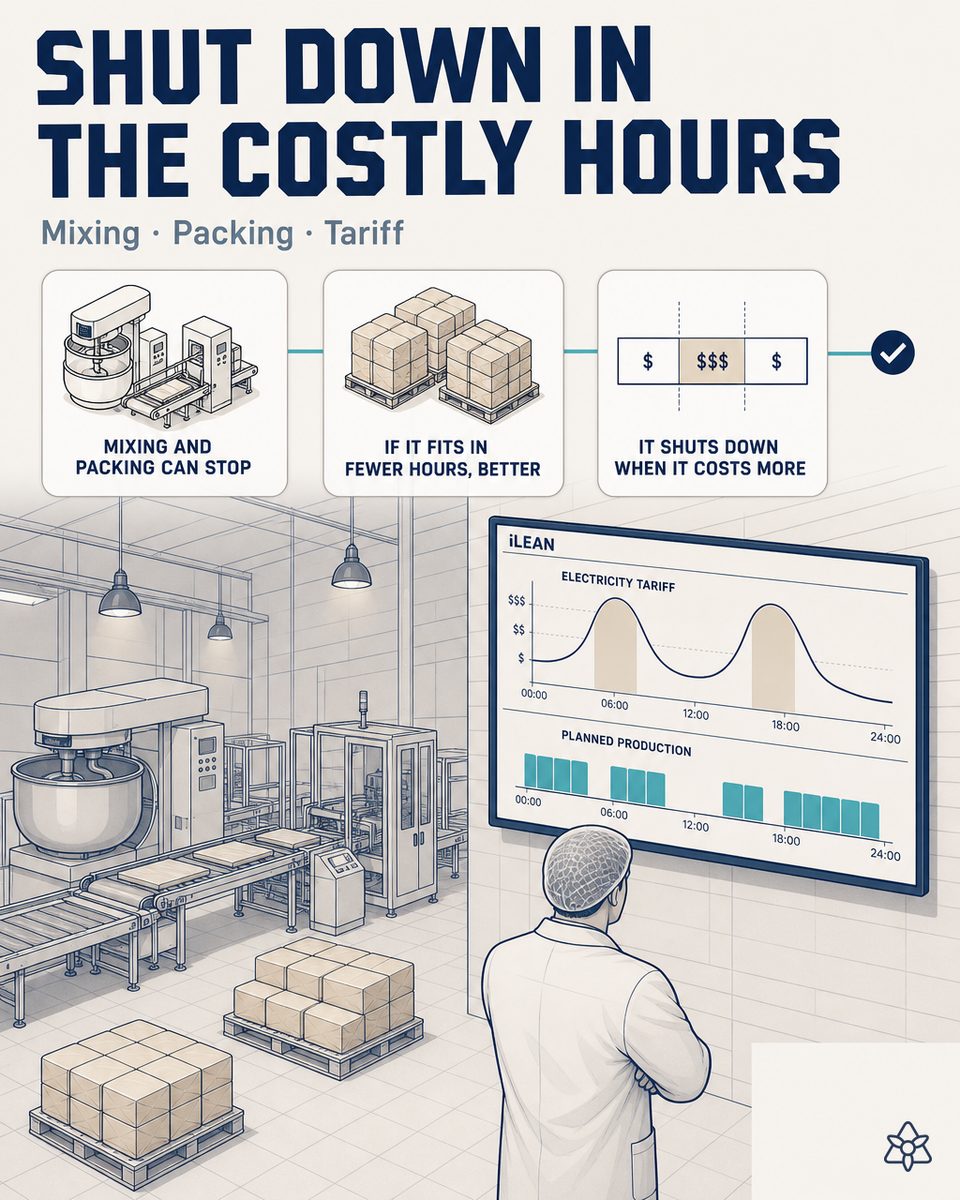
Mixing and packing are not the oven: if the output fits into fewer hours, switch them off — and make those hours the cheap ones.
In a bread, breadstick or crispbread plant, two kinds of work center live side by side: the oven, which runs better the less it is stopped, and the discrete work centers — mixing, packing, slicing — whose cost is proportional to the hours they are switched on. The iLEAN Planning Agent tells them apart: it gives the oven long campaigns, and for the discrete ones it compresses the same output into fewer hours and places them in the off-peak bands of the electricity tariff.
Shifts are inherited; the electricity tariff changes. And nobody recalculates the schedule.
In most plants the distribution of working hours was not decided by a calculation: it was decided by history. Packing runs two shifts “because it has always been that way”. The mixer starts at 6 “because the master baker used to start at 6”. And meanwhile:
- Machines at half load during peak hours. A packing machine at 50% of its capacity for 16 hours consumes more — in energy, in supervision, in wear — than the same machine at full load for 8. And those 16 hours fall wherever they fall, including the most expensive bands of the electricity contract.
- The power bill goes up and the plan never notices. The cost of a kWh between peak and off-peak can vary several times over; the production plan, built in a spreadsheet looking only at demand, is blind to that difference.
- Recalculating the hourly schedule by hand is unmanageable. Moving packing to nights affects product buffers, shifts and maintenance. With a spreadsheet, nobody dares to touch what “already works” — even if it costs money every month.
The oven has an excuse for running when it runs: stopping it is expensive (reheating gas, transient product — we cover that in its own case). Mixing, packing and slicing have no such excuse: they are discrete work centers, and every hour they spend switched on in an expensive band is an avoidable cost the plan could be avoiding.
One plan, two treatments: long campaigns for the oven, off-peak compression for the discrete centers.
The strength of the Planning Agent is that it does not treat every work center the same way. Constraints are configured with data — not with code — and each work center gets its own:
For the oven: continuity and long campaigns. For the discrete centers: the same output in fewer hours, placed where energy is cheap. And the intermediate buffers act as a shock absorber between the two rhythms.
- Connect — absorbs the documents that already exist: production spreadsheets, demand, per-line rates… and the time bands of your electricity contract, which enter the model as penalties by band.
- Planning Agent — builds the plant model and solves it with the constraint optimization engine. For discrete work centers it looks for compression: full load in fewer hours, avoiding the expensive bands. For the oven, long campaigns and minimum stops. And because it plans the full cascade (mixing → proofing → oven → packing), it uses the intermediate buffers to shift hours without leaving the oven unfed or flooded with product.
- Compared scenarios — the “off-peak compressed” plan against the “stable three-shift” plan, side by side, with hourly cost and the rest of the KPIs in plain sight. Plus what-ifs: “what if I move packing to nights?”, “what if the retailer brings the order forward a week?” — recalculated in minutes, with a comparison card beside it.
The decision — how much compression pays off, which shifts to touch, which buffer to accept — belongs to the human, with the numbers in front of them. The approved plan comes out in the usual spreadsheet.
Inherited shifts vs. a plan with off-peak compression
| Aspect | Inherited shifts + spreadsheet | With the Planning Agent |
|---|---|---|
| Running hours of the discrete centers | The usual shift, at whatever load results | Compressed: full load in fewer hours |
| Time band those hours fall in | Whichever comes up — peak included | Shifted off-peak wherever the buffer allows |
| Electricity cost in the plan | Invisible | Penalty by band, compared scenario by scenario |
| The oven's rhythm | Sometimes waiting on upstream | Protected: the cascade guarantees its feed |
| Maintenance windows | Fought over with production | They fall out naturally in the switched-off hours |
| How much does this change save me? | Nobody knows how to calculate it | KPI compared across scenarios, before deciding |
| Redoing the schedule if the tariff or demand changes | You do not touch “what works” | Recalculated in minutes, decision made on numbers |
Impact estimate for your discrete work centers — to be validated with your numbers.
The block below is an estimate to be validated with the specific data of your plant and your electricity contract. We put it forward so the committee has an order of magnitude; we refine it during the diagnostic.
- Bread, breadstick or crispbread plant with a tunnel oven and discrete work centers (mixing, packing, slicing) currently running on inherited shifts, at partial load.
- First planning session on the existing documents + the time bands of the electricity contract. Compared scenarios with hourly cost in days, not months.
- Expected reduction of discrete work center running hours in expensive bands of ≥30%, shifted off-peak through load compression and buffer use. (Conservative range — estimate to be validated; the ceiling depends on how much intermediate product buffer your process allows.)
- Indicative payback between 4 and 9 months, depending on the peak/off-peak spread in your contract, the hours currently run at half load and the shifts the new schedule frees up.
The defensible technical anchor comes from the planner's most thoroughly documented real case: a high-demand industrial plant in heavy industry whose agent built the complete model by itself (one oven with 3 lines, 128 items, 5 constraints, ~4,600 metric tons of demand) from a 114 MB zip of documents with no template, and delivered 3 optimized scenarios in under an hour. The same constraint engine that protects a continuous furnace there is the one that compares the hourly cost of your discrete work centers here.[1]
And the production manager's reasonable doubt
“If I compress packing into the night and something goes wrong, who answers for it?” — the plan is not imposed: it is compared and signed. The scenarios show the compressed plan and the conservative one side by side, with the differences explained one by one; if the intermediate buffer does not stretch far enough for the shift, the engine does not hide it — it flags it as the limiting input. And the transition can be gradual: one what-if a week, measured against the baseline, as far as the plant is comfortable going. The AI proposes; the plant decides how much and when.
[1] Real iLEAN case, high-demand plant in heavy industry — verified pilot figures.
What people ask about planning discrete work centers into off-peak hours
What is the difference between a continuous and a discrete work center?
A continuous work center runs better the less it is stopped: the extreme example is the kiln of a tile plant or a glassworks, where stopping cracks the refractories; the bakery tunnel oven is its milder relative (stopping costs reheating gas and transient product). A discrete work center — the mixer, the packing machine, slicing, the coder — is started and stopped without drama: its cost is proportional to the hours it is switched on. The planning consequence is the opposite in each case: the continuous one wants long campaigns and minimum stops; the discrete one is better off producing the same output in fewer hours and switching off for the rest. A plan that treats both the same wastes money on both.
Where does the saving come from if total output is the same?
From three places. Energy through compression: a machine running at full load for fewer hours consumes less than the same machine at half load for twice as long (idle start-ups, waiting, the base consumption of auxiliary services). Energy by time band: if those hours are also placed in the off-peak bands of the electricity tariff, every kWh costs a fraction of what it costs at peak. Organization: shifts that are freed up or shortened, and maintenance that finally gets clean windows without fighting production for them.
How does the planner know which of my hours are the cheap ones?
Because you tell it with data, not with code: the time bands of your electricity contract are loaded as penalties by band, just like every other constraint in the engine (minimum campaigns, days with no job changes, line affinities). The constraint optimization engine places the output of the discrete work centers so as to avoid the expensive bands, and the scenarios show the effect: you can compare an “off-peak compressed” plan against a “stable three-shift” plan with the numbers in front of you and decide how much it is worth to you.
Doesn't this clash with the oven's rhythm, which should not be interrupted?
It does clash — and that is why it is planned as a network, not work center by work center. The oven sets the rhythm with its long campaigns; mixing sits upstream and packing downstream, with intermediate buffers (dough in proofing, bulk product before packing) that give room to maneuver. The engine plans the full cascade and uses those buffers to shift the hours of the discrete work centers towards the cheap bands without ever leaving the oven unfed or flooded with product. If the buffer does not stretch that far, the plan says so — it does not hide it.
What do I need to try this in my plant?
The documents you already have (production spreadsheets, demand, per-line rates) and your electricity contract with its time bands. The agent builds the model from there, returns an editable receipt with everything it has understood, and solves the compared scenarios. The approved plan comes out in the spreadsheet format your team already uses. No deployment project: the first scenario comparison with hourly cost is ready in days, not months.
More cases from this series
- With the spreadsheets you already have, a near-optimal plan in a morning. With the full network, the optimum.With the documents you already have, the iLEAN Planning Agent delivers a near-optimal production plan in…
- Planning the tunnel oven as what it is: a work center that runs better if you never stop it.The iLEAN Planning Agent builds the tunnel oven's monthly plan with long campaigns and minimum…
Tell us your case and in 48h we'll send you the estimated ROI of this AI project for your plant.
We work on the real data of your plant and your electricity contract, not ours. Diagnostic with no commitment.
Request estimated ROI in 48h ‹ All bakery cases See food industry