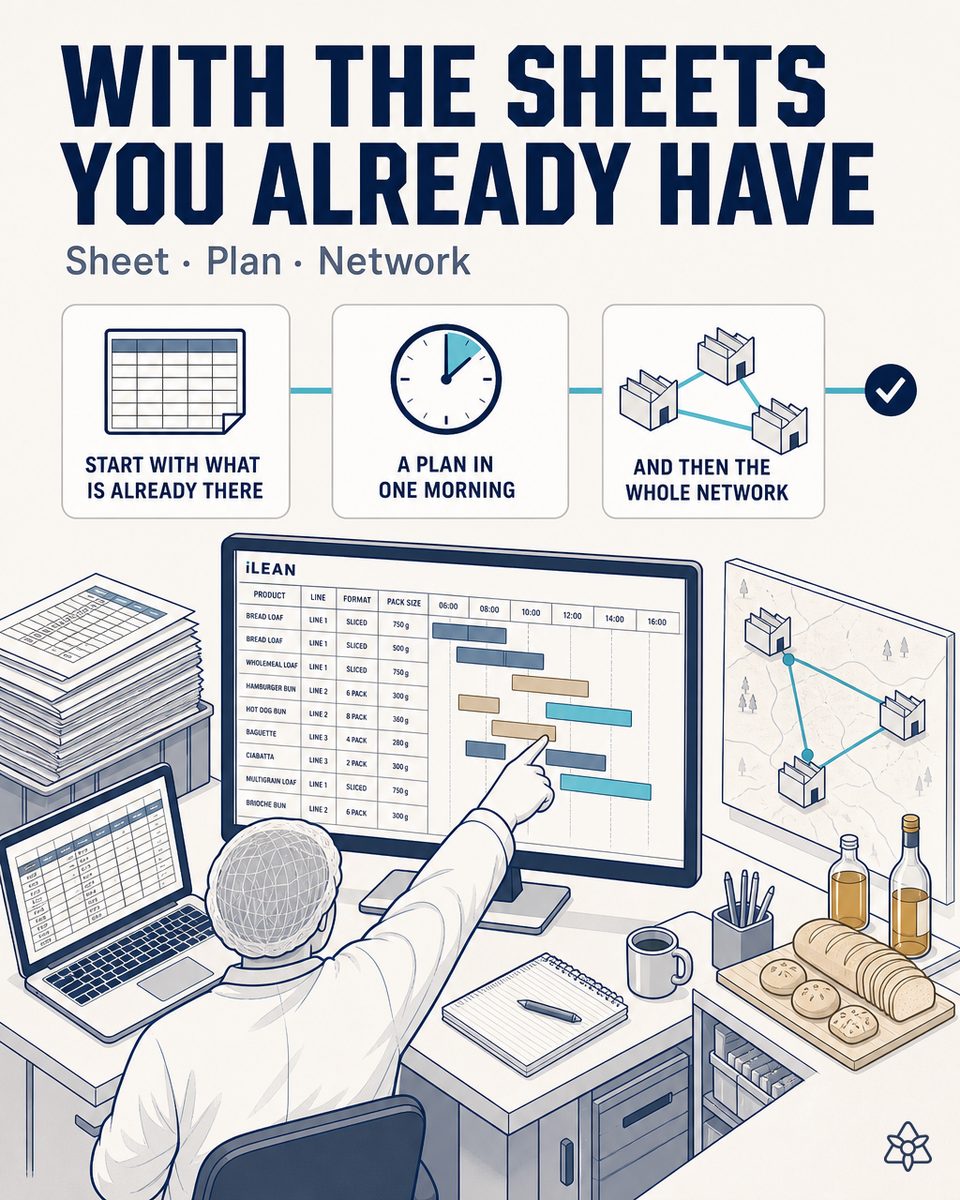
With the spreadsheets you already have, a near-optimal plan in a morning. With the full network, the optimum.
You do not need a data project to start planning with AI. The iLEAN Planning Agent reads the chaotic documents your bread, breadstick or crispbread plant already has — spreadsheets, PDFs, the demand that arrives by email — and delivers three optimized scenarios in a morning, very close to the optimum. And when you want to go for the true optimum, you define the full network (mixing → proofing → oven → packing) and the engine plans the entire cascade, flagging the limiting input.
The plan lives in the planner's head and in a spreadsheet only they understand.
In most mid-sized bread, breadstick and crispbread plants, the production plan is an inherited spreadsheet with years of formulas piled on top. It works — until it stops working:
- Building the monthly plan takes days. And redoing it when the retailer changes the order, a line goes down or strong flour runs short takes just as long again.
- Only ONE plan ever comes out. With a spreadsheet, the planner barely gets to one viable plan. Comparing strategies — “what if I prioritize line stability instead of tonnage?” — is a luxury nobody can afford.
- The knowledge does not belong to the company. When the planner goes on vacation, the plant loses its ability to plan. When they retire, it loses it for good.
The classic alternative — the ERP's APS module — demands months of deployment, perfect master data and consultants: exactly what the plant does not have. That is why 80% of them are still on spreadsheets. The right question is not “spreadsheet or APS?”; it is “how much plan can I get out of the information I already have, today?” — and the answer, with an agent, is: far more than you think.
Two levels of ambition: start with what you have, scale to the full network.
The design principle is the same across the whole IRIS system: capture reality exactly as it exists, rather than demanding that the plant adapt to the tool. Connect absorbs the chaotic documents; the Agent builds and operates the planner; the human verifies and approves.
Level 1 — you drop in your spreadsheets and in a morning you have three near-optimal scenarios. Level 2 — you define the full network of work centers and the engine finds the optimum for the whole plant, with the limiting input flagged.
Level 1 · The near-optimal plan, with the information that already exists. The user drags their files into the drop zone — the 18-tab spreadsheet, the history, the sales demand. The agent classifies them, builds the planner's database by itself (work center, lines, SKUs with their rates, inventory, demand, constraints) and returns an editable intake receipt with everything it understood and every decision taken, in writing. The constraint optimization engine solves and presents three scenarios — maximum output, tight inventory, stability — with compared KPIs and the differences explained. That plan already respects capacities and constraints better than any manual fit: near-optimal, in a morning, with nothing deployed.
Level 2 · The optimum, by defining the full network. A bread plant is not just the oven: it is mixing → proofing → oven → packing, each work center with its own rhythm. When the plant defines that network — which work center feeds which, with what rates and buffers — the engine plans the whole cascade: it derives orders for the supplying work centers, detects the limiting input (the dough that does not arrive, the chamber that falls short, the packing machine that cannot swallow the oven's peak) and flags it in the interface. The plan stops being the oven's optimum and becomes the plant's optimum. And this complexity is only switched on if the plant needs it; if not, you never even see it.
Inherited spreadsheet vs. agent with little information vs. agent with the full network
| Aspect | Inherited spreadsheet | Agent · level 1 (your spreadsheets) | Agent · level 2 (full network) |
|---|---|---|---|
| Start-up | Already running (and that is the problem) | One morning | + defining the network (days, not months) |
| Plan quality | Viable, with luck | Near-optimal for the main work center | Optimal for the whole plant |
| Scope | Whatever one person can hold | The oven and its lines | Mixing → proofing → oven → packing |
| Strategies compared | One | Three + what-ifs | Three + what-ifs, across the whole cascade |
| Upstream bottleneck | Discovered on the floor | Outside the model | Limiting input flagged in the interface |
| Demand that does not fit | Negotiated blind | Partial plan with % coverage and the excluded volume flagged | |
| Replanning an unforeseen event | Days | Minutes | |
Impact estimate for your plant — to be validated with your numbers.
The block below combines verified figures from the reference real case with estimates to be validated for the bakery case. We refine them during the diagnostic.
- Verified real case (high-demand plant in heavy industry): from a 114 MB zip file — a KPI spreadsheet with 18 tabs, one of them with more than 30,000 rows, plus requirement PDFs — the agent built the complete model by itself: one oven with 3 lines, 128 items with their per-line production rates, 5 operational constraints and ~4,600 metric tons of demand. Result: 3 optimized scenarios in under an hour of agent work, end to end.[1]
- And the detail that gives it credibility: the demand did not fit in full. The system did not say “infeasible” — it delivered a partial plan with 99.5% coverage and flagged exactly the 22 metric tons left out, so a human could decide.
- For a bread, breadstick or crispbread plant (estimate to be validated): planning time from days to a morning; ability to replan unforeseen events from days to minutes; indicative payback between 4 and 9 months, depending on the planning hours freed up and the value of the strategic decisions that today cannot be compared at all.
- The move to level 2 (full network) is decided later, with level 1 already delivering value — never as a prerequisite.
And the operations director's reasonable doubt
“What if the agent misreads my spreadsheets?” — that is exactly what the intake receipt is for: before solving anything, the agent shows everything it has understood, by category, with every decision taken in writing (“no stock snapshot supplied → starting inventory set to 0”), and the human corrects inline whatever they want. The opposite doubt — “what if I trust it and the plan then turns out not to be executable?” — is answered by the engine's honesty: partial plans with their % coverage instead of a useless “infeasible”, and the limiting input flagged when the network gets tight. The AI proposes; the plant approves with a stamp.
[1] Real iLEAN case, high-demand plant in heavy industry — verified pilot figures.
What people ask about planning from the spreadsheets you already have
How much information do I really need for the first plan?
Whatever you already have, exactly as it is. The starting point of the planner's most thoroughly documented real case was a 114 MB zip file: a KPI spreadsheet with 18 tabs (one of them with more than 30,000 rows of history), two requirement PDFs and a corporate PDF. No templates and no prior clean-up. The agent read it, built the work center model by itself — one oven with 3 lines, 128 items with their production rates, 5 constraints and ~4,600 metric tons of demand — and delivered 3 optimized scenarios in under an hour. On that basis the plan is already near-optimal: it respects capacities, constraints and demand better than fitting it by hand.
What do I gain by defining the plant's full network?
Going from near-optimal to optimal. With only the oven modeled, the plan optimizes the expensive work center — but assumes that mixing, proofing and packing will keep up. Once you define the full network (which work center feeds which, with what rates and buffers), the engine plans the entire cascade: it derives the orders for the supplying work center, detects the limiting input — the sourdough that does not arrive in time, the proofing chamber that falls short, the packing machine that cannot swallow the oven's peak — and flags it in the interface. The resulting plan is executable end to end across the plant, not just at the oven.
What happens if the month's demand does not fit my capacity?
The system does not just say “infeasible” and leave you stranded — it delivers a partial plan with its coverage figure. In the reference real case, the demand did not fit in full: the plan came out with 99.5% covered and the remaining 22 metric tons flagged precisely, so that a human could decide what to sacrifice or renegotiate. That honesty from the engine is the difference between a dispatch tool and a plant tool.
Does the agent build the model on its own, or do I have to supervise it?
Both, in the right order. The agent downloads your documents, classifies them and builds the planner's database on its own — work center, lines, SKUs with per-line rates, inventory, demand and constraints — asking only when something blocking cannot be derived from the documents. Everything can be followed live from a conversational log. When it finishes it returns a complete, editable intake receipt: anything that came in empty is not hidden, the decision taken is shown (e.g. “no stock snapshot supplied → starting inventory set to 0”) and the human corrects inline whatever they want before solving. Nothing enters the model without you having seen it.
What format does the approved plan come out in?
In the spreadsheet with the production program format the plant already uses. The chosen scenario is approved with a stamp and exported — it slots into the team's current routine instead of replacing it overnight. Adoption does not require anybody to change their daily work in the first month: what changes is the time it takes to reach a good plan (from days to a morning) and the quality of the plan you reach.
More cases from this series
- Mixing and packing are not the oven: if the output fits into fewer hours, switch them off — and make those hours the cheap ones.Mixing and packing are not the oven: they are discrete work centers. The iLEAN Planning Agent compresses…
- Planning the tunnel oven as what it is: a work center that runs better if you never stop it.The iLEAN Planning Agent builds the tunnel oven's monthly plan with long campaigns and minimum…
Tell us your case and in 48h we'll send you the estimated ROI of this AI project for your plant.
We work on the real data of your plant, not ours. Diagnostic with no commitment.
Request estimated ROI in 48h ‹ All bakery cases See food industry